
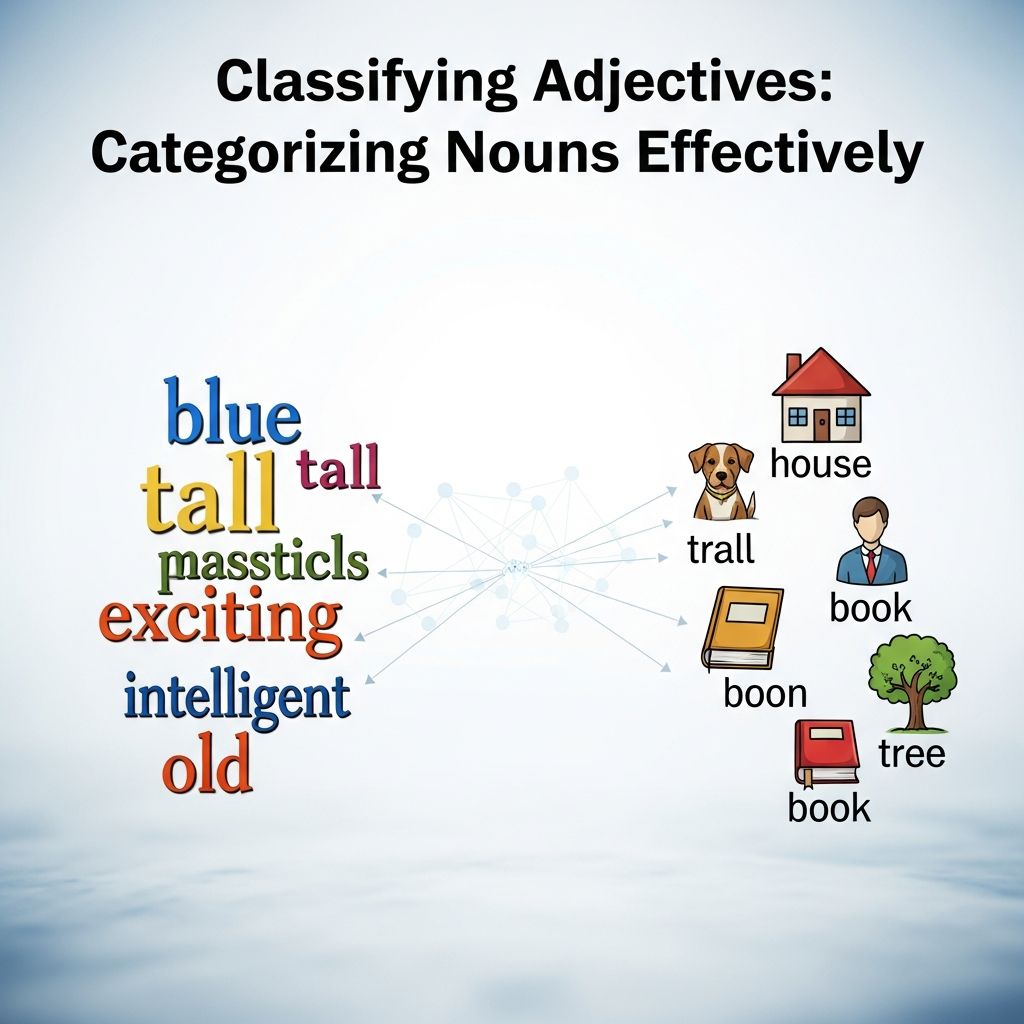
Classifying adjectives serve a crucial role in English by placing nouns into specific categories or groups, distinguishing them from descriptive adjectives that primarily convey qualities or attributes. Unlike descriptive terms like “beautiful” or “large,” classifying adjectives such as “digital” or “medical” narrow down the reference to a particular type, making communication more precise.
Understanding the Basics of Adjectives in English
Adjectives modify nouns or pronouns, adding essential information about their nature. Broadly, they fall into determining and descriptive categories, with descriptive ones further divided into qualifying (e.g., “happy,” “tall”) and classifying types. Classifying adjectives assign permanent or inherent group memberships, often non-gradable, meaning you cannot say “very atomic” or “more chemical” in standard usage.
This distinction matters because classifiers dominate academic and technical writing, where specificity trumps vivid description. For instance, in “hydraulic system,” “hydraulic” classifies the system’s type rather than evaluating it.
Key Differences: Classifying vs. Descriptive Adjectives
Descriptive adjectives paint pictures of qualities, often subjective and gradable (e.g., “very old,” “more beautiful”). Classifying adjectives, however, define categories objectively, resisting intensification.
| Feature | Classifying Adjective | Descriptive Adjective |
|---|---|---|
| Purpose | Categorizes or groups nouns | Describes qualities or states |
| Gradability | Usually non-gradable (e.g., married, dead) | Gradable (e.g., bigger, happier) |
| Examples | atomic bomb, chemical engineer | red car, tall building |
| Context | Academic, technical texts | Narrative, everyday speech |
This table highlights how classifiers restrict meaning to subtypes, while descriptors add layers of perception.
Types of Classifying Adjectives
Classifiers come in subtypes, each serving unique categorization needs.
- Relational Classifiers: Indicate relationships, like “maternal instinct” or “financial report.” They link nouns to origins or functions.
- Topical Classifiers: Denote subjects or fields, such as “economic policy” or “biological process.” Common in scholarly work.
- Absolute Classifiers: Express binary states, e.g., “digital format,” “married couple.” These are definitive and non-negotiable.
- Noun-Derived Classifiers: Nouns acting as modifiers, like “computer science” or “water cycle,” blurring lines with adjectives but functioning similarly.
Some words shift roles contextually: “old” can classify (“old regime”) or describe (“old man”).
Practical Examples Across Contexts
In literature: “Thrillers are my favorite genre” – “thrillers” classifies books by type.
In science: “Atomic bomb” specifies the bomb’s mechanism.
In professions: “Chemical engineer” identifies a specialization.
Everyday: “Spanish language” or “Olympic champion” pinpoint categories.
These examples show classifiers adding depth without exaggeration.
Role in Academic and Professional Writing
Classifiers are staples in informative texts, enabling precise references. In “political science,” “political” classifies the discipline, not describes it. Descriptive adjectives suit stories; classifiers fit reports and analyses. Their non-gradable nature ensures objectivity, vital for credibility.
Consider: “Molecular structure” cannot become “the structure is molecular” without altering sense. This rigidity underscores their classifying power.
Common Pitfalls and How to Avoid Them
Writers often misuse classifiers as descriptors, e.g., grading “unique” as “very unique” – incorrect, as uniqueness is absolute. Another error: confusing noun modifiers with adjectives, but both classify (e.g., “grammar textbook”).
- Tip 1: Ask, “Does this place the noun in a group?” If yes, it’s likely classifying.
- Tip 2: Avoid modifiers like “very” with classifiers.
- Tip 3: Use in pre-noun position for natural flow.
Exercises to Master Classifying Adjectives
Practice strengthens skills. Identify classifiers here:
- Grime music (Answer: grime – genre classifier)
- Olympic champion (Olympic – event classifier)
- Spanish language (Spanish – national classifier)
- Northwest flooding (northwest – regional classifier)
- Internal heating system (internal – type classifier)
Create sentences: Categorize your field, e.g., “neural network” for AI.
Advanced Applications and Nuances
In technical fields, classifiers like “nervous disease” or “musical instrument” specify subtypes precisely. They enhance SEO in content by targeting niches.
Contextual shifts: “Public opinion” classifies broadly; as descriptor, it might imply accessibility, though rare.
ESL learners benefit: Classifiers build vocabulary for categorization, aiding reading comprehension.
Frequently Asked Questions (FAQs)
What is a classifying adjective?
A classifying adjective assigns a noun to a specific category or group, such as “hydraulic” in “hydraulic pump,” differing from quality-focused descriptors.
How do classifying adjectives differ from descriptive ones?
Classifiers categorize without gradability (e.g., “dead language”), while descriptives qualify subjectively and allow degrees (e.g., “very difficult”).
Can adjectives be both classifying and descriptive?
Yes, depending on context; “old” classifies historical eras but describes age.
Why are classifying adjectives common in academic writing?
They provide precision and objectivity, essential for technical and scholarly discourse.
Are noun modifiers considered classifying adjectives?
They function similarly by classifying, e.g., “information technology,” though technically nouns.
Elevating Your Language Precision
Integrating classifying adjectives refines expression, from casual chats to formal papers. Experiment in writing: Replace vague terms with classifiers for clarity. Resources like grammar guides reinforce learning.
(Word count: 1678)
References
- Adjectives: Classifiers — Writing Support. Accessed 2026. https://www.writing.support/adjectives-classifiers.htm
- Adjectives in English – categories, forms and use — Linguapress. Accessed 2026. https://linguapress.com/grammar/adjectives
- Classifiers (Adjectives and Noun Modifiers) — University of Delaware Pressbooks (.edu). Accessed 2026. https://udel.pressbooks.pub/language/chapter/adjectives-and-classifiers/
- 4.6 What is a classifying adjective? — MissHannaLovesGrammar (YouTube educational video). Accessed 2026. https://www.youtube.com/watch?v=y3mlusvlB5I
- Classifying adjective definition — Linguix GrammarDesk. Accessed 2026. https://linguix.com/english/word/classifying%20adjective
- Classifying adjective – Definition, Meaning & Synonyms — Vocabulary.com. Accessed 2026. https://www.vocabulary.com/dictionary/classifying%20adjective

Medha Deb is an editor with a master's degree in Applied Linguistics from the University of Hyderabad. She believes that her qualification has helped her develop a deep understanding of language and its application in various contexts. Medha specializes in the areas of beauty, health, sports, and wellness and is committed to ensuring that the content on the website is…