
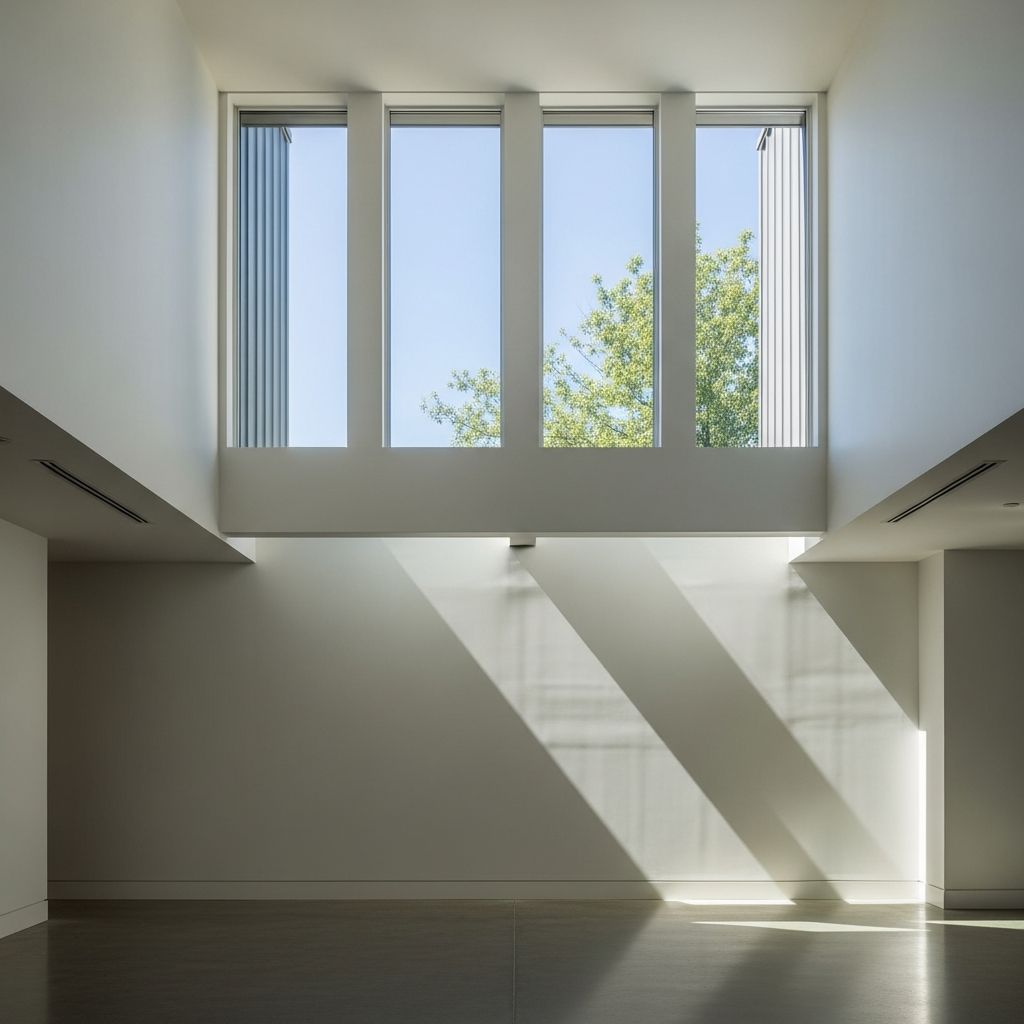
Clerestory windows represent a brilliant architectural solution for introducing natural light into expansive interiors while preserving privacy and structural integrity. Positioned high above eye level, these elevated openings have shaped building design for millennia, evolving from sacred temples to everyday residences.
Defining Clerestory Windows in Modern Terms
A clerestory window is essentially a high-placed opening in a wall, typically above the line of sight, designed primarily to flood interior spaces with daylight and ventilation. Unlike standard windows that span from floor to ceiling or sit at typical heights, clerestories are strategically located near the ceiling or in raised wall sections, often where the roof pitch elevates. This placement allows light to penetrate deeply into rooms without exposing occupants to external views, making them ideal for large halls, churches, and contemporary homes seeking brightness without vulnerability.
The term ‘clerestory’ derives from Old French ‘cler estor,’ meaning ‘clear storey,’ reflecting its role in creating a ‘clear’ or luminous upper level. Pronounced ‘kleer-story,’ it distinguishes itself from transom windows, which are smaller panes above doors or primary windows. In essence, clerestories transform dim enclosures into vibrant, airy environments.
Ancient Origins: From Egyptian Temples to Roman Innovations
The story of clerestory windows begins in ancient Egypt around 1500 BCE, where architects ingeniously lit vast temple interiors. The Great Hypostyle Hall at Karnak Temple Complex exemplifies this: towering columns supported a raised central roof section pierced by high openings. These slits allowed sunlight to cascade over the forest of pillars, illuminating sacred spaces without direct glare on altars below.
Egyptian builders used pierced stone slabs initially, evolving into more refined openings. This technique addressed the challenge of lighting column-filled halls where traditional windows would obstruct views or weaken structures. The innovation spread to Greek and Roman eras, appearing in public baths (thermae), palaces, and basilicas. Roman architects like those behind the Baths of Diocletian incorporated large semicircular clerestory openings in side walls, enhancing both light and airflow in massive complexes.
Medieval Mastery: Clerestories in Romanesque and Gothic Cathedrals
During the Romanesque period (10th-12th centuries), clerestory windows became staples in European churches. Small, arched openings high in nave walls admitted light into barrel-vaulted spaces, countering the dimness of thick stone walls. These were often paired or grouped for dramatic effect.
The Gothic era (12th-16th centuries) elevated clerestory design to artistic heights. Pointed arches, ribbed vaults, and flying buttresses enabled taller walls and larger windows. Iconic examples include Chartres Cathedral in France, where paired clerestory windows feature exquisite stained glass, filtering colorful light across the nave. In Gothic basilicas, clerestories formed a ‘story-sized’ row of glass, a technological leap made possible by advancements in glazing and buttressing. Smaller churches used trefoil or quatrefoil shapes, while Italian variants favored ocular rounds, blending utility with beauty.
Revival and Evolution: 19th to 20th Century Applications
Clerestories waned during the Renaissance but resurged in the 19th century with industrial advancements. Notably, they appeared in railway passenger cars from the 1860s to 1930s, providing light and ventilation in narrow, elongated spaces without compromising passenger privacy.
In the 20th century, Frank Lloyd Wright popularized clerestories in residential Prairie School architecture. His designs integrated horizontal lines with high ribbon windows, bringing daylight into low-slung homes while maintaining sightline seclusion. Mid-century modern homes further embraced them, echoing ancient roots in suburban settings.
Key Benefits of Integrating Clerestory Windows
Clerestory windows offer multifaceted advantages that continue to attract architects and homeowners:
- Superior Natural Lighting: High placement diffuses light evenly, reducing shadows and the need for artificial illumination during peak hours.
- Enhanced Privacy: Positioned above eye level, they prevent views into interiors from streets or neighboring properties.
- Improved Ventilation: Warm air rises to these heights, promoting passive cooling through cross-breezes.
- Energy Efficiency: By maximizing daylight, they lower electricity use for lighting; strategic glazing minimizes heat gain.
- Aesthetic Appeal: They add vertical drama, framing skies and creating dynamic light patterns.
These benefits make clerestories particularly valuable in urban environments where privacy is paramount.
Design Considerations for Clerestory Windows
Implementing clerestories requires thoughtful planning. Key factors include:
- Structural Support: Elevated walls demand robust framing, often with raised roof sections or trusses.
- Glazing Choices: Low-E glass for energy savings, tinted or frosted for privacy, or stained for artistry.
- Size and Proportion: Ribbon strips (continuous horizontals) suit modern aesthetics; grouped panels fit traditional styles.
- Orientation: South-facing for maximum light in northern hemispheres; operable sashes for ventilation.
- Integration with HVAC: High vents aid natural airflow, reducing reliance on mechanical systems.
| Design Type | Best For | Pros | Cons |
|---|---|---|---|
| Ribbon Clerestory | Modern Homes | Seamless horizon views, even light | Requires long wall spans |
| Arched Panels | Historic Revivals | Elegant, traditional charm | Complex fabrication |
| Ocular Rounds | Small Spaces | Compact, decorative | Limited light volume |
| Operable Vents | All Climates | Superior airflow | Maintenance needs |
Contemporary Uses Across Building Types
Today, clerestories thrive in diverse applications. In residential design, they illuminate open-plan kitchens, living rooms, and hallways, as seen in mid-century modern revivals. Commercial spaces like offices and gyms use them for wellness-focused daylighting. Educational and healthcare facilities benefit from their glare-free illumination, supporting circadian rhythms.
Renovations often retrofit clerestories into older structures via roof monitors or wall extensions. Sustainable architecture favors them for passive solar strategies, aligning with LEED certifications.
Comparing Clerestory to Similar Window Features
| Feature | Height | Primary Purpose | Privacy Level | Common Use |
|---|---|---|---|---|
| Clerestory | High (above 7ft) | Daylight/Ventilation | High | Large halls, homes |
| Transom | Above doors/windows | Light over obstructions | Medium | Entrances |
| Skylight | Ceiling-mounted | Overhead light | Variable | Atriums |
| Dormer | Roof projection | Space + light | Low | Attics |
Frequently Asked Questions (FAQs)
What is the main advantage of clerestory windows?
They provide abundant natural light and ventilation while ensuring high privacy levels, ideal for large or urban spaces.
Can clerestory windows be used in homes?
Yes, especially in modern and mid-century designs; Frank Lloyd Wright pioneered their residential use for bright, private interiors.
Are clerestory windows energy-efficient?
Absolutely, when paired with energy-efficient glazing, they reduce lighting needs and support passive cooling.
How do clerestories differ from skylights?
Clerestories are wall-based for horizontal light diffusion; skylights are roof-based for vertical illumination.
What maintenance do they require?
Regular cleaning of high-placed glass and checks on seals; operable ones need lubrication for smooth function.
Future Trends in Clerestory Design
Smart glass technologies, like electrochromic panels that tint on demand, promise to revolutionize clerestories, offering dynamic light control. Integration with building automation for automated venting enhances sustainability. As biophilic design gains traction, expect more clerestories mimicking natural canopies, fostering wellness in urban builds.
In conclusion, clerestory windows endure as a testament to architectural ingenuity, bridging ancient wisdom with modern needs for light-filled, efficient spaces.
References
- What Are Clerestory Windows? Definition, Benefits, and Design Uses — Magic Window. 2023-05-15. https://www.magicwindow.ca/blog/what-are-clerestory-windows-definition-benefits-and-design-uses
- Clerestory Windows | Definition, History & Architecture — Study.com. 2024-01-10. https://study.com/learn/lesson/clerestory-windows-in-architecture.html
- Clerestory — Wikipedia. 2025-03-20. https://en.wikipedia.org/wiki/Clerestory
- What Are Clerestory Windows and Their Spatial Advantages in 24 Projects — ArchDaily. 2023-11-08. https://www.archdaily.com/1005402/what-are-clerestory-windows-and-their-spatial-advantages-in-24-projects
- Why Clerestory Windows Pack A Punch — Atomic Ranch. 2022-07-12. https://www.atomic-ranch.com/architecture-design/clerestory-windows/
- Clerestory Windows: All About These Church-Inspired Windows — Midsouth Exteriors. 2023-09-05. https://www.midsouthexteriors.com/blog/clerestory-windows-all-about-these-church-inspired-windows
- Clerestory — Buffalo Architecture and History. 2021-04-22. https://buffaloah.com/a/DCTNRY/c/clere.html

Medha Deb is an editor with a master's degree in Applied Linguistics from the University of Hyderabad. She believes that her qualification has helped her develop a deep understanding of language and its application in various contexts. Medha specializes in the areas of beauty, health, sports, and wellness and is committed to ensuring that the content on the website is…