
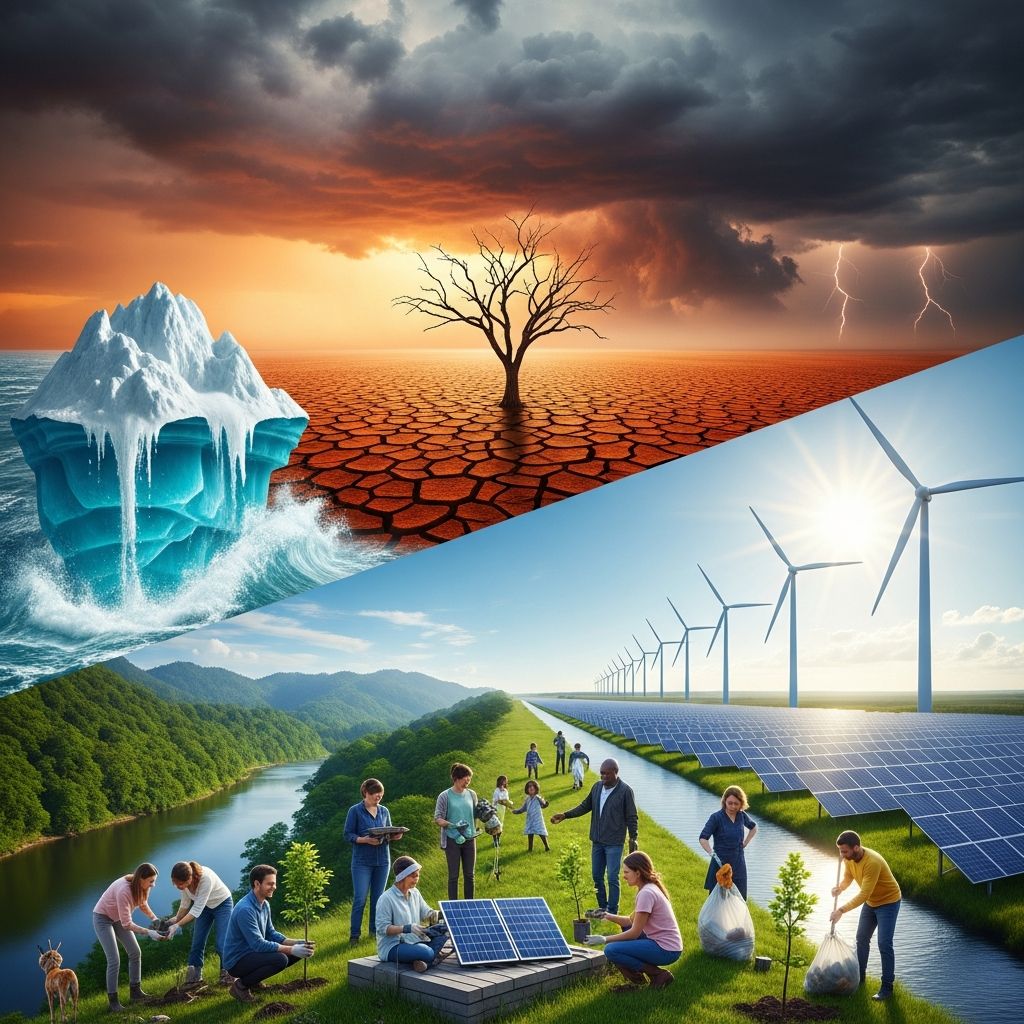
Climate change is one of the defining challenges of this century. It threatens ecosystems, economies, and human wellbeing, and it will shape the lives of future generations. At the same time, there is still meaningful scope to limit the damage and to influence which climate futures become reality.
1. What We Mean by Climate Change
In this article, climate change refers mainly to long-term warming of the planet driven by human emissions of greenhouse gases, especially carbon dioxide (CO2), methane (CH4), and nitrous oxide (N2O). These gases trap heat in the atmosphere and raise global average temperatures over decades and centuries.
Since the late 19th century, Earth’s surface temperature has risen by around 1 °C to 1.2 °C above pre-industrial levels, with the rate of warming accelerating in recent decades. This change may sound small, but it has already shifted the frequency and intensity of heatwaves, droughts, floods, and storms in ways that affect billions of people.
Key physical changes already underway
- Rising temperatures: Global surface temperature has increased by about 0.06 °C per decade since 1850 on average, with faster warming since the 1970s.
- More extreme heat: Recent years rank among the hottest on record, contributing to record-breaking heatwaves on multiple continents.
- Melting ice and rising seas: Ice loss from Greenland and Antarctica has accelerated sharply since the 1990s, committing the planet to long-term sea-level rise.
- Changing ecosystems: Thousands of animal species are already threatened by climate-related habitat shifts, heat stress, and altered food webs.
2. How Serious Is the Problem?
Climate change is serious not only because of how much warming has already occurred, but because current emissions are pushing us toward far more disruptive levels of warming later this century.
2.1 Temperature pathways and overshoot risks
International agreements aim to keep warming well below 2 °C, while pursuing efforts to limit it to 1.5 °C. However, current policies and investment patterns remain far from what is needed to hit those targets.
| Scenario | Approximate Warming by 2100 | Key Features |
|---|---|---|
| Paris-aligned (1.5 °C) | Stabilizes around 1.5 °C with minimal overshoot | Rapid emissions cuts, large-scale clean energy, expanded carbon sinks, limited long-term damage |
| Moderate action (2–3 °C) | Warming exceeds 2 °C, possibly higher | More intense extremes, major ecosystem loss, greater sea-level rise and human displacement |
| High emissions (>3 °C) | Substantially above 3 °C by 2100 | Severe global disruption, higher risk of tipping points and compounding crises |
Recent analyses suggest that, at current emission rates, the remaining carbon budget compatible with a likely chance of staying at 1.5 °C will be exhausted before 2030. Some research indicates that overshooting 1.5 °C is now extremely likely, but the scale and duration of that overshoot are still under human control.
2.2 Near-term impacts
Even in the next few decades, climate change will shape everyday life through:
- Health stress: Heat-related mortality among older people has already risen substantially in recent decades, and further warming is expected to increase heat stress, dehydration, and cardiovascular strain.
- Food and water pressures: Shifts in rainfall patterns and extreme heat affect crop yields and water availability, increasing food insecurity and price volatility in many regions.
- Economic losses: On current trajectories, some estimates suggest climate change could cut global GDP by more than 10% by mid-century, with higher losses in vulnerable countries.
- Displacement: Climate-related droughts, floods, and sea-level rise are projected to drive tens to hundreds of millions of internal climate migrants by 2050.
2.3 Long-term and irreversible changes
Some aspects of climate change unfold over centuries, even if emissions fall:
- Ice sheets and sea level: Ice loss from Greenland and West Antarctica has grown roughly fourfold since the 1990s, and current warming likely commits the planet to several meters of eventual sea-level rise, albeit over long timescales.
- Ecosystem transformation: Many forests, coral reefs, and polar ecosystems face thresholds beyond which returning to previous states becomes impossible. Primary tropical forest loss in 2024 alone emitted billions of tonnes of CO2 and degraded critical biodiversity.
- Persistent temperature change: CO2 persists in the atmosphere for centuries, meaning that much of the warming we lock in will shape conditions for many generations.
3. Why Climate Change Matters for the Long-Term Future
Climate change is not only about weather, crops, or sea level; it also affects the long-term trajectory of human civilization. The scale of the risk includes:
- Global security and stability: Widespread crop failures, water shortages, and extreme weather can fuel conflict, destabilize governments, and increase the likelihood of humanitarian crises.
- Development setbacks: The poorest populations, who have contributed least to emissions, are often the most exposed and least able to adapt, which can lock in inequality for generations.
- Interaction with other global risks: Climate change can act as a threat multiplier—exacerbating pandemics, financial instability, or geopolitical tensions.
Many analysts therefore treat climate change as a systemic risk: it does not necessarily end civilization by itself, but it raises the odds of cascading failures that harm billions of people and constrain the choices available to future generations.
4. Where Emissions Come From
To understand how to act effectively, it helps to see where greenhouse gas emissions originate. Globally, emissions primarily arise from:
- Energy and electricity: Burning coal, oil, and gas for power and heat is the largest single contributor. Despite growth in renewables, fossil CO2 emissions from energy reached record highs in 2025.
- Industry: Production of steel, cement, chemicals, and other materials involves both energy use and direct process emissions, especially from limestone and industrial gases.
- Transport: Cars, trucks, ships, and planes mostly run on petroleum fuels, driving large CO2 emissions and local air pollution.
- Agriculture and land use: Livestock, rice cultivation, fertilizers, deforestation, and peatland degradation emit methane and nitrous oxide, and reduce natural carbon sinks.
- Buildings: Heating, cooling, and cooking rely on electricity and fossil fuels, particularly in colder climates and fast-growing cities.
5. The Gap Between Current Action and What Is Needed
Scientific assessments comparing current policies with pathways consistent with the 1.5 °C goal show a large gap in almost every major sector.
5.1 Slow decline of fossil fuels
Research from the Global Carbon Project indicates that fossil fuel CO2 emissions were projected to rise by about 1.1% in 2025, reaching roughly 38 billion tonnes of CO2 from fossil sources alone. Instead of declining rapidly, emissions remain at record highs.
At the same time, some analyses find that countries plan to expand fossil fuel production through 2030, even though meeting the 1.5 °C limit would require sustained reductions in production and use.
5.2 Limited progress on key indicators
Independent trackers assessing dozens of indicators—such as coal use in power, deforestation, electric vehicle adoption, and energy efficiency—conclude that progress is far too slow to align with 1.5 °C pathways by 2030.
- Coal’s share in power generation needs to fall rapidly, but it remains a major source of electricity in many countries.
- To protect climate and biodiversity, deforestation must decline sharply, yet primary forest loss remains high, especially in the tropics.
- While clean technologies like solar, wind, and electric vehicles are growing quickly, they are not yet displacing fossil fuels at the necessary speed.
6. High-Impact Ways Individuals Can Contribute
Individual choices like diet, travel, or home energy use matter, but the largest opportunities often lie in influencing systems: technologies, policies, and institutions that shape emissions at scale. Depending on your skills and resources, several strategies can have outsized impact.
6.1 Careers focused on climate solutions
Your career is one of the most powerful levers you control. Over decades, your work can help accelerate technologies, shape laws, or mobilize resources.
- Clean energy and storage: Engineering, research, and deployment of renewables, batteries, and grid technologies that replace fossil fuels.
- Public policy and governance: Roles in government, international organizations, or advocacy groups that design and implement ambitious climate policies, such as carbon pricing, clean energy standards, or building codes.
- Industrial decarbonization: Work on low-carbon steel, cement, hydrogen, and other hard-to-abate sectors.
- Climate finance: Directing capital toward low-carbon projects, adaptation infrastructure, and innovative mitigation technologies.
- Research and risk analysis: Studying extreme scenarios, tipping points, and policy design to ensure that climate planning reflects the full range of potential futures.
6.2 Philanthropy and targeted donations
If you have financial resources, supporting effective climate organizations can multiply your personal impact. Potential focus areas include:
- Policy advocacy: Groups that push for strong national and international climate laws, improved regulations, and enforcement.
- Technology innovation: Nonprofits and research centers working on long-duration storage, advanced nuclear, geothermal, carbon removal, or low-cost green hydrogen.
- Preserving carbon sinks: Efforts to prevent deforestation, protect peatlands, and restore degraded ecosystems, which deliver both mitigation and biodiversity benefits.
- Adaptation for vulnerable communities: Organizations helping at-risk populations prepare for heatwaves, floods, and other climate-related hazards.
6.3 Advocacy, voting, and community action
Collective political choices determine the speed and scale of climate action:
- Supporting evidence-based policy: Voting for candidates and policies that prioritize emissions reduction and climate resilience.
- Engaging locally: Pushing for clean public transport, green building standards, and resilient infrastructure in your city or region.
- Shaping norms: Talking about climate change in informed, practical ways can make it easier for institutions—schools, companies, governments—to move faster.
6.4 Personal footprint choices
While system-level change is crucial, reducing your own emissions can still help by:
- Lowering direct environmental impact.
- Increasing credibility when advocating for broader changes.
- Creating visible demand for low-carbon products and services.
High-leverage personal actions often include flying less, driving less or switching to electric vehicles in regions with cleaner grids, improving home insulation, choosing renewable electricity where available, and adopting more plant-rich diets.
7. How Climate Change Compares to Other Global Priorities
Climate change is extraordinarily important, but decision-makers and philanthropists must also weigh it alongside other global problems, such as pandemic preparedness, nuclear risk, and extreme poverty. Some frameworks evaluate problems using criteria like:
- Scale: How many people are affected, and how severely?
- Neglectedness: How many resources are already devoted to the problem relative to its importance?
- Tractability: How much progress can additional effort realistically achieve?
Climate change scores extremely high on scale, but in high-income countries it already receives substantial public attention and investment. That suggests that the most impactful niches may be those that are still underexplored, such as overlooked technologies, high-quality research on extreme risks, or policy work in regions and sectors where momentum remains weak.
8. Open Questions and Areas for Further Work
Despite decades of research, there are still crucial questions where additional analytical and scientific work could make a large difference:
- Worst-case scenarios: How likely are high-end warming outcomes above 4 °C, and what would their social, economic, and geopolitical consequences be?
- Tipping points and cascades: How do potential tipping elements—like ice sheet collapse or Amazon forest dieback—interact, and how does that shape risk?
- Carbon removal and negative emissions: What mix of natural and technological approaches can be scaled responsibly, and how should they be governed?
- Fairness and burden-sharing: How can climate policy better address equity between countries that have very different historical emissions and income levels?
- Resilience under deep uncertainty: How can infrastructure, supply chains, and institutions be made robust to a wide range of climate futures?
Frequently Asked Questions (FAQs)
Q1: Has the world already failed to meet the 1.5 °C target?
Recent years have recorded average temperatures more than 1.5 °C above pre-industrial levels for sustained periods, but temporary overshoots do not necessarily mean the long-term target is unreachable. The Paris Agreement focuses on stabilizing temperatures around 1.5 °C by 2100, which may still be possible if emissions fall rapidly and carbon removal scales up. However, overshooting 1.5 °C, even temporarily, increases risks and irreversible impacts.
Q2: Is climate change mainly a problem for future generations?
No. Climate change is already altering weather patterns, damaging ecosystems, and affecting health, infrastructure, and livelihoods today. However, future generations will likely experience larger cumulative impacts, especially if emissions remain high. Our decisions now strongly influence the severity of those future risks.
Q3: Do individual lifestyle changes really matter?
Individual lifestyle choices make a modest difference on their own, but they can become powerful when combined with systemic action. Personal changes help create demand for low-carbon products, set social norms, and lend credibility to calls for ambitious policy. The highest-leverage actions usually involve careers, voting, and advocacy that shift whole sectors, in addition to personal footprint reductions.
Q4: Is economic growth compatible with cutting emissions?
Many countries have shown that it is possible to grow their economies while reducing CO2 emissions from energy, largely through efficiency improvements and clean energy deployment. The challenge is scaling this decoupling globally and rapidly enough to meet climate goals. Evidence from clean technology costs suggests that well-designed climate policies can support innovation and economic opportunity while cutting emissions.
Q5: What is the single most impactful thing I can do?
There is no universal answer, but for many people the most impactful step is to align their career or major time commitments with high-leverage climate work, such as clean technology, policy, or research. For others, especially those with significant financial resources, strategic philanthropy or investment can be similarly powerful. Combining these with informed civic engagement and thoughtful personal choices can significantly increase your overall contribution.
References
- Climate change facts you need to know in 2025 — Charity Digital summarizing multiple scientific and policy sources. 2025-01-22. https://charitydigital.org.uk/topics/climate-change-facts-you-need-to-know-in-2025-10655
- The State of Climate Action in 2025: 10 Key Findings — World Resources Institute. 2025-11-20. https://www.wri.org/insights/climate-action-progress-1-5-degrees-c-2025
- Fossil fuel CO2 emissions hit record high in 2025 — Global Carbon Project. 2025-11-13. https://globalcarbonbudget.org/fossil-fuel-co2-emissions-hit-record-high-in-2025/
- 2025 state of the climate report: a planet on the brink — Ripple et al., BioScience (Oxford Academic). 2025-10-09. https://academic.oup.com/bioscience/advance-article/doi/10.1093/biosci/biaf149/8303627
- Climate Reports — United Nations / World Meteorological Organization. 2025. https://www.un.org/en/climatechange/reports
- Global Climate Report – May 2025 — NOAA National Centers for Environmental Information. 2025-06. https://www.ncei.noaa.gov/access/monitoring/monthly-report/global/202505
- Climate change: global temperature — NOAA Climate.gov. Updated 2024-05. https://www.climate.gov/news-features/understanding-climate/climate-change-global-temperature

- Integrated M.A. in Applied Linguistics, University of Hyderabad
- 5+ years in editorial, instructional, SEO, and research-based writing
Sneha is a relationships and lifestyle writer with a strong foundation in applied linguistics and certified training in relationship coaching. She brings over five years of writing experience to theskillvault, crafting thoughtful, research-driven content that empowers readers to build healthier relationships, boost emotional well-being, and embrace holistic living. Her writing and insights reflect the belief that beauty, happiness, and wellness…