
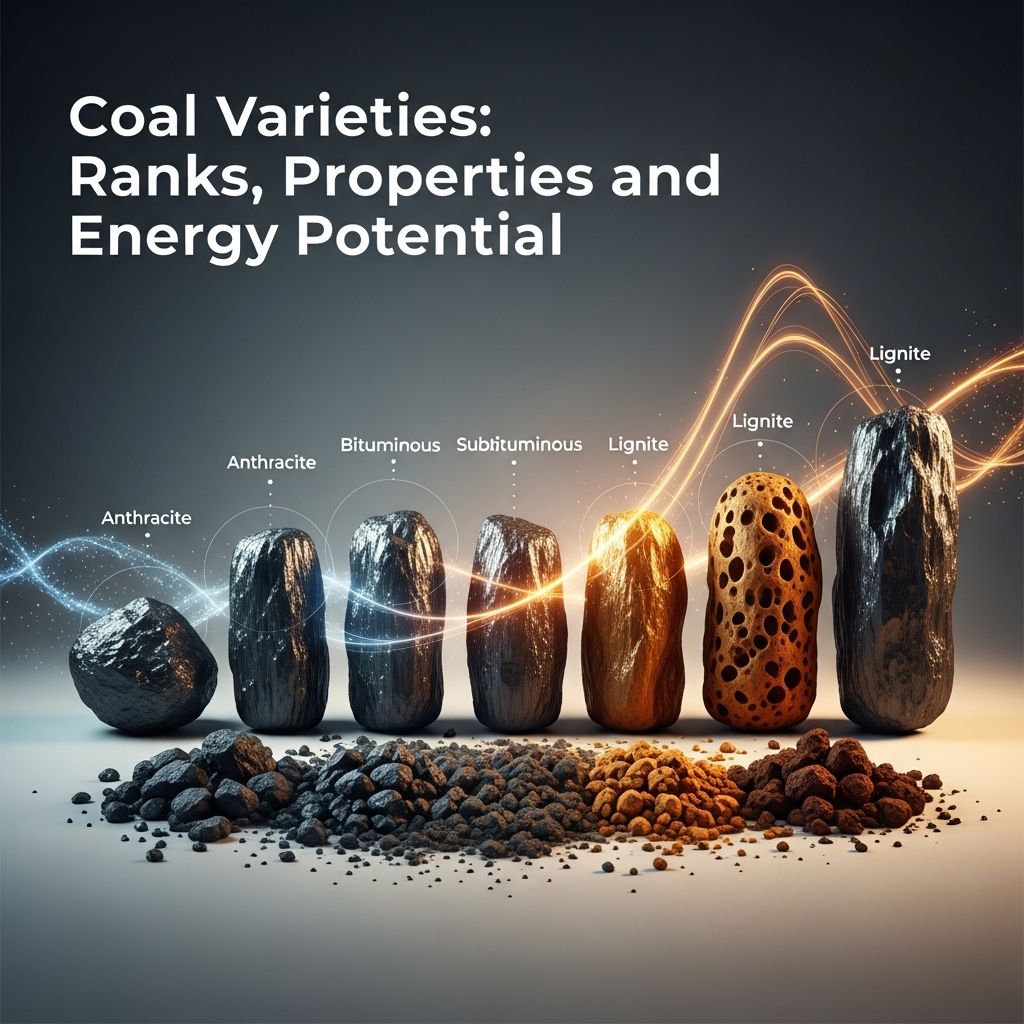
Coal, a vital fossil fuel derived from ancient plant matter, varies significantly in quality and utility based on its geological maturation. These differences, known as ranks, determine everything from energy yield to environmental impact during combustion. Understanding these distinctions is essential for energy professionals, policymakers, and industries relying on coal for power and manufacturing.
Understanding Coal Formation and Ranking System
Coal originates from peat, which accumulates in swampy environments where dead vegetation decomposes under anaerobic conditions. Over millions of years, burial under sediment subjects this material to escalating heat and pressure, driving off moisture and volatiles while concentrating carbon. This metamorphic process defines coal’s rank, from lowest (lignite) to highest (anthracite).
The ranking hinges on carbon percentage, calorific value (heat released per unit mass), and physical traits like hardness and luster. Higher ranks boast greater carbon content—up to 97% in anthracite—yielding more energy and burning cleaner with reduced smoke and emissions.
- Key Formation Factors: Depth of burial, temperature, pressure duration, and original plant type influence final rank.
- Age Indicator: Younger coals like lignite formed recently (geologically), while anthracite dates back 300+ million years.
- Global Reserves: Bituminous and subbituminous dominate worldwide, comprising over half of reserves due to favorable formation conditions.
Lignite: The Entry-Level Coal
Lignite, dubbed brown coal, represents the least evolved rank, retaining high moisture (up to 45%) and low carbon (25-35%). Its crumbly texture and earthy brown hue stem from minimal compression of peat. With a heat value of 4,000-8,300 BTU/lb, it underperforms other coals, necessitating large volumes for energy production.
Primarily mined in shallow, open-pit operations, lignite suits electricity generation near deposits to minimize transport costs. In 2022, U.S. lignite output was 8% of total coal, led by Texas (over 40%) and North Dakota (nearly 40%). Its high moisture leads to lower efficiency and higher CO2 emissions per energy unit, prompting scrutiny in emission regulations.
| Property | Lignite Value |
|---|---|
| Carbon Content | 25-35% |
| Moisture | 25-45% |
| Heat Value (BTU/lb) | 4,000-8,300 |
| Primary Use | Power plants |
Subbituminous Coal: A Step Up in Efficiency
Subbituminous coal bridges lignite and bituminous, featuring 35-45% carbon and reduced moisture (15-30%). Blacker and drier than lignite, it delivers 8,300-13,000 BTU/lb, enabling cleaner burns with lower sulfur. Formed under moderate heat and pressure over 100 million years, it’s abundant in Wyoming’s Powder River Basin, source of 46% of U.S. subbituminous in 2022.
This rank powers many U.S. plants due to cost-effectiveness and moderate emissions. Its duller luster distinguishes it from shinier bituminous varieties. Environmental advantages include less ash and sulfur dioxide, aligning with cleaner coal technologies.
- Top Producers (2022): Wyoming (88%), others minor.
- Applications: Electricity (primary), some industrial heating.
Bituminous Coal: The Workhorse of Industry
Bituminous, or ‘soft’ coal, spans 45-86% carbon, offering 10,500-15,000 BTU/lb and versatile properties. Aged 100-300 million years, it’s dense, black, and often banded, formed via intense compression. In 2022, it constituted 46% of U.S. production, with West Virginia leading at 31%.
Subtypes include thermal coal for power (high volatiles for easy ignition) and metallurgical (coking) coal for steelmaking, which carbonizes into coke when heated sans oxygen. Bituminous fuels cement kilns and generates steam historically, though rail use has declined.
| Bituminous Subtype | Carbon Range | Main Use |
|---|---|---|
| Thermal | 45-60% | Electricity generation |
| Metallurgical | 80-90% | Steel production (coke) |
Anthracite: Premium Hard Coal
Anthracite, the pinnacle rank, contains 86-97% carbon, nearly 15,000 BTU/lb, and minimal volatiles (<10%). Hard, brittle, and glossy, it forms in tectonically active zones like Pennsylvania’s Appalachians via extreme pressure on bituminous. Rare at 0.2% of U.S. output, Pennsylvania monopolizes production.
Its smokeless, hot burn suits home heating, forges, and metallurgy. Long burn times and high heat make it ideal for stoves and industrial processes. Historically powering steel foundries, it remains prized for efficiency despite scarcity.
Comparative Analysis of Coal Ranks
Ranking escalates energy density: lignite lags far behind anthracite in efficiency. Carbon concentration inversely correlates with moisture and volatiles, impacting handling, storage, and pollution.
| Rank | Carbon (%) | Heat Value (BTU/lb) | Moisture (%) | U.S. Production Share (2022) |
|---|---|---|---|---|
| Anthracite | 86-97 | ~15,000 | <15 | <1% |
| Bituminous | 45-86 | 10,500-15,000 | 2-15 | 46% |
| Subbituminous | 35-45 | 8,300-13,000 | 15-30 | 46% |
| Lignite | 25-35 | 4,000-8,300 | 25-45 | 8% |
This table, derived from U.S. Energy Information Administration data, underscores bituminous and subbituminous dominance in volume, balanced by anthracite’s superior quality.
Modern Applications and Industry Roles
Electricity generation consumes most coal: subbituminous and bituminous power U.S. plants, lignite locally. Metallurgical bituminous underpins steel (world’s largest coal use outside power). Anthracite heats spaces and processes metals.
Declining steam coal use reflects rail electrification, but coke demand persists. Innovations like gasification enhance lower ranks’ viability.
Environmental and Economic Considerations
Higher ranks emit less CO2 per energy unit due to efficiency; anthracite minimizes particulates. Yet, all coals contribute to climate change, spurring transitions to renewables. Economically, Powder River Basin subbituminous offers low-cost power, while anthracite commands premiums.
Regulations favor low-sulfur varieties like subbituminous, reducing scrubber needs.
Frequently Asked Questions
What determines a coal’s rank?
Rank depends on carbon content, shaped by heat, pressure, and time applied to peat. Higher ranks have more carbon and energy.
Which coal is best for home heating?
Anthracite excels for its clean, hot, long-lasting burn with minimal smoke.
Is lignite viable for electricity?
Yes, near mines, despite low energy and high moisture; it’s economical for local plants.
How does bituminous coal support steelmaking?
Metallurgical bituminous cokes into porous carbon for blast furnaces, binding iron ore.
Are there U.S. states without coal production?
Many, but key producers include Wyoming, West Virginia, Pennsylvania for all ranks.
References
- Coal Explained — U.S. Energy Information Administration. 2023-10-25. https://www.eia.gov/energyexplained/coal/
- Characteristics & Types of Coal — Fossil Consulting Services. 2023. https://www.fossilconsulting.com/blog/power-plant-fundamentals/characteristics-of-coal/
- The Different Types of Coal — Homefire. 2023. https://www.homefire.co.uk/blogs/blog/the-different-types-of-coal
- What are the different types of coal? — American Geosciences Institute. 2023. https://profession.americangeosciences.org/society/intersections/faq/what-are-the-different-types-of-coal/
- Coal 101: The 4 Coal Types and Their Uses — Investing News Network. 2023-05-15. https://investingnews.com/daily/resource-investing/industrial-metals-investing/coal-investing/types-of-coal/
- What Coal Is — ND Studies. 2023. https://www.ndstudies.gov/energy/level2/module-3-coal/what-coal

- Integrated M.A. in Applied Linguistics, University of Hyderabad
- 5+ years in editorial, instructional, SEO, and research-based writing
Sneha is a relationships and lifestyle writer with a strong foundation in applied linguistics and certified training in relationship coaching. She brings over five years of writing experience to theskillvault, crafting thoughtful, research-driven content that empowers readers to build healthier relationships, boost emotional well-being, and embrace holistic living. Her writing and insights reflect the belief that beauty, happiness, and wellness…