
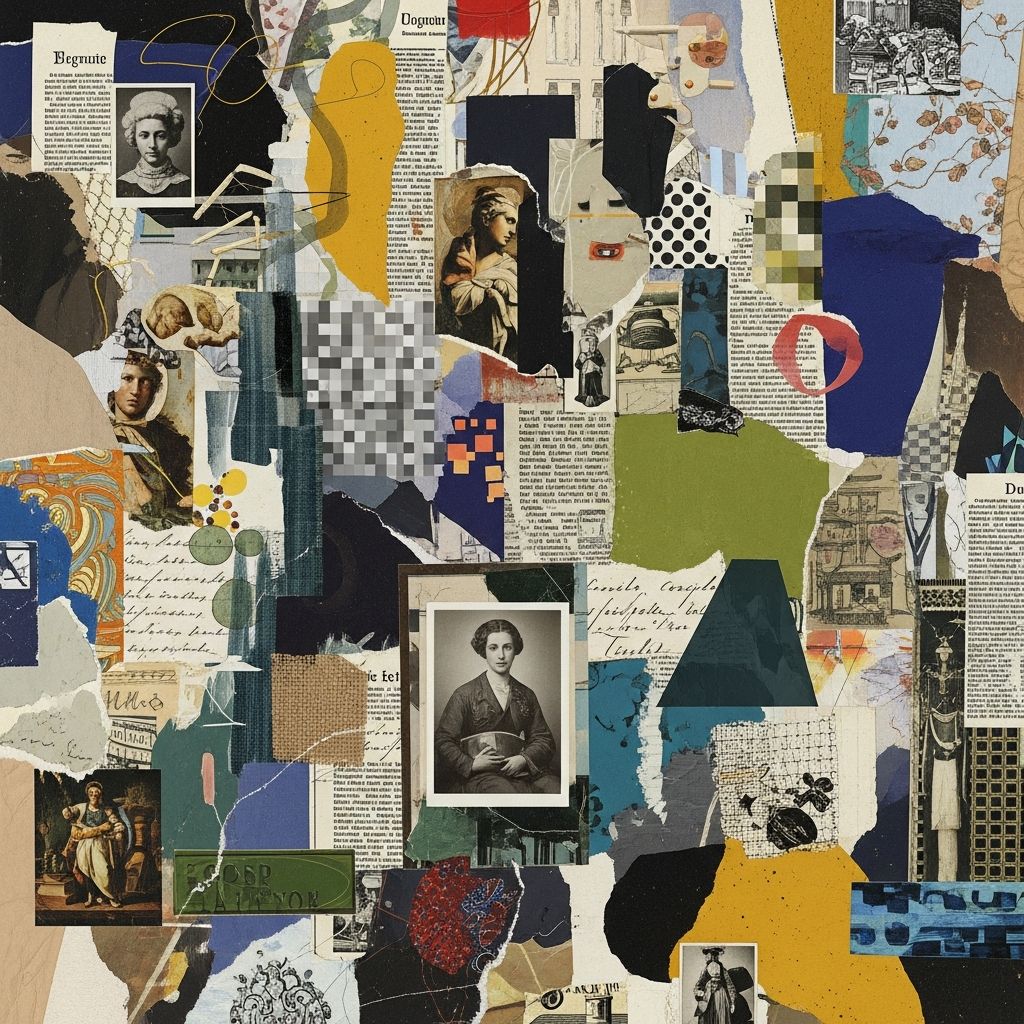
Collage art represents a groundbreaking approach in visual expression, where diverse materials are assembled to form cohesive, meaningful compositions. Derived from the French word coller, meaning ‘to glue,’ this technique involves adhering fragments like paper, photographs, fabrics, and found objects onto a substrate to create innovative imagery.
The Fundamental Principles of Collage Creation
At its core, collage thrives on the juxtaposition of disparate elements, transforming ordinary items into extraordinary art. Artists select, cut, arrange, and affix materials, emphasizing curation over traditional rendering skills. This democratic method lowers barriers to entry, allowing anyone to produce compelling works without advanced drawing proficiency.
The process begins with gathering materials: magazines for clippings, textured papers, ribbons, or ephemera like tickets and newspapers. These are meticulously cut into shapes and layered onto canvas, wood, or paper. Adhesives such as glue sticks, mod podge, or archival sprays ensure durability. The magic lies in composition—balancing chaos and harmony to evoke emotion or narrative.
- Selection: Choose items that resonate thematically, like urban debris for social commentary.
- Cutting and Shaping: Use scissors, craft knives, or撕裂 for organic edges.
- Arrangement: Experiment with overlaps, transparencies, and negative space before final adhesion.
- Finishing: Seal with varnish to protect layers and enhance vibrancy.
Historical Roots and Pioneering Moments
While rudimentary forms trace to ancient China around 200 B.C. with paper invention, modern collage emerged in early 20th-century Europe amid avant-garde fervor. Cubism’s Georges Braque and Pablo Picasso shattered conventions by incorporating real-world fragments into paintings, challenging the purity of fine art.
Picasso’s Still Life with Chair Caning (1912) marks a seminal moment, featuring an oilcloth mimicking chair caning glued to canvas—the first true papiers collés. This innovation defied bourgeois aesthetics, elevating ephemera to high art and influencing Dada, Surrealism, and beyond.
Dadaists like Hannah Höch and Kurt Schwitters weaponized collage for political satire, shredding magazines to critique war and consumerism. Surrealists, inspired by Freud, crafted dreamlike assemblages blending the unconscious with reality. Post-WWII, artists like Robert Rauschenberg blurred lines between collage and sculpture via combines—hybrid paintings with everyday objects.
Diverse Techniques in Contemporary Collage
Today’s collage spans 2D and 3D realms, evolving with digital tools while honoring analog roots. Key variants include:
| Technique | Description | Key Artists | Materials |
|---|---|---|---|
| Papiers Collés | Paper cutouts glued to canvas, foundational Cubist method. | Braque, Picasso | Newspapers, wallpaper |
| Photomontage | Photographic images layered for surreal or political effect. | Hannah Höch, John Heartfield | Magazine photos, prints |
| Assemblage | 3D extension using found objects in sculptural compositions. | Marcel Duchamp, Louise Nevelson | Wood, metal, fabrics |
| Digital Collage | Software-based layering of scanned or digital elements. | Contemporary digital artists | Photoshop, Procreate |
Assemblage extends collage into dimensionality, pioneered by Surrealists creating absurd objects from Freudian dream logic. Photomontage, a Dada staple, manipulates images for propaganda-like impact, as seen in Höch’s gender critiques. Digital variants democratize access, enabling global sharing via platforms like Instagram.
Iconic Artists and Their Lasting Impact
Pablo Picasso and Georges Braque’s Cubist experiments legitimized collage in fine art, integrating ‘low’ materials to fragment perspective. Dada’s Hannah Höch pioneered feminist photomontage, dissecting Weimar-era media to expose societal hypocrisies.
Kurt Schwitters’ Merz works transformed urban refuse into poetic environments, embodying anti-art ethos. Romare Bearden’s mid-century collages celebrated Black life, layering photos and paint to narrate Harlem experiences—a multiplicity drawing from jazz rhythms. Contemporary figures like Wangechi Mutu fuse collage with painting, addressing postcolonial themes through hybrid figures.
These innovators elevated collage’s anti-aesthetic rebellion, proving art’s power in recombination over creation from scratch.
Practical Guide: Crafting Your First Collage
Embarking on collage requires minimal investment. Start with a sturdy base like matboard or illustration board. Collect ‘junk’—old magazines, sheet music, fabric scraps. Theme your piece: nature’s chaos, urban melancholy, or abstract emotion.
- Prepare Workspace: Cover surfaces; gather tools (scissors, glue, brushes).
- Sort Materials: Categorize by color, texture, symbolism.
- Sketch Layout: Lightly pencil composition guidelines.
- Layer Dynamically: Build from background to foreground, photographing iterations.
- Refine and Seal: Trim excesses; apply fixative for longevity.
Beginners should experiment freely—perfectionism stifles discovery. Scale up to assemblages by adding 3D elements like buttons or wires.
Collage in Broader Cultural Contexts
Beyond galleries, collage permeates fashion ( patchwork designs), advertising (mashups), and music (sampling). It mirrors postmodernism’s embrace of appropriation, questioning originality. In education, choice-based art programs use collage to foster creativity sans technical hurdles.
Socially, it empowers marginalized voices: street artists paste posters for activism; scrapbookers preserve personal histories. Environmentally conscious creators repurpose waste, aligning with sustainability.
Challenges and Innovations Ahead
Preservation poses issues—adhesives yellow, papers acidify. Archival glues and acid-free papers mitigate this. Digitally, AI tools generate collages, sparking debates on authorship. Yet, analog tactility endures, offering therapeutic escape in a virtual age.
Hybrid forms emerge: augmented reality overlays on physical collages. Global exchanges via online communities accelerate evolution.
Frequently Asked Questions (FAQs)
What materials are best for beginners in collage art?
Start with magazines, colored paper, glue sticks, and canvas. These are affordable and versatile for experimenting with layers and textures.
Is collage considered fine art?
Yes, since Picasso and Braque’s innovations; major museums like MoMA showcase collages as pivotal modern works.
How does assemblage differ from traditional collage?
Assemblage is three-dimensional, incorporating objects like wood or metal, while collage is typically flat.
Can digital tools replace physical collage?
They complement it; software excels in precision, but physical collage offers tactile joy and serendipity.
What’s the historical origin of collage?
Modern collage began in 1912 with Cubists, though paper-based forms date to ancient China.
References
- A Guide to Collage — Rise Art. 2023. https://www.riseart.com/guide/2371/a-guide-to-collage
- Collage — Wikipedia. 2026-04-01. https://en.wikipedia.org/wiki/Collage
- A Brief History of Collage — Maureen Maki. 2022. https://www.maureenmaki.com/blog/a-brief-history-of-collage
- Collage — Tate. 2024. https://www.tate.org.uk/art/art-terms/c/collage
- What Is a Collage? 4 Types of Collages in Art — MasterClass. 2026. https://www.masterclass.com/articles/what-is-a-collage
- 5 Minute Demo: Intro to Collage — YouTube (Choice-Based Art Education). 2023. https://www.youtube.com/watch?v=UpgEu6PV7XQ
- Collage — MoMA. 2022-11-01. https://www.moma.org/collection/terms/collage

- Integrated M.A. in Applied Linguistics, University of Hyderabad
- 5+ years in editorial, instructional, SEO, and research-based writing
Sneha is a relationships and lifestyle writer with a strong foundation in applied linguistics and certified training in relationship coaching. She brings over five years of writing experience to theskillvault, crafting thoughtful, research-driven content that empowers readers to build healthier relationships, boost emotional well-being, and embrace holistic living. Her writing and insights reflect the belief that beauty, happiness, and wellness…