
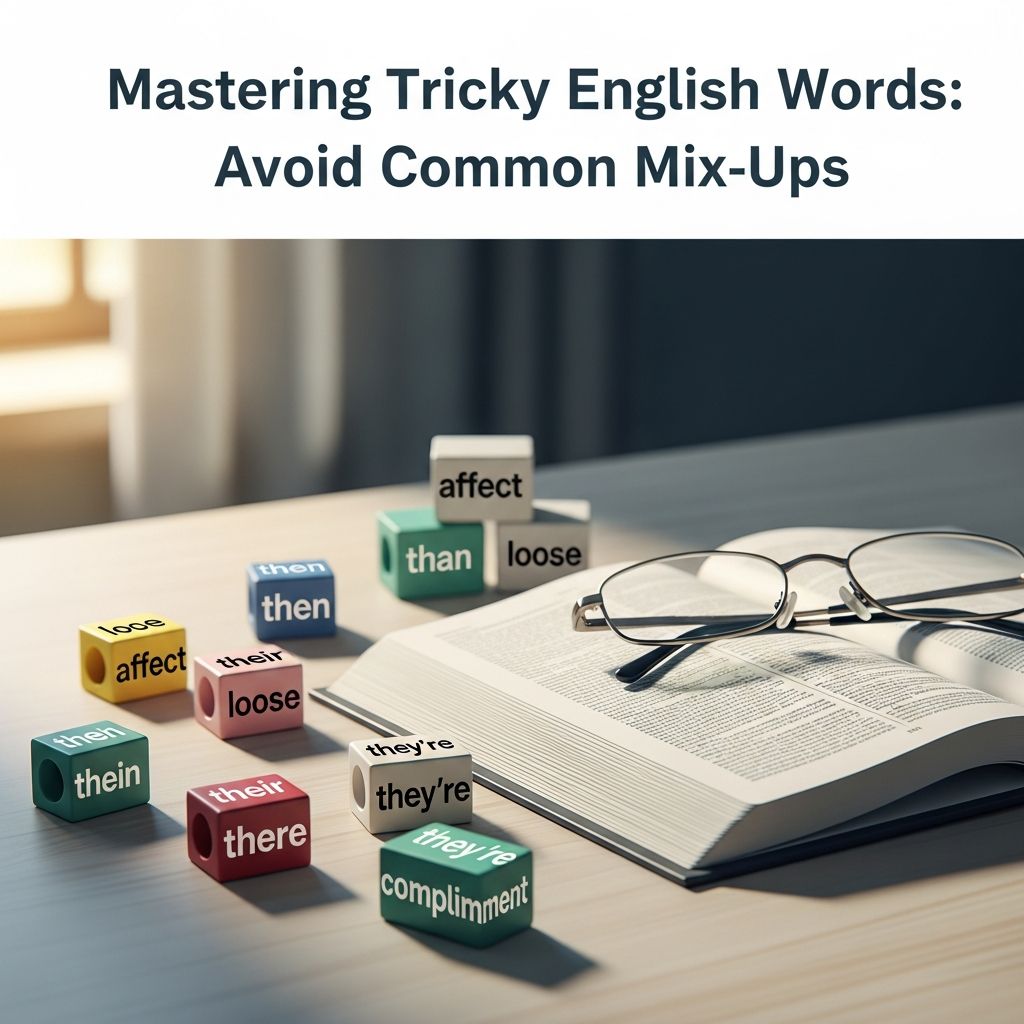
English is renowned for its quirks, especially when it comes to words that sound alike or look similar but carry distinct meanings. These commonly confused words trip up even seasoned speakers, leading to misunderstandings in emails, essays, and conversations. This comprehensive guide explores key examples, explains their differences, and provides actionable strategies to sidestep errors, drawing from reliable academic insights to help you communicate with precision.
Why Word Confusion Happens and Its Impact
Confusion arises from homophones—words that sound the same but differ in spelling and meaning—like ‘there,’ ‘their,’ and ‘they’re.’ Irregular pronunciations, such as ‘colonel’ sounding like ‘kernel,’ add another layer. Academic resources note that these mix-ups stem from English’s evolution, blending influences from Latin, French, and Germanic languages, resulting in silent letters and deceptive spellings.
In professional settings, such errors erode credibility. A study from university writing centers highlights that misused words in resumes or reports can reduce hiring chances by signaling carelessness. Mastering them elevates your writing from adequate to authoritative.
Top Categories of Confused Words
Tricky words fall into groups: homophones, heteronyms (same spelling, different sounds/meanings), and near-synonyms. Let’s break them down with examples.
Homophones: Sound-Alikes with Different Spells
- Its vs. It’s: ‘Its’ shows possession (the dog wagged its tail). ‘It’s’ contracts ‘it is’ or ‘it has’ (it’s raining). Test: Replace with ‘it is’—if it fits, use ‘it’s’.
- Your vs. You’re: ‘Your’ indicates ownership (your book). ‘You’re’ means ‘you are’ (you’re late). Quick check: ‘You are’ works? Apostrophe it.
- Hear vs. Here: ‘Hear’ is auditory (hear the music). ‘Here’ denotes place (come here).
- To, Too, Two: ‘To’ for direction (go to school); ‘too’ means also/excess (too tired); ‘two’ is the number.
Heteronyms: Same Spelling, Shifting Pronunciations
- Read: Present (/reed/) as in ‘I read daily’; past (/red/) as in ‘I read it yesterday’.
- Lead: Metal (/led/); to guide (/leed/).
- Wind: Air movement (/wind/); to twist (/wahynd/).
Near-Synonyms and Tricky Pairs
| Word Pair | Meaning & Use | Example |
|---|---|---|
| Affect/Effect | Affect (verb: influence); Effect (noun: result). Rare: Effect (verb: cause). | Rain affects crops; the effect was drought. |
| Accept/Except | Accept (receive); Except (exclude). | Accept the prize; all except one. |
| Assure/Ensure/Insure | Assure (comfort); Ensure (guarantee); Insure (financial protection). | Assure her; ensure safety; insure the car. |
| Among/Between | Among (group); Between (two or pairwise). | Among friends; between you and me. |
| Fewer/Less | Fewer (countable); Less (uncountable). | Fewer books; less water. |
Irregular Pronunciations and Silent Letters
- Colonel: Pronounced ‘kernel,’ not ‘col-o-nel’.
- Knife/Knives: Silent ‘k’; plural ‘knives’.
- Debt/Doubt: Silent ‘b’.
- Yacht: /yaht/, not as spelled.
- Women: /wim-in/, not ‘wo-men’.
Proven Strategies to Eliminate Mix-Ups
Beyond memorization, adopt these six evidence-based techniques, refined from university grammar guides.
1. Create Personal Mnemonics
Link words to vivid images. For ‘its/it’s,’ picture ‘its’ as possessive without apostrophe (no ‘is’ there); ‘it’s’ squeezes in ‘it is.’ Practice daily: Write five sentences per pair.
2. Read Aloud for Pronunciation Checks
Heteronyms like ‘read’ reveal themselves when spoken. Record yourself reading passages with targets like ‘though/thought/through.’ Phonetic drills build muscle memory.
3. Use Substitution Tests
For contractions: Swap ‘you’re’ with ‘you are.’ If smooth, correct. For ‘less/fewer,’ ask: Can I count it?.
4. Build Contextual Sentences
Context clarifies. ‘Loose’ (not tight); ‘lose’ (fail to keep): ‘Don’t lose your loose change.’ Repeat in varied scenarios.
5. Leverage Tools Wisely
Spell-check misses homophones. Use Grammarly or Hemingway App for flags, but verify manually. University tutorials recommend printing lists for desks.
6. Practice with Quizzes and Games
Daily quizzes on sites like Vocabulary.com reinforce. Tongue twisters: ‘Though the tough cough through, thorough thoughts thought through.’ Group challenges make it fun.
Real-World Applications in Writing and Speech
In academic essays, precision matters. Massey University advises proofreading for ‘conscious/conscience’: Awareness vs. moral sense. Emails? ‘Their/there/they’re’ errors annoy bosses. Public speaking? Nail ‘said’ (/sed/), not ‘say-ed’.
Professionals in IELTS or business report 20% clarity gains post-training on these. Students see grade boosts by avoiding ‘principal/principle’ slips.
Advanced Tips for Lifelong Learners
Track errors in a journal. Read diverse texts—news, novels—to spot patterns. Discuss with peers: Explain ‘lay/lie’ (lay needs object; lie doesn’t). For plurals like ‘women,’ chant rhymes: ‘Women swimmin’.’
Etymology helps: ‘Debt’ from Latin ‘debitum,’ ‘b’ added erroneously, now silent.
Frequently Asked Questions (FAQs)
What are the most common confused words for non-native speakers?
Top ones: its/it’s, your/you’re, there/their/they’re, affect/effect, and fewer/less.
How can I quickly tell ‘lose’ from ‘loose’?
‘Loose’ is the opposite of tight; ‘lose’ rhymes with ‘choose’ but means to misplace.
Is ‘between’ only for two items?
No—use for multiple pairwise relations, like ‘agreements between four parties’.
Why is ‘colonel’ pronounced ‘kernel’?
From French influence; spelling stayed, pronunciation shifted.
Best way to practice pronunciation?
Tongue twisters and audio repetition, focusing on phonetics.
Final Thoughts on Precision
Conquering these words transforms communication. Consistent practice yields fluency. Start with one category today—your future self will thank you.
References
- Confusing English Words for IELTS: How to Avoid Mistakes — British Council. 2023-05-15. https://takeielts.britishcouncil.org/blog/confusing-english-words
- Commonly Confused Words — Massey University. 2024-01-10. https://www.massey.ac.nz/study/study-and-assignment-support-and-guides/academic-writing/grammar-and-spelling/commonly-confused-words/
- Commonly Confused Words — University of Illinois Springfield. 2023-08-22. https://www.uis.edu/learning-hub/writing-resources/handouts/learning-hub/commonly-confused-words
- Commonly Confused Words — Vocabulary.com. 2024-02-14. https://www.vocabulary.com/articles/commonly-confused-words/
- Top 30 Commonly Confused Words in English — Grammarly. 2025-03-01. https://www.grammarly.com/blog/commonly-confused-words/30-commonly-confused-words/

- Integrated M.A. in Applied Linguistics, University of Hyderabad
- 5+ years in editorial, instructional, SEO, and research-based writing
Sneha is a relationships and lifestyle writer with a strong foundation in applied linguistics and certified training in relationship coaching. She brings over five years of writing experience to theskillvault, crafting thoughtful, research-driven content that empowers readers to build healthier relationships, boost emotional well-being, and embrace holistic living. Her writing and insights reflect the belief that beauty, happiness, and wellness…