
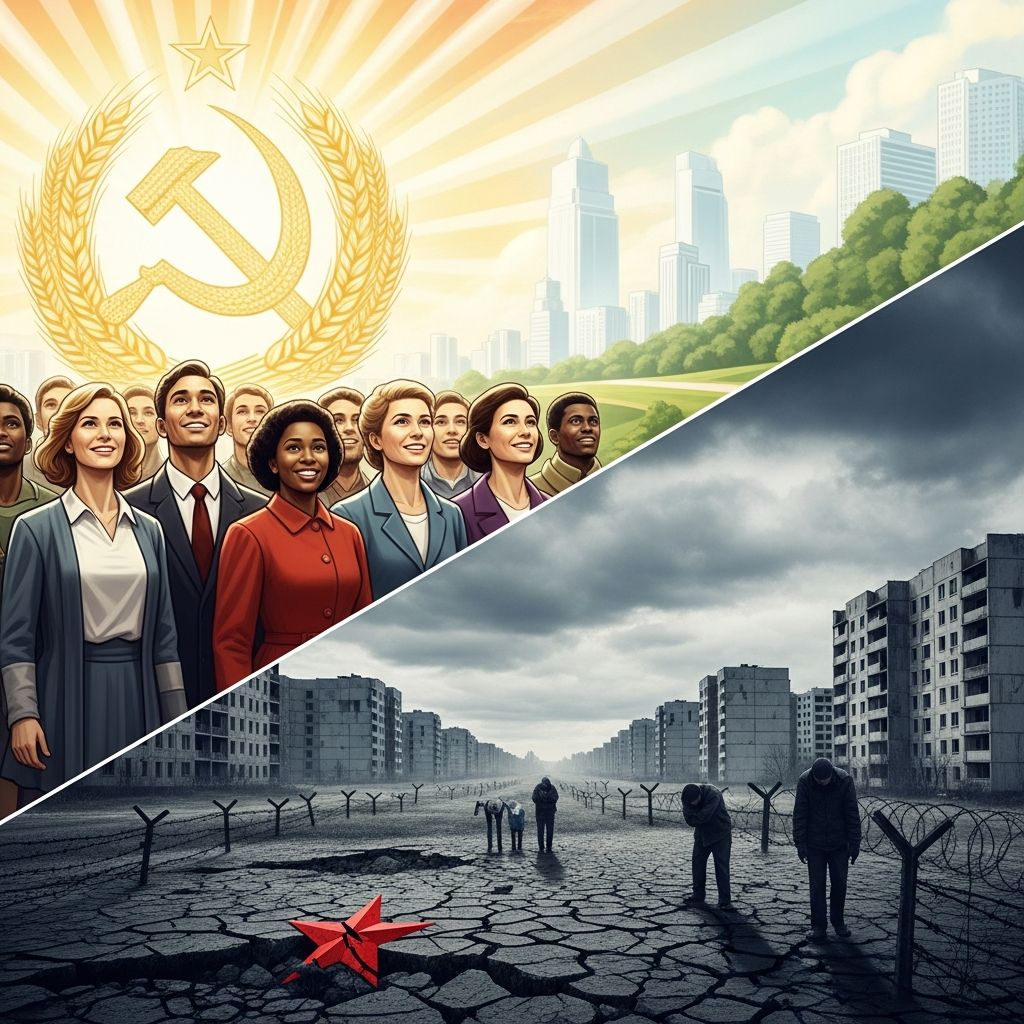
Communism represents a radical vision for society, aiming to eliminate class divisions through collective ownership of resources. Rooted in 19th-century philosophy, it promises equality but has sparked intense debate over its feasibility and consequences.
Core Principles of Communist Thought
At its heart, communism seeks a **classless society** where the major means of production—such as factories, mines, and land—are owned collectively rather than by individuals or corporations. This system eliminates private property in productive assets, distributing goods based on need rather than market forces.
The guiding slogan, “From each according to his ability, to each according to his needs,” encapsulates this ethos. In theory, individuals contribute based on their capacities, and resources are allocated to meet personal requirements, fostering universal prosperity without exploitation.
- Public Ownership: All key industries and resources controlled by the community.
- No Private Property: Personal items allowed, but not means of production.
- Class Elimination: End of bourgeoisie-proletariat divide.
- No State in Endgame: Government withers away after transition.
These ideas distinguish communism from capitalism, where private ownership drives profit and competition.
Foundational Thinkers and Their Visions
Karl Marx and Friedrich Engels laid communism’s intellectual groundwork in The Communist Manifesto (1848). Marx analyzed capitalism’s contradictions, arguing that workers (proletariat) are alienated from labor’s fruits, controlled by owners (bourgeoisie).
Marx envisioned history as class struggle progressing from feudalism to capitalism, then socialism, and finally communism. Socialism acts as a bridge: a transitional phase with limited private property under proletarian dictatorship.
Engels expanded on family and state roles, seeing them as tools of class oppression that would dissolve in communism.
| Thinker | Key Work | Main Contribution |
|---|---|---|
| Karl Marx | The Communist Manifesto (1848) | Class struggle and capitalist critique |
| Friedrich Engels | The Origin of the Family (1884) | State and family as oppressive structures |
| V.I. Lenin | State and Revolution (1917) | Revolutionary vanguard party |
Distinguishing Communism from Socialism
Communism and socialism overlap but differ fundamentally. Socialism permits some private enterprise and market elements during transition, while communism demands total communal control and no classes or state.
Marxists view socialism as communism’s preparatory stage, where the state seizes production means to prevent capitalist restoration. Full communism emerges when scarcity ends, making coercion obsolete.
- Socialism: Worker/state control, wages, limited markets.
- Communism: Need-based distribution, no money, stateless.
Historical Rise and Major Implementations
Communism transitioned from theory to practice post-World War I. Lenin’s Bolshevik Revolution in 1917 established the Soviet Union, the first self-proclaimed communist state, via proletarian dictatorship.
Key milestones include:
- 1917 Russian Revolution: Overthrew tsarism, nationalized industry.
- 1949 Chinese Revolution: Mao Zedong created People’s Republic, adapting Marxism to agrarian society.
- Cuban Revolution (1959): Fidel Castro nationalized economy, allied with USSR.
These regimes centralized power under single parties, implementing Five-Year Plans for rapid industrialization.
Economic Framework in Communist Systems
Communist economies prioritize central planning over markets. Governments set production quotas, allocate resources, and distribute outputs via state mechanisms.
Advantages claimed: Eliminates inequality, directs resources to social needs like housing and healthcare. Critics highlight inefficiencies, shortages, and innovation stifling due to absent price signals.
| Aspect | Capitalism | Communism |
|---|---|---|
| Ownership | Private | Collective |
| Decision-Making | Markets | Central Planning |
| Motivation | Profit | Social Good |
| Inequality | High | Theoretically None |
Critiques and Challenges Faced
Despite ideals, implementations revealed flaws. Economic stagnation plagued the USSR by the 1980s, with black markets thriving amid shortages.
Authoritarianism emerged: Parties suppressed dissent, creating totalitarian structures Marx never endorsed. Human costs included millions dead from famines, purges, and gulags.
Ideological rigidity stifled adaptation, as seen in Mao’s Great Leap Forward, causing massive famine.
Communism’s Global Influence and Legacy
Communism inspired anti-colonial movements in Asia, Africa, and Latin America. Cold War pitted it against capitalism, shaping geopolitics.
Post-1991 Soviet collapse, pure communism waned, but hybrids persist in China, Vietnam, Cuba—blending markets with party control.
Today, it influences debates on inequality, with renewed interest amid capitalist crises.
Modern Interpretations and Variants
Beyond Marxism-Leninism, variants include anarchist communism (no state), Trotskyism (permanent revolution), and eco-communism (sustainable collectives).
21st-century thinkers adapt ideas to automation, proposing post-scarcity via technology.
Frequently Asked Questions (FAQs)
Is communism the same as socialism?
No, socialism is a transitional phase toward communism, retaining some state and market elements, while communism is fully classless and stateless.
Has true communism ever existed?
No major state achieved Marx’s stateless ideal; all stopped at socialist stages with strong governments.
Why did communist economies fail?
Central planning ignored incentives and information problems, leading to inefficiencies and corruption.
What is the role of the Communist Party?
It acts as vanguard, guiding revolution and preventing counter-revolution during transition.
Can communism work with modern technology?
Proponents argue AI and abundance could enable need-based distribution without past shortages.
Key Takeaways on Communism’s Enduring Debate
Communism critiques capitalism’s excesses but struggles with human nature and complexity. Its legacy warns of utopian pitfalls while highlighting equality’s appeal.
References
- What is communism? | Britannica — Encyclopædia Britannica. 2023. https://www.britannica.com/question/What-is-communism
- Communism | Definition, History, Varieties, & Facts – Britannica — Encyclopædia Britannica. 2023. https://www.britannica.com/topic/communism
- Communism – Wikipedia — Wikipedia. 2023. https://en.wikipedia.org/wiki/Communism
- What is communism? – Communist Crimes — CommunistCrimes.org. 2023. https://communistcrimes.org/en/commemoration/what-communism
- What Are the Origins of Communism? – CFR Education — Council on Foreign Relations. 2023. https://education.cfr.org/learn/reading/what-are-origins-communism

- Integrated M.A. in Applied Linguistics, University of Hyderabad
- 5+ years in editorial, instructional, SEO, and research-based writing
Sneha is a relationships and lifestyle writer with a strong foundation in applied linguistics and certified training in relationship coaching. She brings over five years of writing experience to theskillvault, crafting thoughtful, research-driven content that empowers readers to build healthier relationships, boost emotional well-being, and embrace holistic living. Her writing and insights reflect the belief that beauty, happiness, and wellness…