
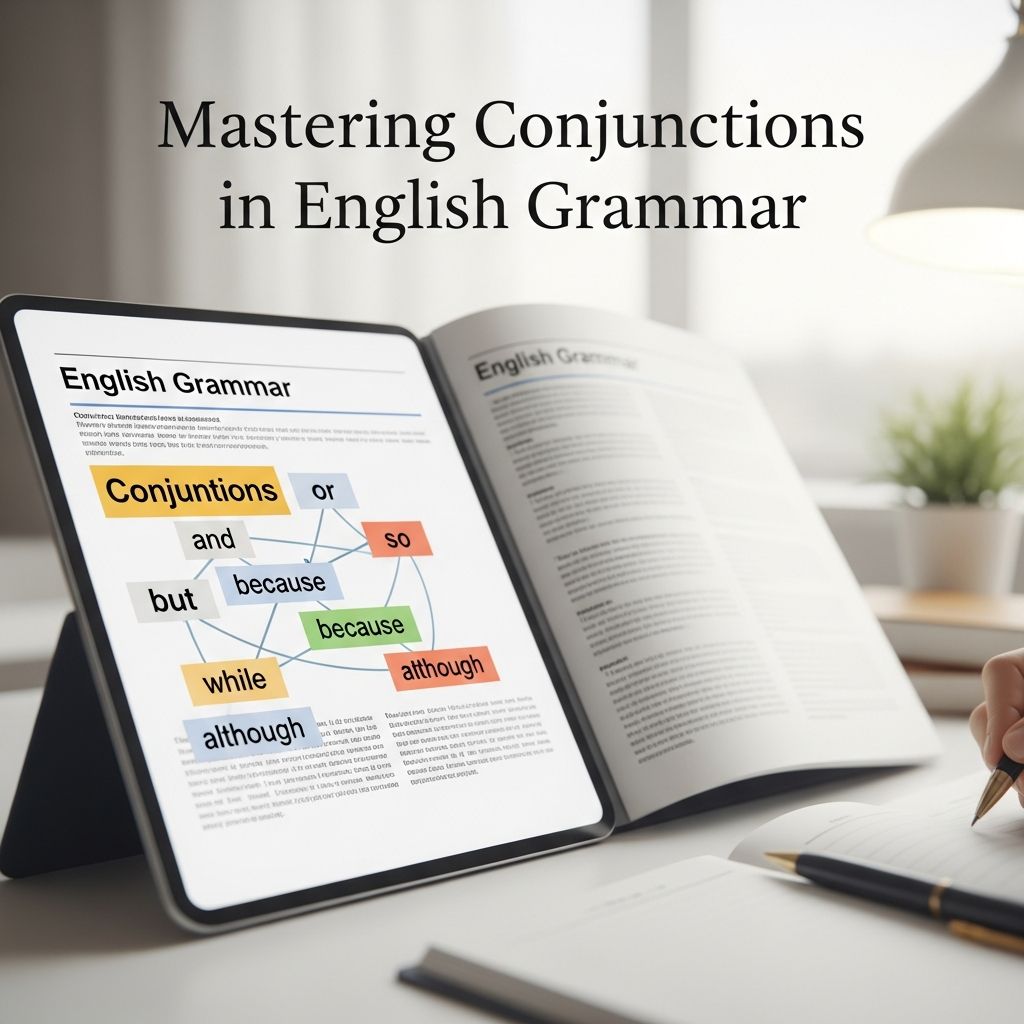
Conjunctions serve as the essential connectors in English, linking words, phrases, or clauses to form coherent and complex sentences. These small but mighty words enable writers and speakers to express relationships between ideas, such as addition, contrast, cause, or condition, making communication more nuanced and efficient.
The Fundamental Role of Conjunctions in Sentence Building
At their core, conjunctions act like bridges, uniting grammatical elements that would otherwise stand alone. Without them, sentences would be choppy and disjointed, limiting the ability to convey intricate thoughts. For instance, instead of saying “I wanted to go. It rained,” we can say “I wanted to go, but it rained,” creating a smooth flow that highlights contrast.
Conjunctions fall into distinct categories based on what they connect and how they function syntactically. Understanding these categories is crucial for constructing grammatically correct and stylistically varied sentences. They ensure parallelism, maintain balance, and clarify logical connections, which are vital in academic writing, professional emails, and everyday conversation.
Coordinating Conjunctions: Balancing Equal Elements
**Coordinating conjunctions** join items of equal grammatical weight, such as words, phrases, or independent clauses. The seven primary ones—remembered by the acronym **FANBOYS** (for, and, nor, but, or, yet, so)—each carries a specific meaning.
- For: Indicates reason or cause, similar to “because.” Example: “She studied hard, for she wanted to pass the exam.”
- And: Adds information or shows sequence. Example: “He ran and jumped over the fence.”
- Nor: Negates both elements, pairing with “neither.” Example: “She neither smiled nor spoke.”
- But: Shows contrast. Example: “The cake was delicious, but it was too sweet.”
- Or: Presents alternatives. Example: “Would you like tea or coffee?”
- Yet: Introduces unexpected contrast. Example: “It was early, yet the sun set.”
- So: Indicates result. Example: “It rained heavily, so we stayed indoors.”
When linking independent clauses, use a comma before the coordinating conjunction. This rule, known as the comma-conjunction rule, prevents run-on sentences and enhances readability.
Subordinating Conjunctions: Creating Hierarchy in Sentences
**Subordinating conjunctions** introduce dependent clauses, linking them to main clauses to show relationships like time, cause, condition, or concession. Unlike coordinating ones, they establish one clause as subordinate, unable to stand alone.
Common subordinating conjunctions include:
| Relationship | Examples | Sample Sentence |
|---|---|---|
| Cause/Reason | because, since, as | We hurried because the meeting started soon. |
| Time | when, while, before, after | Call me when you arrive. |
| Condition | if, unless, provided that | I’ll go if you join me. |
| Concession/Contrast | although, though, even though | She succeeded although she faced obstacles. |
| Purpose | so that, in order that | He whispered so that no one heard. |
Position matters: A subordinating conjunction can start the sentence (followed by a comma if the dependent clause comes first) or appear mid-sentence without a comma.
Correlative Conjunctions: Paired Connectors for Precision
**Correlative conjunctions** work in pairs to connect balanced elements, emphasizing symmetry and parallelism. They add emphasis and ensure grammatical consistency.
- Either…or: Choices. “Either study hard or risk failing.”
- Neither…nor: Negated choices. “Neither the cat nor the dog was happy.”
- Not only…but also: Addition with surprise. “She is not only talented but also kind.”
- Both…and: Dual affirmation. “Both players and coaches celebrated.”
- Whether…or: Alternatives. “Whether it rains or shines, we’ll proceed.”
A key rule is maintaining parallelism: Ensure paired elements match in form (e.g., noun with noun, verb with verb). Faulty pairing like “Both A as well as B” is incorrect; use “both A and B.”
Conjunctive Adverbs: Transitional Links Between Ideas
Though not true conjunctions, **conjunctive adverbs** (e.g., however, therefore, moreover) connect independent clauses, signaling transitions. They require a semicolon before and a comma after when joining clauses.
- Contrast: however, nevertheless, still
- Addition: furthermore, moreover, besides
- Cause/Result: therefore, thus, consequently
- Sequence: meanwhile, otherwise
Example: “It was late; however, we continued working.” This structure provides smooth idea flow in essays and reports.
Essential Rules and Common Pitfalls to Avoid
To use conjunctions effectively:
- Match grammatical units: Join like with like (e.g., don’t pair a noun with a clause).
- Use commas correctly: Before coordinating conjunctions in compound sentences; after introductory dependent clauses.
- Avoid fragments: Subordinate clauses can’t start sentences alone.
- Ensure parallelism: In correlative pairs, keep structures identical.
Common errors include comma splices (joining clauses without conjunctions), run-ons, and mismatched pairs. Practice spotting these elevates writing quality.
Practical Applications in Writing and Speech
Conjunctions enhance variety: Short sentences with coordinators for punchiness; complex ones with subordinators for depth. In speech, they aid fluency, reducing pauses.
In professional contexts, precise conjunctions clarify arguments—use “however” for rebuttals, “therefore” for conclusions. Students benefit in essays by varying structures to avoid repetition.
Advanced Tips for Conjunction Mastery
Experiment with placement: Fronted subordinators emphasize conditions (“If you help, I’ll succeed”). Combine types for sophistication: “Not only did she win, but she also set a record, although injured.”
Study idiomatic phrases like “not just…but” or “as…as” that function similarly. Reading diverse texts reveals nuanced usage.
Frequently Asked Questions (FAQs)
Can sentences start with conjunctions?
Yes, conjunctions like “and” or “but” can begin sentences for emphasis, though traditional style guides advise caution in formal writing.
What’s the difference between “and” and “but”?
“And” adds; “but” contrasts. Both coordinate equals.
How many coordinating conjunctions exist?
Seven main ones: FANBOYS.
Do correlative pairs always need commas?
No, unless interrupting flow or following standard comma rules.
Are conjunctive adverbs conjunctions?
No, they are adverbs functioning transitionally with punctuation.
Exercises to Reinforce Learning
Try combining: 1. It snowed. We canceled the picnic. → “It snowed, so we canceled the picnic.”
2. Study. Fail the test. → “Either study or fail the test.”
Punctuate: “She was tired ___ she finished the project (but).
Conjunctions transform basic sentences into compelling narratives. Master them through practice for eloquent expression.
References
- Conjunction (grammar) — Wikipedia. 2023-10-15. https://en.wikipedia.org/wiki/Conjunction_(grammar)
- What Are Conjunctions? Definition and Examples — Grammarly. 2023-08-22. https://www.grammarly.com/blog/parts-of-speech/conjunctions/
- Conjunctions: Definition and Examples — Grammar Monster. 2023-05-10. https://www.grammar-monster.com/lessons/conjunctions.htm
- Using Conjunctions | Definition, Rules & Examples — Scribbr. 2023-11-01. https://www.scribbr.com/parts-of-speech/conjunctions/
- What is a conjunction? — English Grammar Revolution. 2022-12-05. https://www.english-grammar-revolution.com/what-is-a-conjunction.html
- Conjunctions – English Grammar Lessons — YouTube (TED-Ed style channel). 2021-07-20. https://www.youtube.com/watch?v=3qbfcHiUrcI

- Integrated M.A. in Applied Linguistics, University of Hyderabad
- 5+ years in editorial, instructional, SEO, and research-based writing
Sneha is a relationships and lifestyle writer with a strong foundation in applied linguistics and certified training in relationship coaching. She brings over five years of writing experience to theskillvault, crafting thoughtful, research-driven content that empowers readers to build healthier relationships, boost emotional well-being, and embrace holistic living. Her writing and insights reflect the belief that beauty, happiness, and wellness…