
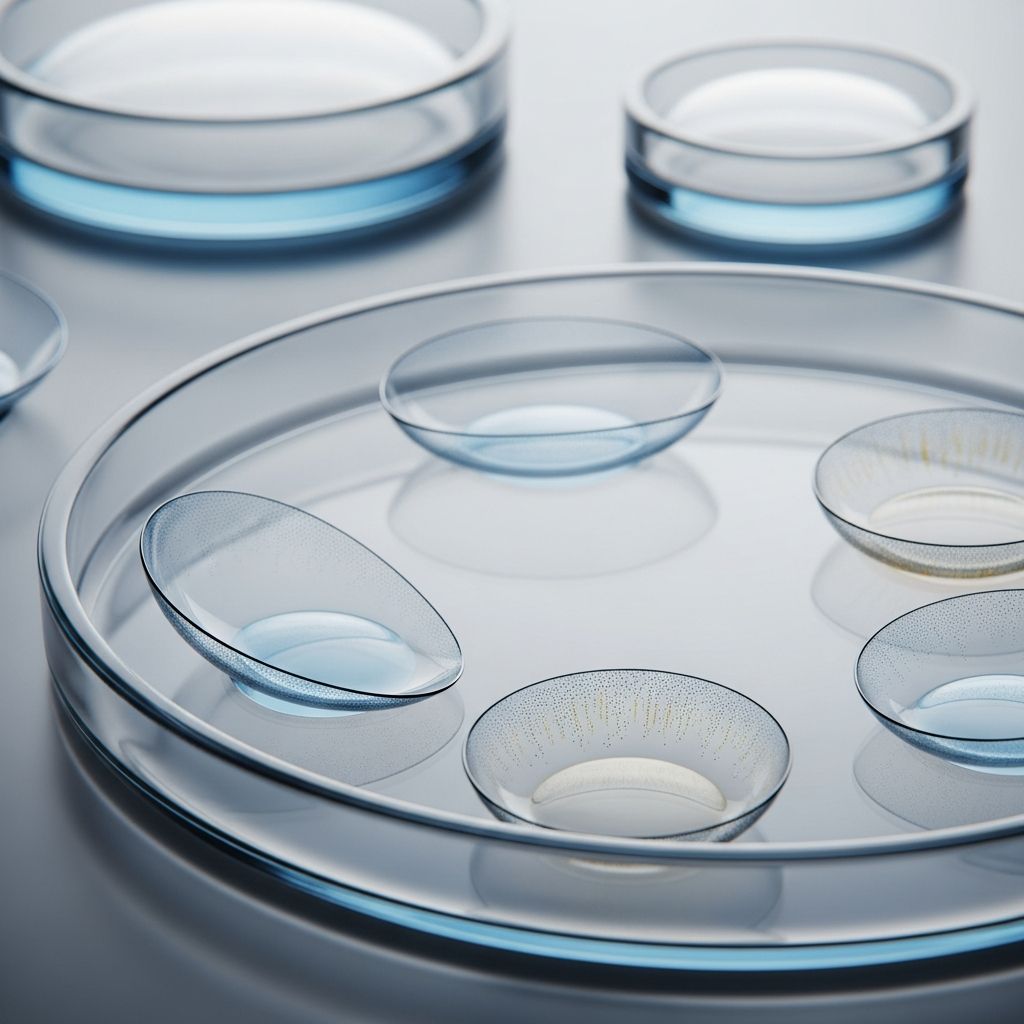
Contact lenses represent a remarkable fusion of polymer science and ophthalmology, designed to correct vision while maintaining eye health. At their core, these devices are crafted from specialized plastics that balance flexibility, oxygen permeability, and biocompatibility. Understanding the materials behind contact lenses helps users make informed choices for comfort and safety.
Foundational Polymers in Lens Production
The journey of contact lens manufacturing begins with plastic polymers engineered for ocular use. Hard lenses historically relied on polymethyl methacrylate (PMMA), a rigid material offering durability but limited oxygen transmission. Modern soft lenses, however, predominantly use poly hydroxyethyl methacrylate (pHEMA), a hydrophilic polymer that attracts water, mimicking the eye’s natural tear film.
Hydrophilic properties ensure lenses integrate seamlessly with the eye’s moist environment, reducing irritation. Manufacturers mold these polymers through processes like lathe cutting for rigid types or spin-casting and injection molding for soft variants, creating precise curvatures tailored to individual prescriptions.
Hydrogel Lenses: Flexibility and Water Absorption
Hydrogel lenses dominate the soft contact market due to their pliability. These lenses incorporate high water content, typically ranging from 36% to 70%, which directly influences oxygen permeability—higher water means better oxygen flow to the cornea. Poly-HEMA forms the backbone, providing the flexibility that makes insertion comfortable.
Key advantages include immediate comfort upon wear, as the material conforms to the eye’s shape. However, drawbacks emerge with prolonged use: lower oxygen levels compared to newer materials can lead to dryness or deposits. Common formulations include:
- Low water content hydrogels (e.g., polymacon at 36% water): Ideal for daily wear with moderate oxygen needs.
- High water content hydrogels (e.g., hilafilcon A at 70%): Enhanced comfort but higher dehydration risk.
In practice, hydrogels account for about 24% of fittings, favored for their softness.
Silicone Hydrogel Innovation: Superior Oxygen Flow
Representing a breakthrough, silicone hydrogel (SiHy) lenses combine silicone’s oxygen-transporting prowess with hydrogel’s hydration. Unlike traditional hydrogels, where oxygen permeability (Dk) ties to water content, SiHy’s Dk stems from silicone, achieving 5 times more oxygen transmission. This allows extended or overnight wear without compromising corneal health.
Silicone imparts a gel-like resilience, used in medical implants for its biocompatibility. Popular SiHy materials like lotrafilcon A/B, comfilcon A, and senofilcon A feature water contents from 24% to 74% and Dk values of 60-140, balancing handling ease and vision clarity. They comprise 65% of U.S. fittings, reflecting their dominance.
| Material | Water Content (%) | Dk Value | Best For |
|---|---|---|---|
| lotrafilcon A | 24 | 140 | Extended wear |
| comfilcon A | 48 | 116 | Daily comfort |
| senofilcon A | 38 | 103 | Astigmatism correction |
SiHy lenses excel in wettability and modulus, minimizing handling issues while supporting longer wear times.
Rigid Gas Permeable Lenses: Durability Meets Clarity
Rigid gas permeable (RGP) lenses, making up 9% of prescriptions, prioritize crisp vision for conditions like keratoconus. Contemporary RGPs blend fluoro-silicone or siloxane components with hydrophilic monomers such as HEMA and methacrylic acid, boosting Dk over outdated PMMA or cellulose acetate butyrate.
These lenses maintain a firm structure, resisting deposits and providing stable correction. Initial adaptation requires time, but long-term benefits include longevity and precise fit. Silicone integration enhances permeability, making RGPs viable for orthokeratology.
- Fluoro-silicone variants: High Dk for all-day wear.
- Siloxane-based: Improved wettability and comfort.
Though less flexible, RGPs offer unmatched optical quality.
Hybrid Lenses: Best of Both Worlds
Hybrid designs, at 2% of fittings, merge RGP centers for sharp vision with soft skirts for comfort. Typically featuring acrylate-silicone-fluorine cores, they suit irregular corneas where single materials fall short. This dual structure minimizes movement while cushioning the sclera.
Patients with astigmatism or post-surgical needs benefit most, as hybrids reduce aberrations without sacrificing ease.
Material Properties Impacting Performance
Beyond type, properties like modulus (stiffness), wettability, and deposit resistance define user experience. High-modulus SiHy aids handling; low-modulus hydrogels enhance drape. Oxygen permeability remains paramount—FDA classifies lenses by transmissibility, with Group V (high Dk/t) ideal for continuous wear.
Water content affects evaporation: ionic materials (with MAA) bind water better than non-ionic. Trends show SiHy rising due to reduced hypoxia risks.
Evolution of Contact Lens Materials
From 1970s PMMA to today’s SiHy, innovation addresses oxygen deprivation and comfort. Early silicone acrylates paved RGP paths; 1990s hydrogels popularized disposables. Post-2000, SiHy captured markets with Dk breakthroughs. Future directions include smart polymers for drug delivery and UV blockers.
Prescription data underscores shifts: PMMA now negligible, hydrogels stable, SiHy surging.
Choosing the Right Material for Your Eyes
Selection hinges on lifestyle, eye shape, and wear schedule. Dry eyes favor high-Dk SiHy; budget users opt hydrogels. Consult optometrists for trials—factors like tear film and lid tension influence success. Proper care extends material life, preventing protein buildup.
| Need | Recommended Material | Key Benefit |
|---|---|---|
| Daily comfort | Hydrogel | Flexibility |
| Extended wear | Silicone Hydrogel | Oxygen permeability |
| High precision | RGP | Visual acuity |
| Irregular cornea | Hybrid | Combined comfort/sharpness |
Frequently Asked Questions (FAQs)
Which contact lens material allows the most oxygen to the eye?
Silicone hydrogel lenses provide the highest oxygen permeability, up to 5 times more than traditional hydrogels, supporting healthier extended wear.
Are hydrogel lenses better for dry eyes?
Hydrogels offer initial comfort but may dehydrate faster; SiHy with stable water balance often suits dry eyes better.
How do RGP lenses compare to soft ones in durability?
RGP lenses last longer (1-2 years) due to rigidity, resisting tears and deposits unlike softer, disposable options.
Can all lenses be worn overnight?
Only high-Dk/t approved lenses like certain SiHy are safe for overnight use; always check FDA classification.
What makes hybrid lenses unique?
They feature rigid centers for vision and soft edges for comfort, ideal for complex prescriptions.
This comprehensive overview equips wearers with knowledge to navigate options. Advances continue, promising even safer, smarter lenses ahead.
References
- How Contact Lenses Are Made — Walker Eye Care. 2023. https://www.walkereyecare.com/how-contact-lenses-are-made/
- List of soft contact lens materials — Wikipedia. 2024-01-15. https://en.wikipedia.org/wiki/List_of_soft_contact_lens_materials
- Contact Lenses 101, Part 1: Contact Lens Materials — CooperVision. 2023. https://coopervision.com/practitioner/ecp-viewpoints/technicians-and-staff/contact-lenses-101-part-1-contact-lens-materials
- What Are Contact Lenses Made Of? Understanding Contact Lens Materials Types — Hubble Contacts. 2024. https://www.hubblecontacts.com/blog/what-are-contact-lenses-made-of-understanding-contact-lens-materials-types
- Awareness of Contemporary Contact Lenses, Materials — 20/20 Magazine. 2022-05-01. https://www.2020mag.com/ce/awareness-of-contemporary-contact-lenses-materials
- Things you should know about Contact Lens Materials — Bausch + Lomb. 2023. https://www.bauschandlomb.in/lens-article/things-you-should-know-about-contact-lens-materials

Medha Deb is an editor with a master's degree in Applied Linguistics from the University of Hyderabad. She believes that her qualification has helped her develop a deep understanding of language and its application in various contexts. Medha specializes in the areas of beauty, health, sports, and wellness and is committed to ensuring that the content on the website is…