
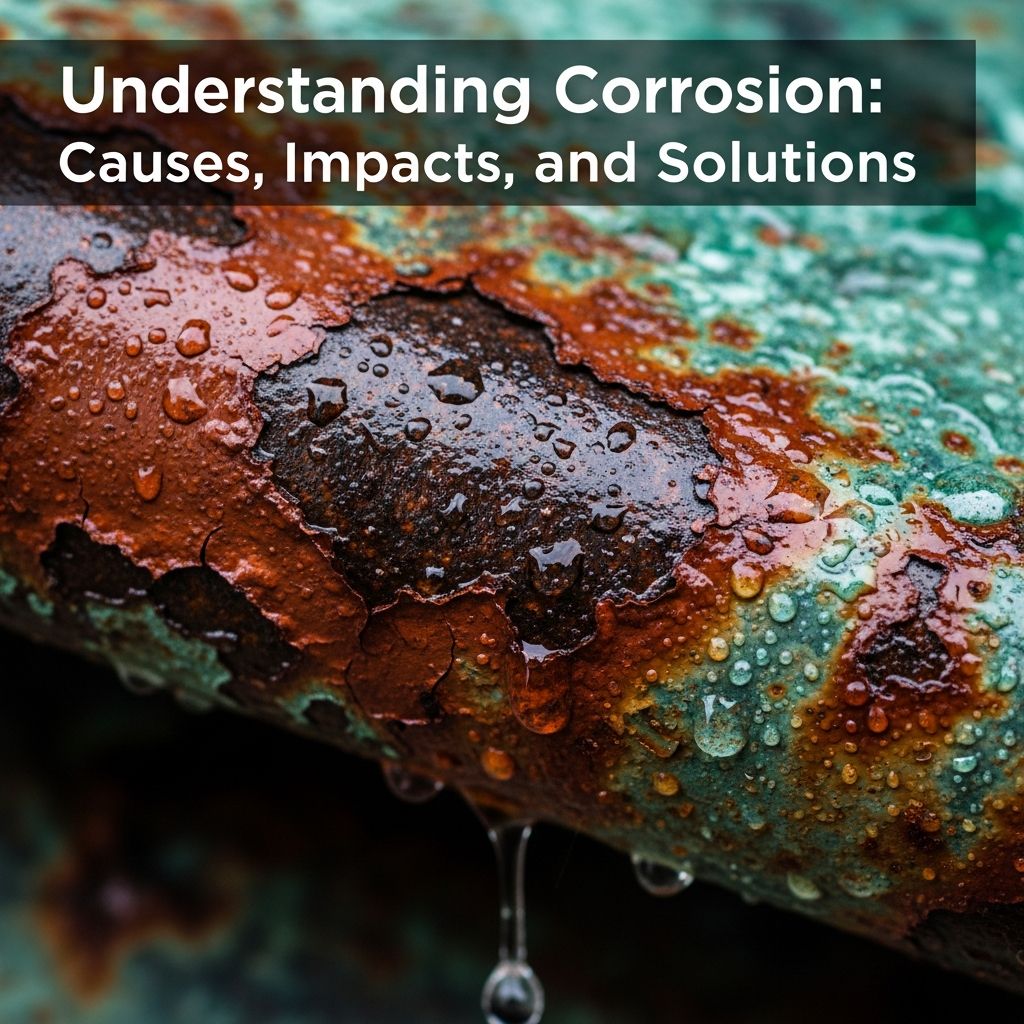
Corrosion represents a fundamental challenge in materials science, where metals and other substances deteriorate through interaction with their surroundings. This process, primarily electrochemical in nature, leads to the gradual breakdown of structures, from everyday items to critical infrastructure.
The Nature of Material Degradation
At its essence, corrosion is the natural tendency of refined metals to return to a more stable, oxidized state. When metals like iron or steel encounter moisture, oxygen, or electrolytes, they undergo oxidation, losing electrons and forming compounds such as rust. This electrochemical reaction involves anodic sites where metal atoms dissolve and cathodic sites where reduction occurs, creating a complete circuit driven by environmental factors.
Unlike mechanical wear, corrosion subtly erodes material integrity over time, often invisibly until failure occurs. It affects not just metals but can degrade polymers and ceramics under specific conditions, though metals remain the primary concern due to their widespread use in construction, transportation, and manufacturing.
Electrochemical Foundations of Corrosion
Corrosion functions like a battery: an anode corrodes by releasing electrons, which flow through the metal to a cathode where they reduce oxygen or hydrogen ions in the presence of water. This setup requires four key elements: an anode, cathode, metallic pathway for electrons, and electrolyte for ion movement. Without any one, the reaction halts.
For iron, the anodic reaction is Fe → Fe²⁺ + 2e⁻, while the cathodic reaction in neutral water is O₂ + 2H₂O + 4e⁻ → 4OH⁻. The resulting iron hydroxide oxidizes further to form rust (Fe₂O₃·nH₂O), a flaky, expansive layer that accelerates damage by exposing fresh metal.
Common Manifestations in Everyday Life
- Rusting of Steel: The iconic orange-red flakes on iron-based alloys exposed to humid air, common on vehicles and bridges.
- Uniform Corrosion: Even thinning across a surface, seen in pipelines carrying water.
- Pitting Corrosion: Localized deep holes that undermine strength, dangerous in pressure vessels.
- Galvanic Corrosion: Accelerated attack when dissimilar metals contact in an electrolyte, like steel and aluminum in saltwater.
These forms vary by environment; coastal areas see more chloride-induced pitting, while industrial zones suffer from acidic gases.
Environmental Triggers and Accelerators
Moisture acts as the primary electrolyte, but salts, acids, and pollutants intensify the process. High temperatures speed reactions, as in engine components or exhaust systems. Sulfur dioxide from pollution forms sulfuric acid, promoting sulfidation in hot atmospheres. Even microbes in soil or water can drive microbiologically influenced corrosion through metabolic byproducts.
| Factor | Effect on Corrosion Rate | Examples |
|---|---|---|
| Temperature | Increases exponentially | Hot pipes vs. ambient storage |
| Humidity/Salinity | Provides electrolyte | Marine vs. desert environments |
| pH Level | Low pH (acidic) accelerates | Industrial effluents |
| Oxygen Concentration | Drives cathodic reaction | Aerated water vs. deaerated |
Economic and Safety Consequences
Globally, corrosion inflicts trillions in damages annually, exceeding 3% of GDP in some nations. In the U.S., estimates reach $2.5 trillion yearly, covering repairs to infrastructure like bridges, pipelines, and aircraft. Safety risks are profound: corroded parts lead to structural collapses, leaks in hazardous material transport, and failures in medical devices.
Industries bear heavy costs—oil and gas pipelines corrode internally from produced water, automotive parts fail prematurely, and naval vessels require constant maintenance in seawater. Preventive neglect amplifies expenses, often multiplying repair budgets severalfold.
Advanced Types and Specialized Scenarios
Beyond standard rusting, high-temperature corrosion plagues turbines and furnaces, where metals react with oxygen, sulfur, or carbon at elevated temperatures, forming brittle scales. Crevice corrosion thrives in shielded gaps, like under gaskets, due to oxygen depletion and acid buildup. Stress corrosion cracking combines tensile stress and specific corrosives, fracturing seemingly intact components.
Electrolytic corrosion affects electronics when moisture bridges charged contacts, mimicking a battery. These niche forms demand tailored engineering solutions.
Proven Strategies for Mitigation
Prevention hinges on disrupting the corrosion cell. Key methods include:
- Coatings: Paints, epoxies, or galvanizing create barriers; zinc sacrificially protects steel by corroding preferentially.
- Cathodic Protection: Impressed current or sacrificial anodes make the structure the cathode, halting oxidation.
- Material Selection: Stainless steels, titanium, or alloys like Hastelloy resist harsh environments.
- Inhibitors: Chemicals adsorb onto metal surfaces, blocking reactions.
- Design Improvements: Drainage to avoid water pooling, avoiding dissimilar metal contacts.
Regular inspections using ultrasonics or radiography detect early damage, enabling timely intervention.
Industry-Specific Applications and Innovations
In aerospace, NASA employs advanced alloys and coatings for corrosion resistance in harsh atmospheres. Oil rigs use sacrificial anodes in seawater. Recent advances include nanotechnology coatings for self-healing and graphene barriers. Standards from bodies like AMPP guide best practices, ensuring longevity.
Emerging research focuses on bio-inspired inhibitors and AI-driven predictive modeling to forecast corrosion risks in real-time.
Frequently Asked Questions (FAQs)
What exactly causes rust on metal objects?
Rust forms when iron reacts with oxygen and water in an electrochemical process, producing iron oxide that flakes away, exposing more metal.
Can corrosion affect non-metal materials?
Yes, though less commonly termed ‘corrosion,’ polymers degrade from UV light, and concrete suffers from chemical attack, termed degradation.
How much does corrosion cost the global economy?
It accounts for over 3% of global GDP, with U.S. losses around $2.5 trillion annually from repairs and replacements.
What is the most effective way to stop galvanic corrosion?
Separate dissimilar metals with insulators or use compatible alloys; cathodic protection works well in conductive environments.
Does dry environments prevent all corrosion?
No, even low humidity allows slow oxidation; temperature-driven or gaseous corrosion persists without moisture.
Future Directions in Corrosion Control
Ongoing research promises smarter materials, like shape-memory polymers for crack-sealing coatings and machine learning for risk assessment. Sustainability drives recyclable inhibitors and green coatings, reducing environmental impact while curbing economic losses. Collaborative efforts between academia, industry, and governments will refine standards, ensuring durable infrastructure for generations.
References
- What Is Corrosion? Causes & Effects — Stabilit America. 2023. https://www.stabilitamerica.com/blog/what-is-corrosion/
- What is corrosion? — Cathwell. 2023. https://cathwell.com/what-is-corrosion/
- Corrosion Fundamentals — NASA Kennedy Space Center. 2023. https://public.ksc.nasa.gov/corrosion/corrosion-fundamentals/
- What is Corrosion? — The Electrochemical Society. 2023. https://www.electrochem.org/corrosion-science
- What is Corrosion? — AMPP (Association for Materials Protection and Performance). 2023. https://www.ampp.org/technical-research/what-is-corrosion
- Corrosion — Wikipedia (for background; primary sources cited). 2026-04-04. https://en.wikipedia.org/wiki/Corrosion

Medha Deb is an editor with a master's degree in Applied Linguistics from the University of Hyderabad. She believes that her qualification has helped her develop a deep understanding of language and its application in various contexts. Medha specializes in the areas of beauty, health, sports, and wellness and is committed to ensuring that the content on the website is…