
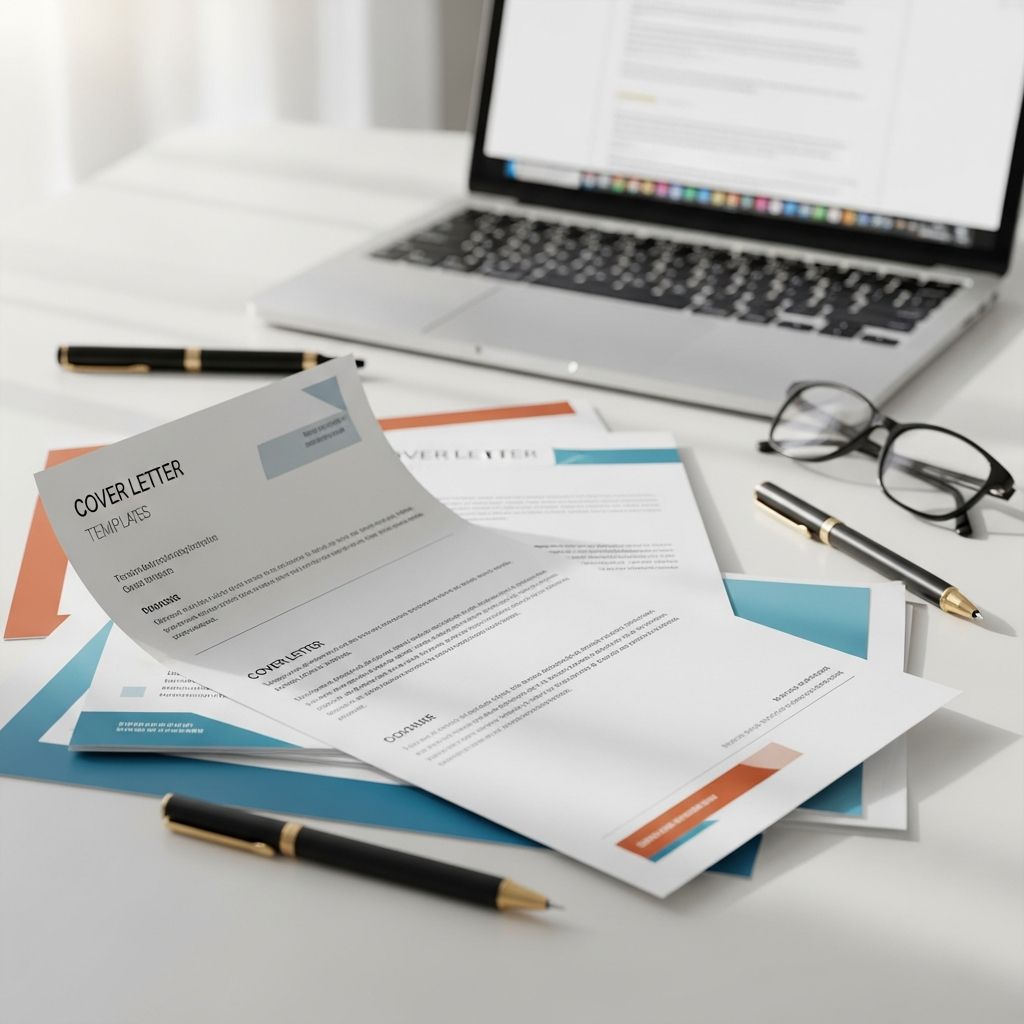
A well-structured cover letter, paired with a matching template, can significantly improve your chances of being invited to an interview by highlighting your most relevant qualifications in a clear and engaging way.
While your resume summarizes your experience, a cover letter explains why that experience matters for this specific role and employer.
Why Cover Letter Templates Still Matter
Despite the rise of quick-apply tools and automated screening systems, many employers still expect a cover letter for professional roles.
- Shows motivation: Submitting a tailored letter signals genuine interest in the role and organization.
- Provides context: You can explain career changes, employment gaps, or your motivation in ways a resume cannot.
- Highlights relevance: A cover letter lets you select and emphasize the two or three experiences that best match the job posting.
- Demonstrates communication skills: Employers use it to assess how clearly and professionally you write.
Using a template gives you a clean starting point for formatting, so you can focus your energy on content and customization rather than layout.
Main Types of Cover Letter Templates (and When to Use Them)
The best template depends on your industry, seniority, and personal brand. Below are common styles and where each works best.
| Template Style | Best For | Key Features | Potential Drawbacks |
|---|---|---|---|
| Classic / Traditional | Conservative fields (finance, law, government, academia) | Simple layout, minimal color, aligned with standard business-letter norms | May look plain if you are applying for highly creative roles |
| Modern / Clean | Most office-based and corporate jobs | Subtle use of color or lines, clear typography, logical information hierarchy | Too much styling can distract if not used sparingly |
| Creative / Visual | Design, marketing, media, startups | Stronger colors, visual elements, sometimes icons or sidebars | May not pass applicant tracking systems if graphics interfere with text parsing |
| Minimalist | Candidates who want a highly professional and versatile look | Lots of white space, one font family, light or no color accents | Requires strong content; there is nowhere for weak writing to hide |
How to Choose the Right Cover Letter Template
Selecting a template is less about aesthetics and more about alignment with the employer’s expectations and your message.
- Match industry norms: Use conservative designs for traditional sectors, and consider modest creativity for innovation-driven environments.
- Pair with your resume: Your cover letter and resume should share fonts, spacing, and visual style to look like a cohesive application package.
- Prioritize readability: Choose templates that use a simple professional font (e.g., Arial, Calibri, Times New Roman) at 10–12 points with adequate white space.
- Ensure ATS-friendliness: Avoid heavy graphics or text inside images so applicant tracking systems can read your contact details and main text.
- Respect length: Most career centers recommend no more than one page, roughly 250–400 words, which your template should naturally support.
Essential Elements Every Cover Letter Template Should Include
Regardless of design, strong templates share a common structure that follows professional business-letter standards.
1. Contact and Header Area
- Full name and professional email address
- Phone number and (optionally) city and state
- LinkedIn or portfolio link if relevant
- Date of writing
- Employer’s name, title, company, and office location
Mirroring your resume header at the top of the cover letter reinforces your personal brand and helps recruiters quickly match your documents.
2. Greeting That Feels Personal
Whenever possible, address a specific person (e.g., “Dear Ms. Patel” or “Dear Hiring Committee”). If no name is available, options like “Dear Hiring Manager” are widely accepted.
3. Compelling Opening Paragraph
The opening should do more than just announce the job you are applying for.
- State the position title and where you found it.
- Express brief, genuine enthusiasm for the organization.
- Offer a one-sentence summary of why you are a strong match.
This sets the tone and encourages the reader to continue.
4. Focused Body Paragraphs
Most guides recommend one to two short body paragraphs that make a clear case for your fit.
- Select 2–3 of the most important skills or requirements from the job posting.
- Describe specific examples that show how you used those skills, including outcomes or impact when possible.
- Use keywords from the job description (accurately) so both human readers and applicant tracking systems can see the match.
Think of the body as proof that you can perform the responsibilities listed in the ad.
5. Concise Closing Paragraph and Sign-Off
Your closing should be brief but confident.
- Reinforce your interest in the role and the value you would bring.
- Thank the reader for their time and consideration.
- Politely signal that you look forward to potential next steps, without sounding demanding (e.g., “I look forward to the possibility of discussing…”).
- Include a professional sign-off such as “Sincerely,” followed by your name.
Customizing Any Template for a Specific Job
Templates are starting points, not final products. Employers quickly recognize generic letters that have been copied across multiple postings.
Use this simple three-step approach to tailoring your letter:
- Study the job description: Highlight repeated phrases, required skills, and measurable goals. These reveal what the employer cares about most.
- Connect your experience: For each priority skill, choose a single concrete example that demonstrates how you have already done similar work.
- Echo their language ethically: Use some of the same terms and phrases from the posting while describing your own authentic experience.
This process helps you move from a generic template to a sharply focused message that aligns closely with the employer’s needs.
Formatting Best Practices for Professional Cover Letters
Good formatting makes your letter easier to read and conveys professionalism before the first sentence is fully processed.
- Font choice: Use common, legible fonts such as Arial, Calibri, or Times New Roman between 10–12 points.
- Margins: Keep margins around 1 to 1.25 inches for an uncluttered look.
- Alignment: Left-align all body text; center alignment can look informal for business communication.
- Spacing: Single-spacing within paragraphs and a blank line between paragraphs usually works best.
- Length: Aim for one page, typically 250–400 words, unless a posting requests something different.
Common Mistakes to Avoid When Using Templates
Templates can save time, but only if you avoid these frequent pitfalls.
- Leaving placeholder text: Always replace all sample names, job titles, and company details with accurate information.
- Repeating your resume verbatim: Use the letter to tell brief stories and highlight context, not to restate bullet points.
- Overusing buzzwords: Claims like “hard-working team player” without proof are far less convincing than a specific achievement.
- Using the same letter everywhere: Recruiters can quickly spot generic content that ignores the details of their posting.
- Writing too much: Dense blocks of text discourage reading; short, focused paragraphs are more effective.
Example Outline You Can Apply to Any Template
Instead of copying wording, adapt this flexible outline into the template design you choose:
- Intro (3–4 sentences): Position + where you saw it, one or two reasons you are excited about this employer, and your quick overall fit statement.
- Body Paragraph 1 (4–5 sentences): Focus on a single core requirement (e.g., project management, data analysis) and provide a specific accomplishment that relates to it, including quantifiable outcomes where possible.
- Body Paragraph 2 (optional, 3–5 sentences): Emphasize a second requirement or a combination of skills (e.g., communication plus leadership) with another clear example.
- Closing (2–3 sentences): Reaffirm interest, summarize value, thank the reader, and indicate openness to further discussion.
This structure fits comfortably within one page in most templates and can be expanded or condensed as needed.
Frequently Asked Questions About Cover Letter Templates
Q1: Do employers still read cover letters?
Many employers continue to use cover letters as a way to evaluate motivation, communication skills, and fit with the role, especially in professional and graduate-level positions. Even when they are optional, submitting a thoughtful letter can help you stand out from applicants who do not include one.
Q2: How long should my cover letter be when I use a template?
Career centers and university guidelines generally recommend keeping cover letters to one page and about 250–400 words. A good template will naturally guide you toward this length with appropriate spacing and font size.
Q3: Can I use the same template and letter for multiple jobs?
You can reuse the same visual template, but the content should be customized for each application. Adjust the greeting, mention the correct role and organization, and change the examples so they align with each job description’s priorities.
Q4: Should my cover letter match my resume design?
Yes. Using matching headers, fonts, and consistent spacing across your resume and cover letter helps create a cohesive, professional impression and makes it easier for recruiters to keep your documents together.
Q5: Is it acceptable to use color in a modern cover letter template?
Subtle color accents are usually acceptable, especially for modern or creative roles, as long as they do not reduce readability or clash with a conservative industry culture. When in doubt, choose a simple design with minimal color and let your content carry the impact.
References
- Cover Letter Writing Guide — University of Arizona, Student Engagement & Career Development. 2024-01-10. https://career.arizona.edu/resources/cover-letter-writing-guide/
- How to Write a Cover Letter (With Examples and Tips) — Indeed Editorial Team. 2023-08-21. https://www.indeed.com/career-advice/resumes-cover-letters/how-to-write-a-cover-letter
- Cover Letters — Texas A&M University Career Center. 2023-09-01. https://careercenter.tamu.edu/current-students/resume-documents/cover-letters
- Basic Principles of Cover Letter Writing — Princeton University Center for Career Development. 2022-11-15. https://careerdevelopment.princeton.edu/cover-letter-guide/basic-principles-cover-letter-writing
- Cover Letter Writing Guide — University of Pennsylvania Career Services. 2022-10-20. https://careerservices.upenn.edu/cover-letter-writing-guide/
- Cover Letter Resources — University of Michigan University Career Center. 2023-03-01. https://careercenter.umich.edu/content/cover-letter-resources
- Cover Letters — UC Berkeley Career Engagement. 2023-05-12. https://career.berkeley.edu/prepare-for-success/cover-letters/

Medha Deb is an editor with a master's degree in Applied Linguistics from the University of Hyderabad. She believes that her qualification has helped her develop a deep understanding of language and its application in various contexts. Medha specializes in the areas of beauty, health, sports, and wellness and is committed to ensuring that the content on the website is…