
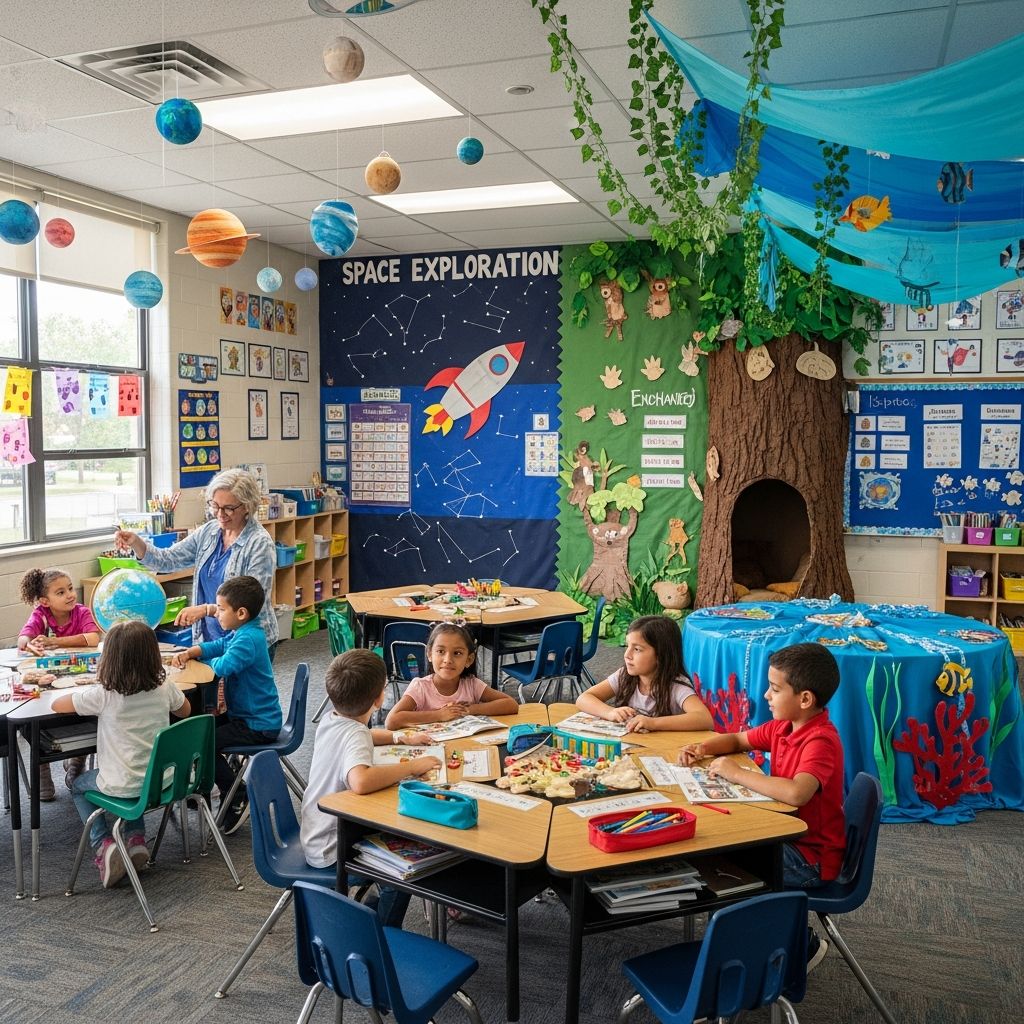
Transforming an elementary classroom into an inspiring hub of discovery begins with thoughtful theming. These creative setups go beyond decoration; they immerse students in worlds that align with curriculum goals, nurture social-emotional growth, and ignite daily enthusiasm for learning. By integrating thematic elements like interactive displays, role-playing zones, and sensory experiences, educators can cultivate environments where young minds flourish.
Why Themes Matter in Early Education
Thematic classrooms serve as powerful tools for engagement. Research shows that visually stimulating, story-driven spaces enhance retention and participation, particularly for children aged 5-10 whose brains thrive on narrative and play. They bridge abstract concepts with tangible experiences, making lessons memorable. For instance, a space-themed room can turn math into planetary calculations, while a jungle adventure makes reading about ecosystems vivid.
Themes also build community. Shared motifs encourage collaboration, as students contribute ideas or artifacts, fostering ownership. According to educational studies, such environments reduce behavioral issues by 20-30% through increased focus and joy. Moreover, they support diverse learners by incorporating multisensory elements, aiding kinesthetic and visual pupils alike.
Space Exploration: Journey to the Stars
Launch young astronauts into cosmic learning with a space exploration theme. Cover walls in starry black with glowing planets and nebulae using glow-in-the-dark paint. Suspend model rockets and satellites from the ceiling for a 3D galaxy effect.
- Reading Corner: A spaceship cockpit with cushions, binoculars, and alien logbooks for storytime voyages.
- Math Station: Orbit charts for graphing planetary distances and rocket fuel fractions.
- Science Lab: DIY telescopes from cardboard and density experiments mimicking zero gravity.
Incorporate daily announcements with ‘Mission Control’ updates, sharing student ‘launches’ like completed projects. This theme ties into STEM standards, encouraging inquiry about astronomy and physics.
Underwater Odyssey: Dive into Discovery
Submerge your class in an underwater odyssey, evoking ocean depths with blue-tinted walls, hanging jellyfish mobiles, and wave projectors. Coral reef murals frame whiteboards, turning lessons into aquatic adventures.
- Writing Nook: Mermaid tails as seats around a ‘lagoon’ table for narrative scripting about sea creatures.
- Art Area: Sponge painting fish and shell mosaics using recycled materials.
- Social Studies: Maps of ocean currents linking to global geography and marine conservation.
Enhance with bubble machines during transitions and ‘diver debriefs’ in morning huddles, highlighting kindness ‘currents’. This setup promotes environmental awareness and fluid group dynamics.
Enchanted Forest: Magical Nature Realm
Step into an enchanted forest where trees crafted from green paper arch over desks, fairy lights twinkle like fireflies, and mossy rugs define cozy reading glades. Animal masks and woodland creature puppets populate shelves.
- Drama Zone: Fairy circle for storytelling circles and puppet shows on folktales.
- Math Grove: Tree ring counters for place value and leaf pattern symmetries.
- Health Lessons: Herb garden simulations teaching nutrition through forest foraging.
Morning rituals include ‘forest whispers’—quick shares of gratitude. This theme nurtures empathy via nature connections, aligning with character education goals.
Superhero Academy: Powers of Learning
Empower students as superheroes in a headquarters-themed room. Comic-strip borders, capes on hooks, and power badge charts adorn the space. Hero emblems mark achievement walls.
- Problem-Solving HQ: Challenge boards with math riddles and logic puzzles.
- PE Power-Up: Obstacle courses mimicking hero training for gross motor skills.
- Vocabulary Vault: Word webs as ‘super spells’ to expand language.
Announce ‘hero spotlights’ daily, celebrating acts of bravery like helping peers. Ideal for building resilience and self-efficacy.
Global Village: Around the World Adventure
Craft a global village with continent murals, flag bunting, and cultural artifact displays. Desks form a ‘world map’ layout, with passports for tracking learning journeys.
- Cultural Kitchen: Recipe cards for international snacks tied to fractions and measurements.
- Language Lodge: Phrase wheels for greetings in multiple tongues.
- History Hut: Timeline tapestries of world events.
Rotate ‘passport stamps’ for mastered skills. This fosters inclusivity and cultural competence.
Implementing Themes Successfully
Start small: Survey students for input to boost buy-in. Budget-friendly materials include dollar-store finds, student artwork, and recycled items. Involve families via ‘theme contribution nights’.
Rotate themes quarterly to maintain freshness, aligning with units. Track impact through journals noting engagement spikes. Maintenance tip: Assign ‘theme guardians’—rotating student roles for upkeep.
| Theme | Core Subjects Boosted | Key Materials | Engagement Activity |
|---|---|---|---|
| Space Exploration | STEM | Glow paint, models | Star quizzes |
| Underwater Odyssey | Science, Art | Blue fabrics, projectors | Bubble challenges |
| Enchanted Forest | ELA, Health | Paper trees, lights | Story circles |
| Superhero Academy | Math, PE | Capes, badges | Hero missions |
| Global Village | Social Studies | Flags, maps | Passport travels |
Enhancing with Dynamic Morning Announcements
Pair themes with tailored announcements for maximum impact. Use recurring segments like ‘Hero Highlights’ or ‘Ocean Observations’ to recap previous days and preview adventures. Incorporate polls, jokes, and trivia for interactivity—e.g., ‘Which planet has the most moons?’ in space weeks.
Student-led delivery builds confidence; rotate anchors weekly. Tech like slideshows with theme graphics keeps it visual.
Frequently Asked Questions (FAQs)
What is the best age for themed classrooms?
Elementary students (K-5) benefit most, as themes match their developmental stage of imaginative play and concrete learning.
How often should themes change?
Every 6-9 weeks to align with grading periods, preventing monotony while allowing deep immersion.
Can themes work in small spaces?
Yes—focus on vertical elements like wall pockets and ceiling hangs to maximize floor space.
Do themes improve test scores?
Studies indicate heightened engagement correlates with better retention and performance in themed settings.
Overcoming Common Challenges
Allergies? Opt for hypoallergenic fabrics. Mess concerns? Use removable adhesives. Parental skepticism? Share photo updates and progress data. Adapt for inclusivity with sensory-friendly options like soft lighting.
Themes evolve: Start with one zone, expand based on feedback. Professional development resources emphasize their role in positive school climate.
References
- Good Morning! A.M. Announcements Build School Community — Education World. 2023-01-15. https://www.educationworld.com/a_admin/admin/admin351.shtml
- 8 Creative Ideas for Recurring Segments to Add to School Morning Announcements — Padcaster. 2024-08-20. https://padcaster.com/blogs/stories/8-creative-ideas-for-recurring-segments-to-add-to-school-morning-announcement
- 10 Fun Morning Announcement Ideas for Schools, Backed by Pedagogical Research — Kapwing Resources. 2024-09-10. https://www.kapwing.com/resources/10-fun-morning-announcement-ideas-for-schools-backed-by-pedagogical-research/
- Morning Announcement Script — Teachers Pay Teachers. 2023-05-12. https://www.teacherspayteachers.com/browse/free?search=morning+announcement+script
- Morning School Wide Announcements and Template — Principal Principles. 2024-02-28. https://principalprinciples.net/morning-school-wide-announcements-and-template/
- Engaging Morning Announcement Ideas for School Leaders — Alpaca. 2024-07-05. https://www.getalpaca.com/resources/engaging-morning-announcement-ideas-for-school-leaders
- Morning Announcements Slides — Teachers Pay Teachers. 2023-11-18. https://www.teacherspayteachers.com/browse/free?search=morning+announcements+slides

- Integrated M.A. in Applied Linguistics, University of Hyderabad
- 5+ years in editorial, instructional, SEO, and research-based writing
Sneha is a relationships and lifestyle writer with a strong foundation in applied linguistics and certified training in relationship coaching. She brings over five years of writing experience to theskillvault, crafting thoughtful, research-driven content that empowers readers to build healthier relationships, boost emotional well-being, and embrace holistic living. Her writing and insights reflect the belief that beauty, happiness, and wellness…