
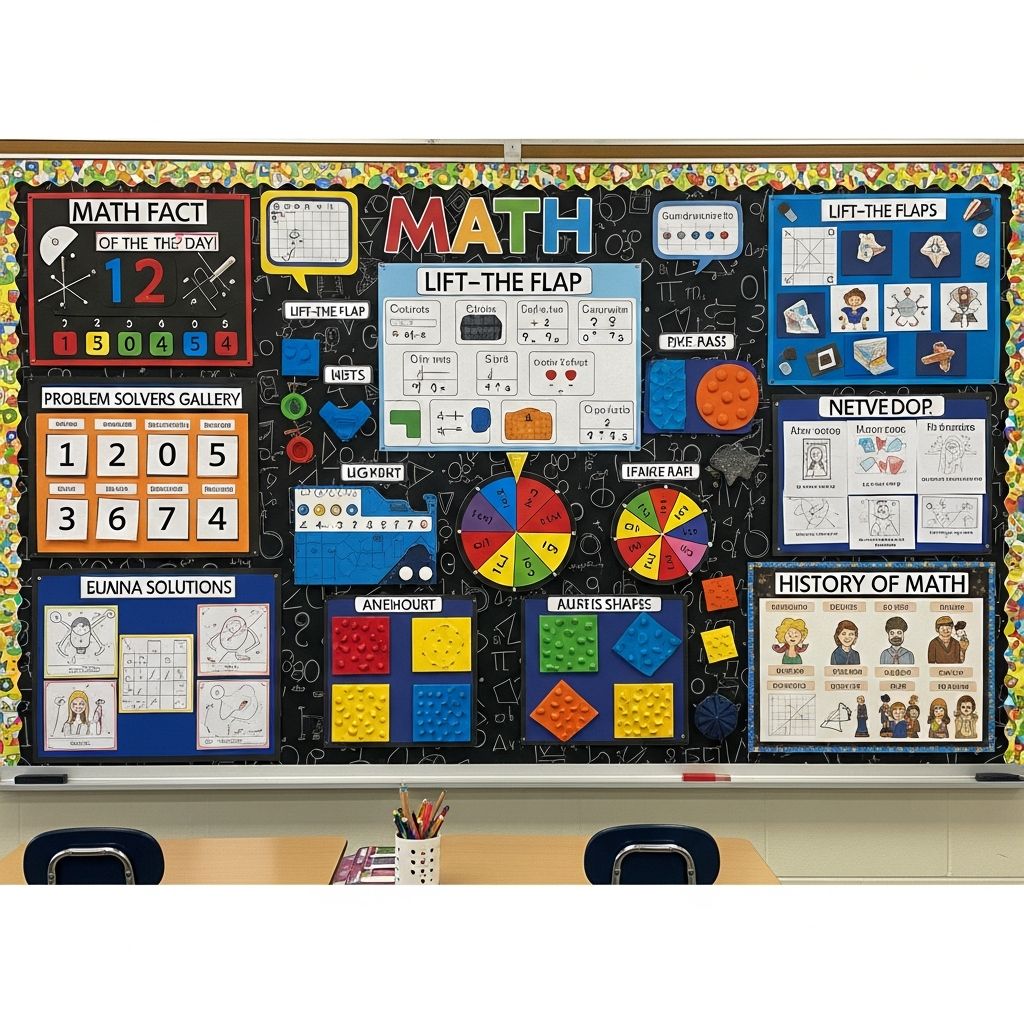
Creating visually appealing and educationally rich bulletin boards in math classrooms can significantly enhance student engagement and retention. These displays serve as constant reminders of key concepts, motivational tools, and interactive learning hubs. By incorporating elements like puzzles, real-life examples, and student work, teachers can turn passive walls into active learning spaces that inspire curiosity and confidence in mathematics.
Building a Foundation with Vocabulary and Concepts
One of the most effective ways to support math learning is through dedicated displays that highlight essential terminology and foundational ideas. A **vocabulary showcase** allows students to quickly reference definitions, synonyms, and visual aids for terms like ‘perimeter,’ ‘variable,’ or ‘hypotenuse.’ Update it seasonally to align with current units, using colorful cards that students can contribute to, fostering ownership.
Complement this with a **concept anchor chart** featuring core formulas or theorems. For instance, display the Pythagorean theorem with a simple proof sketch and historical note on its ancient origins. This not only aids quick recall but also connects math to its cultural roots, making lessons more memorable.
Interactive Elements to Spark Daily Engagement
Static boards lose appeal quickly; interactive features keep students involved. An **expandable number line** spanning the wall lets learners pin numbers, fractions, or decimals in order during lessons. Add magnets for temporary placements, encouraging group activities where students manipulate positions to solve inequalities or plot data points.
- Use Velcro-backed pieces for easy rearrangement without damage.
- Incorporate themes like a ‘galaxy timeline’ for negative numbers in space contexts.
- Extend to include probability lines for events like coin flips or dice rolls.
For geometry enthusiasts, a **shape discovery zone** with cutouts of polygons, circles, and 3D models invites hands-on exploration. Students measure angles, identify symmetry, and match shapes to everyday objects like traffic signs or pizza slices.
Real-World Connections to Make Math Relevant
Students often question math’s practicality; boards bridging classroom concepts to daily life counter this. A **math in action panel** illustrates applications such as calculating discounts during shopping, estimating travel times, or budgeting for events. Include photos of recipes with fraction conversions or sports stats with averages.
Highlight **patterns in the environment**, from Fibonacci sequences in sunflowers to tessellations in floor tiles. Provide blank spaces for students to photograph and label their own discoveries, turning the board into a collaborative gallery.
| Concept | Real-World Example | Activity Idea |
|---|---|---|
| Fractions | Pizza slicing | Draw and label equal shares |
| Geometry | Bridges and arches | Sketch structural shapes |
| Statistics | Weather data | Graph temperature trends |
| Algebra | Shopping budgets | Solve for sale prices |
Challenges and Puzzles for Critical Thinking
Infuse excitement with rotating **brain teasers and riddles**. Post a weekly puzzle, such as ‘How many squares in this grid?’ or logic problems involving sequences. Include solutions on the back of removable flaps, rewarding solvers with stickers or shout-outs.
A **monthly equation spotlight** dives into famous formulas like Euler’s identity (e^{iπ} + 1 = 0), explaining its beauty and uses in engineering. Pair with QR codes linking to short videos for deeper exploration (if tech allows).
Competition boards amplify motivation. Track class progress on **themed progress trackers**, like a thermometer rising with average quiz scores or a racetrack where classes advance based on fact fluency.
Motivational and Growth-Oriented Displays
Positive messaging builds mindset. A **growth goals tracker** lists class targets, such as ‘Master 80% of multiplication facts,’ with progress bars filled by stickers. Individual pockets hold personalized goals, promoting accountability.
Incorporate **inspirational quotes** from mathematicians like ‘Mathematics is the language with which God has written the universe’ – Galileo. Surround with student testimonials on math ‘aha’ moments to normalize struggle and celebrate success.
Tools, History, and Fun Twists
Showcase **historical math artifacts**, from ancient abacuses to modern graphing tools. Label their evolutions and invite students to try replicas during free time.
Humor lightens the mood: A **jokes corner** with gems like ‘Why did the math book look sad? Because it had too many problems!’ rotates weekly, easing test anxiety.
Design Tips for Maximum Impact
To ensure boards captivate:
- Color strategically: Use bold contrasts for headers, pastels for details.
- Refresh often: Bi-weekly updates prevent staleness.
- Student involvement: Assign design roles to build pride.
- Accessibility: Place at eye level, use large fonts.
Budget-friendly materials include recycled cardboard, fabric backgrounds, and printed templates.
Frequently Asked Questions (FAQs)
What are the best themes for elementary math bulletin boards?
Themes like animals with shape patterns or food fractions engage young learners visually and contextually.
How can bulletin boards support diverse learners?
Incorporate visuals, manipulatives, and multilingual labels to aid ELL and special needs students.
Implementing These Ideas Step-by-Step
Start small: Choose one board, gather supplies, involve students in brainstorming. Measure impact via pre/post quizzes or engagement surveys. Scale up as confidence grows, adapting to grade levels—simpler visuals for K-2, complex problems for 6-12.
For middle school, emphasize algebra walls with variable puzzles; high school might feature calculus previews or data analysis graphs. Seasonal ties, like holiday budgeting or summer geometry in architecture, keep relevance high.
Digital hybrids: Pair physical boards with class apps for virtual contributions, extending reach for hybrid learning.
These displays not only decorate but transform culture, proving math is vibrant and essential.
References
- 18 Creative Math Bulletin Board Ideas to Engage Students — SplashLearn. 2023. https://www.splashlearn.com/blog/math-bulletin-board-ideas/
- 6 Engaging Math Bulletin Board Competition Ideas — ExploreLearning Reflex. 2023. https://reflex.explorelearning.com/resources/insights/math-competition-bulletin-board-ideas
- Absolutely Free Math Bulletin Board Printables — Scaffolded Math. 2019-09-01. https://www.scaffoldedmath.com/2019/09/absolutely-free-math-bulletin-board-printables.html
- Math Bulletin Board and Door Ideas — Rise Over Run. 2023. https://www.riseoverrunteacher.com/rise-over-run-blog/math-bulletin-boards
- Free Math Bulletin Board Ideas — Teachers Pay Teachers. 2023. https://www.teacherspayteachers.com/browse/classroom-decor/bulletin-board-ideas/math/free

- Integrated M.A. in Applied Linguistics, University of Hyderabad
- 5+ years in editorial, instructional, SEO, and research-based writing
Sneha is a relationships and lifestyle writer with a strong foundation in applied linguistics and certified training in relationship coaching. She brings over five years of writing experience to theskillvault, crafting thoughtful, research-driven content that empowers readers to build healthier relationships, boost emotional well-being, and embrace holistic living. Her writing and insights reflect the belief that beauty, happiness, and wellness…