
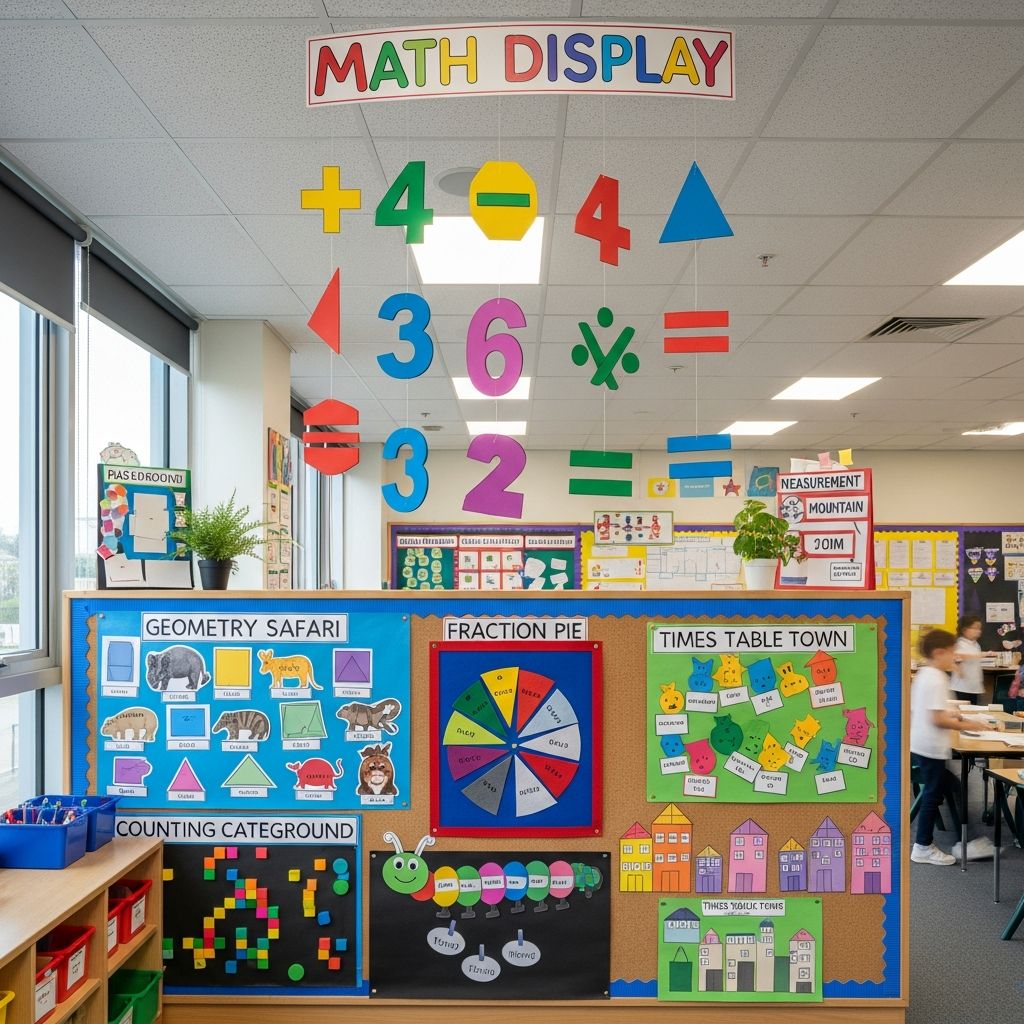
Visual aids play a crucial role in making abstract mathematical concepts accessible and memorable. Bulletin boards serve as dynamic tools that not only decorate the classroom but also actively support instruction by providing constant reinforcement of key ideas. These displays can transform passive learning into interactive experiences, helping students internalize strategies, vocabulary, and procedures at a glance.
Building Foundational Skills Through Visual Reminders
Start with displays that anchor core competencies. For instance, create a vibrant chart outlining step-by-step problem-solving approaches. Divide the board into zones for methods like drawing diagrams, creating tables, working backwards, or eliminating impossible options. Use colorful icons—such as a lightbulb for ‘look for patterns’ or a magnifying glass for ‘identify key information’—to make the board scannable during independent work. This setup encourages students to self-regulate their thinking process, reducing frustration during challenging problems.
Extend this to vocabulary mastery by designing a ‘Math Terms Dictionary’ board. Categorize words by operation: addition (sum, total, altogether), subtraction (difference, minus, remaining), multiplication (product, times, groups of), and division (quotient, per, shared equally). Incorporate student-contributed examples, like ‘8 + 5 = 13 (sum)’ with doodles of apples, turning the display into a collaborative resource that evolves with the class.
Interactive Elements to Boost Participation
Incorporate hands-on components to draw students in. A ‘Math Quest Trail’ board features a winding path with embedded problems on fractions, decimals, or geometry. Solving each correctly advances a class mascot—perhaps a cartoon rocket—toward a goal like ‘Mastery Mountain.’ Award small tokens for contributions, redeemable for privileges, fostering teamwork and persistence.
For multiplication practice, set up an ‘Array Cityscape.’ Students construct buildings from grid paper arrays, where each floor represents factors (e.g., 3×4=12 windows). Assemble into a skyline display, labeling products prominently. This artistic approach demystifies arrays, linking them to real-world patterns like city grids.
- Benefits of interactive boards:
- Increase daily exposure to concepts without direct teaching time.
- Promote peer tutoring as students explain solutions.
- Build confidence through visible progress tracking.
Geometry and Measurement Mastery Displays
Geometry thrives on visuals. Craft ‘Shape Suspect Files’ where each shape gets a mugshot-style poster detailing attributes: vertices, sides, angles, and real-life examples. Students design these, adding fun bounties like ‘Reward: Extra recess for spotting this rhombus!’ The narrative element aids retention over rote memorization.
Address place value with a giant number line expanded into a ‘Value Vault.’ Color-code blocks: millions (gold), thousands (silver), ones (bronze). Include manipulatives like pocket charts for composing/decomposing numbers, allowing daily demos. For advanced learners, add decimals with a treasure map showing tenths as islands and hundredths as coves.
| Concept | Display Idea | Grade Level | Materials Needed |
|---|---|---|---|
| Place Value | Value Vault Number Line | 2nd-5th | Colored paper, pocket charts, number cards |
| Geometry Shapes | Shape Suspect Files | 3rd-6th | Construction paper, markers, string for ‘wanted’ signs |
| Fractions | Pizza Slice Equivalents | 4th-7th | Foam circles, fabric scraps, labels |
Competition and Motivation Boards
Fuel enthusiasm with gamified trackers. A ‘Fluency Thermometer’ monitors class progress in fact mastery. Fill the mercury line as averages rise—red for 0-50%, orange 51-75%, green 76-100%. Personal badges for milestones add individual pride. Tie to themes like ‘Heating Up Math Skills’ for seasonal relevance.
Launch a ‘Peak Performer Peak’ where top scores climb a mountain graph. Categories include quickest problem solvers, highest accuracy, or creative word problem crafters. Rotate weekly spotlights to ensure inclusivity, celebrating diverse strengths like perseverance or explanation clarity.
Seasonal and Themed Transformations
Align displays with holidays or units for freshness. During winter, a ‘Snowflake Symmetry Gallery’ showcases student-drawn symmetric patterns with reflection lines. Spring brings ‘Growth Charts’ graphing plant height data against quadratic models. Back-to-school? ‘Math Mindset Motto Wall’ with quotes like ‘Mistakes are proof you’re trying.’
For algebra intros, a ‘Variable Voyage’ map plots equations as treasure hunts: solve y=2x+3 for points to unlock the chest. Visual proofs for theorems, like Pythagoras via pixel art triangles, make proofs tangible.
Advanced Concepts and Puzzle Zones
Challenge upper grades with a ‘Sudoku Street’ grid. Provide erasable pockets for collaborative solving during transitions. Pair with logic puzzles displayed as ‘Brain Teaser Boulevard,’ rotating weekly to sharpen deduction.
Introduce statistics via ‘Data Dashboards.’ Students input survey results into live-updating bar graphs or pie charts pinned to the board. Discuss trends, like favorite snacks, reinforcing mean, median, mode through class data.
Practical Tips for Lasting Impact
To maximize effectiveness:
- Place boards at eye level, near work areas.
- Refresh quarterly to maintain novelty.
- Involve students in creation for ownership.
- Layer with borders in math motifs like pi symbols or number patterns.
Budget-friendly supplies: recycled cardboard, printed templates, student artwork. Digital twists? QR codes linking to tutorial videos for absent students.
Frequently Asked Questions
What materials work best for durable math boards?
Use laminated cardstock, foam board backing, and push pins over tape for reusability. Fabric pockets hold manipulatives securely.
How often should I update displays?
Bi-monthly aligns with units, preventing visual fatigue while sustaining engagement.
Can these work for diverse learners?
Yes—add tactile elements for kinesthetic learners, color-coding for visual, and audio QR links for auditory support.
Ideas for limited space?
Opt for door hangings, window clings, or magnetic fridge-style boards on metal surfaces.
How to measure display success?
Track referral frequency (e.g., ‘Check the board!’) and pre/post quizzes on featured concepts.
Student Showcase and Growth Mindset
Dedicate space to ‘Math Masters Gallery’ featuring solved challenges, error analyses, and ‘aha!’ moments. Captions like ‘I struggled with division but broke it into steps’ model resilience. Pair with growth prompts: ‘What math power do you want to level up?’
These displays cultivate a culture where math is approachable and exciting. By weaving instruction into the environment, teachers create spaces where learning permeates every glance.
References
- Principles and Standards for School Mathematics — National Council of Teachers of Mathematics. 2000-01-01. https://www.nctm.org/Standards-and-Positions/Principles-and-Standards/Principles-and-Standards-for-School-Mathematics/
- Visual Representations in Mathematics — National Council of Teachers of Mathematics. 2022-05-15. https://www.nctm.org/Publications/Teaching-Children-Mathematics/Blog/Visual-Representations-in-Mathematics/
- Classroom Environment and Student Engagement — U.S. Department of Education, Institute of Education Sciences. 2023-09-12. https://ies.ed.gov/ncee/wwc/Docs/PracticeGuide/wwc_classroomclimate_090513.pdf
- Using Bulletin Boards Effectively — Association for Supervision and Curriculum Development. 2021-11-08. https://www.ascd.org/el/articles/using-bulletin-boards-effectively
- Math Visual Learning Strategies — American Federation of Teachers. 2024-02-20. https://www.aft.org/ae/winter2023-2024/math-visual-learning-strategies

- Integrated M.A. in Applied Linguistics, University of Hyderabad
- 5+ years in editorial, instructional, SEO, and research-based writing
Sneha is a relationships and lifestyle writer with a strong foundation in applied linguistics and certified training in relationship coaching. She brings over five years of writing experience to theskillvault, crafting thoughtful, research-driven content that empowers readers to build healthier relationships, boost emotional well-being, and embrace holistic living. Her writing and insights reflect the belief that beauty, happiness, and wellness…