
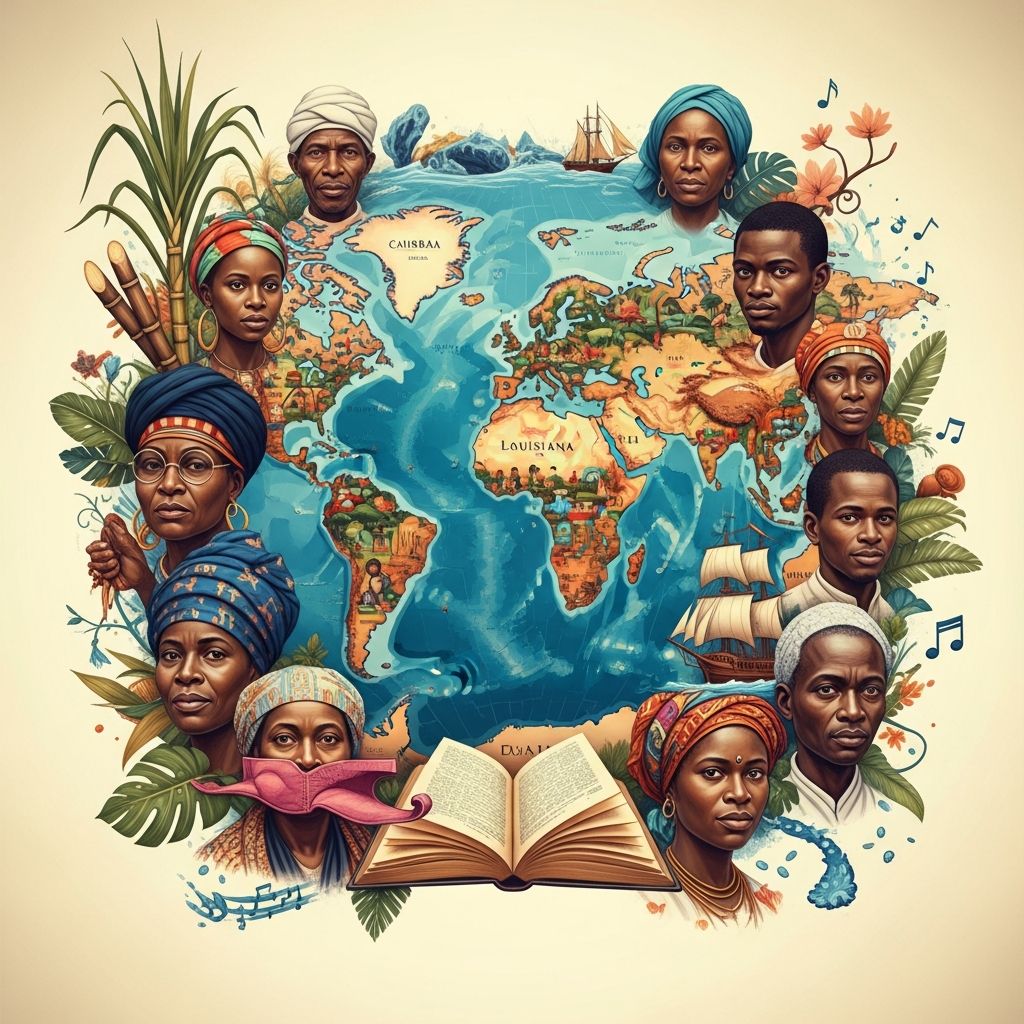
Creole languages represent dynamic products of human interaction, emerging when diverse linguistic groups forge new communication systems under pressure. These tongues arise from pidgins—simplified contact varieties—and mature into stable, native languages with complex grammars and vocabularies.
Foundations in Pidgins: The Starting Point
Pidgins form as rudimentary bridges between speakers of mutually unintelligible languages, often in trade, labor, or colonial settings. Lacking native speakers initially, they feature limited lexicons focused on immediate needs and minimal grammar.
Key traits of pidgins include:
- Reduced vocabulary, primarily from a dominant language.
- Simplified syntax without complex tenses or inflections.
- Gestures and context supplementing verbal elements.
Transition to creole occurs via creolization, where children acquire the pidgin as their first language, expanding it into a full system.
Historical Contexts of Emergence
Most creoles trace to 17th-18th century European colonial plantations along Atlantic and Indian Ocean coasts, involving enslaved Africans, indigenous peoples, and European overseers.
| Region | Dominant Influences | Notable Examples |
|---|---|---|
| Caribbean | French, English, African substrates | Haitian Creole, Jamaican Creole |
| Atlantic Islands | Portuguese, African languages | Cape Verdean Creole |
| Indian Ocean | French, Malagasy, Bantu | Mauritian Creole |
| North America | English, Gullah influences | Gullah, Louisiana Creole |
Exceptions like Brazil avoided creoles due to different social dynamics, while slave depots in Cape Verde fostered them without large plantations.
Linguistic Blueprint of Creoles
Creoles exhibit systematic grammars distinct from parent languages, often streamlining irregularities for efficiency.
Vocabulary Dynamics: Lexicons derive mainly from superstrate (dominant, often European) languages, with 70-90% roots there, but substrates contribute semantics and phonetics. Shifts occur, e.g., French ‘manger’ becomes Haitian ‘manje’.
Grammar Innovations:
- Invariant verb forms without conjugation.
- Preverbal particles for tense/aspect (e.g., ‘ti’ for past in Haitian).
- Serial verb constructions uncommon in European tongues.
- Simplified pronouns and no gender markings.
These features arise not from simplification alone but innate language acquisition processes.
Prominent Creole Languages in Focus
Haitian Creole: A Revolutionary Voice
Spoken by over 10 million, Haitian Creole (Kreyòl Ayisyen) blends French lexicon with West African grammar. Born from 18th-century Saint-Domingue slavery, it fueled Haiti’s 1804 independence.
Example phrases:
- French: ‘Je mange la pomme.’ → Kreyòl: ‘Mwen manje pòm nan.’
- Invariant verbs: ‘Li te vini’ (He was coming).
Jamaican Patois: Vibrant Expression
English-based with African influences, Jamaican Creole thrives in music like reggae. Features include ‘fi’ for possession and habitual ‘does’.
Gullah: African American Legacy
On U.S. Sea Islands, Gullah preserves African retentions in an English matrix, resisting full assimilation.
Papiamento and Others
Portuguese-Dutch hybrid in Aruba/Bonaire/Curaçao, Papiamento exemplifies multilingual substrates.
Creoles vs. Dialects and Mixed Languages
Unlike dialects (regional variants of a standard language), creoles are autonomous with native speakers. Mixed languages like Media Lengua (Quechua-Spanish) differ by balanced fusion, not pidgin origins.
Distinguishing table:
| Feature | Creole | Dialect | Pidgin |
|---|---|---|---|
| Native Speakers | Yes | Yes (of parent) | No |
| Grammar Complexity | Full system | Matches parent | Minimal |
| Origin | Pidgin expansion | Internal variation | Contact simplification |
Sociolinguistic Dimensions
Creoles often face stigma as ‘broken’ versions of colonial languages, yet they embody cultural resistance and identity. Official status grows: Haitian Creole is Haiti’s co-official language; Papua New Guinea recognizes Tok Pisin.
Diglossia prevails where creoles coexist with standard languages, affecting education and media.
Current Status and Future Trajectories
Over 100 creoles exist, many endangered but others expanding via urbanization and digital media. Revitalization efforts include Kouri-Vini documentation in Louisiana.
Globalization introduces English influences, potentially hybridizing creoles further.
Frequently Asked Questions (FAQs)
What defines a creole language?
A creole is a stable, native language evolved from a pidgin through child acquisition, featuring unique grammar and vocabulary from multiple sources.
How do creoles differ from pidgins?
Pidgins lack native speakers and full grammar; creoles expand into complete languages.
Are creoles simpler than other languages?
No, they have complex, systematic rules, often more regular than parent languages.
Which is the most spoken creole?
Haitian Creole, with millions of speakers worldwide.
Can creoles become official languages?
Yes, examples include Haitian Creole and Tok Pisin.
References
- Creole language – Wikipedia — Wikipedia contributors. 2023-10-15. https://en.wikipedia.org/wiki/Creole_language
- Creole languages | History, Characteristics & Examples — Encyclopædia Britannica. 2024-01-20. https://www.britannica.com/topic/creole-languages
- Creole Language | Definition & Examples — Study.com. 2023-11-05. https://study.com/academy/lesson/what-is-creole-language-definition-phrases.html
- What Is a Creole Language? — Lighthouse Translations. 2024-02-12. https://www.lighthouseonline.com/blog-en/what-is-creole-language/
- Creole languages | Research Starters — EBSCO. 2023-09-18. https://www.ebsco.com/research-starters/language-and-linguistics/creole-languages
- Creole Languages – Origins and Common Features — PoliLingua. 2023-12-01. https://www.polilingua.com/blog/post/creole-languages-origins-features.htm

Medha Deb is an editor with a master's degree in Applied Linguistics from the University of Hyderabad. She believes that her qualification has helped her develop a deep understanding of language and its application in various contexts. Medha specializes in the areas of beauty, health, sports, and wellness and is committed to ensuring that the content on the website is…