
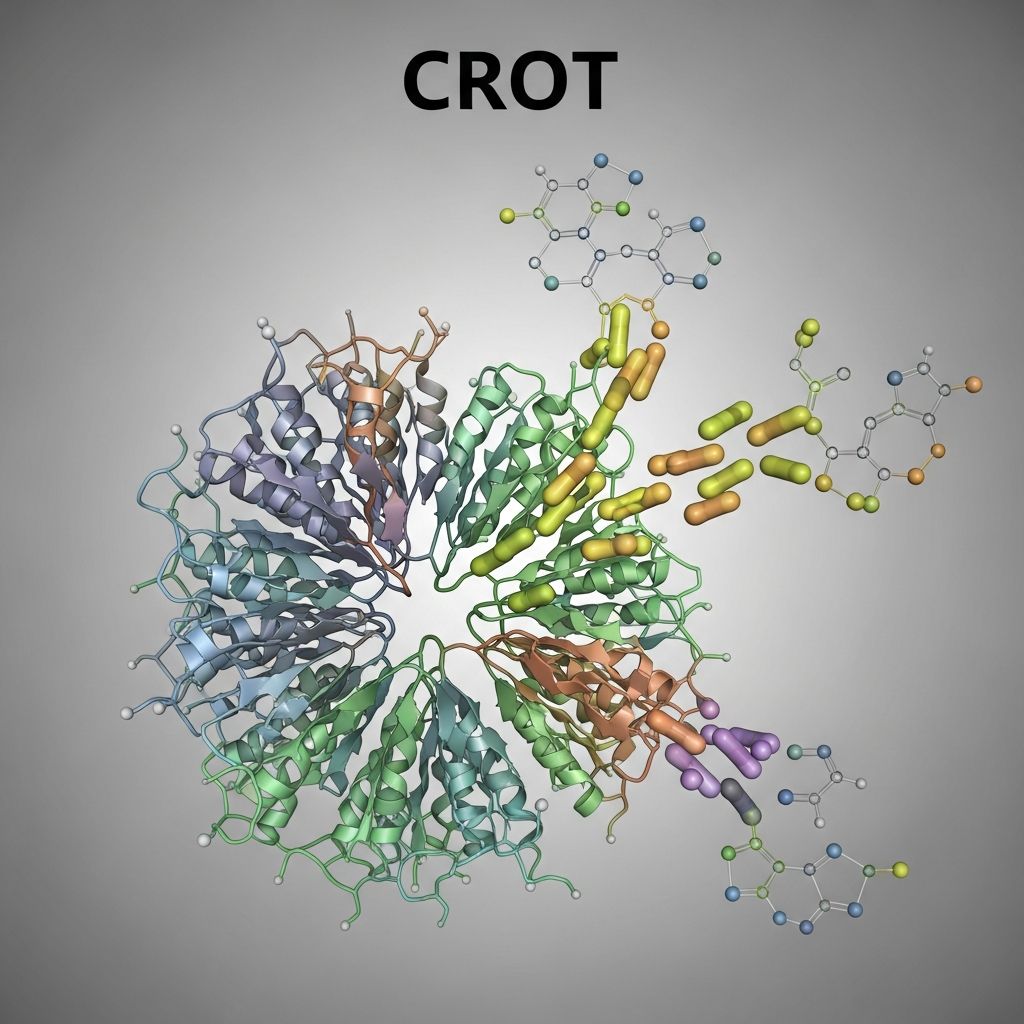
The enzyme known as Carnitine O-Octanoyltransferase, encoded by the CROT gene, serves as a critical component in cellular lipid metabolism. Located primarily in peroxisomes, CROT facilitates the conversion of specific acyl-CoA molecules into their carnitine esters, enabling the transport of medium- and long-chain fatty acids from peroxisomes to mitochondria for complete beta-oxidation. This process is essential for maintaining energy homeostasis and preventing lipid accumulation in cells.
Understanding the Molecular Basics of CROT
CROT belongs to the carnitine/choline acetyltransferase family of enzymes. It specifically acts on substrates like 4,8-dimethylnonanoyl-CoA, transforming it into the corresponding carnitine ester through transesterification. This reaction occurs exclusively in the peroxisome, a cellular organelle specialized for breaking down very long-chain fatty acids (VLCFAs) that cannot be processed by mitochondria alone.
The human CROT gene is identified by several standard identifiers: HGNC: 2366, NCBI Gene: 54677, Ensembl: ENSG00000005469, OMIM: 606090, and UniProtKB/Swiss-Prot: Q9UKG9. Its protein product, often abbreviated as OCTC or OCTC_HUMAN, exhibits peak activity on fatty acids with chain lengths from C6 to C10. This specificity underscores its role in handling the byproducts of pristanic acid beta-oxidation, a branched-chain fatty acid derivative.
Gene ontology annotations link CROT to functions such as signaling receptor binding and carnitine O-octanoyltransferase activity. It participates in pathways including peroxisomal lipid metabolism and general metabolism, with a notable paralog being CRAT (carnitine O-acetyltransferase), which shares evolutionary and functional similarities.
Peroxisomal Role in Fatty Acid Breakdown
Peroxisomes initiate the beta-oxidation of VLCFAs, shortening them into medium-chain acyl-CoAs. However, these products cannot directly enter mitochondria due to the impermeability of mitochondrial membranes to acyl-CoAs. CROT bridges this gap by catalyzing the reversible transfer of acyl groups from CoA to L-carnitine, forming acyl-carnitines that can shuttle across cellular compartments to the cytosol and then mitochondria for final oxidation.
This peroxisome-to-mitochondria handoff is vital for complete fatty acid catabolism. Without CROT, medium-chain products would accumulate in peroxisomes, disrupting lipid flux and potentially leading to toxic buildup. Studies in gene databases confirm that CROT’s activity regulates the breakdown of VLCFAs, ensuring efficient energy production from lipids.
- Key Substrates: 4,8-Dimethylnonanoyl-CoA (primary), medium-chain acyl-CoAs (C6-C10).
- Location: Peroxisomal matrix.
- Reaction Type: Reversible transesterification: Acyl-CoA + L-Carnitine ⇌ Acyl-Carnitine + CoASH.
- Outcome: Export of oxidation intermediates for mitochondrial beta-oxidation.
Gene Expression and Regulatory Mechanisms
Expression of the CROT gene is dynamically regulated, particularly by microRNAs such as the miR-33 family and its passenger strand miR-33*. These non-coding RNAs repress CROT translation, thereby limiting fatty acid degradation and helping maintain lipid balance across cell types. This regulatory circuit prevents excessive lipid breakdown, which could otherwise deplete cellular energy stores during fasting or stress.
Alternative splicing produces multiple transcript variants, adding layers of complexity to CROT function. In various tissues, CROT levels fluctuate in response to nutritional status, hormonal signals, and metabolic demands. For instance, during high-fat diets, upregulation of CROT supports increased peroxisomal activity to handle lipid overload.
Links to Human Diseases and Pathophysiology
Dysfunction in CROT has been associated with several metabolic disorders. Diseases linked to CROT include Refsum Disease (classic), Adrenoleukodystrophy, and Abdominal Obesity-Metabolic Syndrome 1. These conditions often feature impaired peroxisomal function, leading to VLCFA accumulation, neurodegeneration, and metabolic dysregulation.
Recent research highlights CROT’s unexpected role beyond lipid metabolism. In vascular smooth muscle cells, CROT expression increases during osteogenic differentiation, promoting vascular calcification—a key feature of atherosclerosis and chronic kidney disease. Proteomics studies identified CROT in pathways related to peroxisomes and lipid metabolism that drive this pathological mineralization.
Mouse models with CROT deficiency (Crot−/− and Crot+/−) reveal intriguing metabolic shifts. Liver and plasma metabolomics show elevated levels of omega-3 fatty acids like EPA, DPA, and DHA, alongside anti-inflammatory dicarboxylic acids such as tetradecanedioic acid and azelaic acid. These changes suggest that CROT suppression could confer protective effects against calcification, potentially through enhanced anti-inflammatory lipid profiles.
| Condition | CROT Implication | Key Metabolite Changes (in Knockouts) |
|---|---|---|
| Adrenoleukodystrophy | Peroxisomal dysfunction | VLCFA accumulation |
| Vascular Calcification | Promotes osteogenic shift | Increased omega-3s (EPA, DHA) |
| Metabolic Syndrome | Lipid homeostasis disruption | Anti-inflammatory dicarboxylic acids |
Experimental Insights from Knockout Models
In Ldlr−/− mice (a model of dyslipidemia), CROT knockout studies provide deeper understanding. Genetic deletion leads to higher hepatic omega-3 fatty acids, which are known for their cardioprotective properties. Plasma analyses confirm elevated EPA in Crot−/− mice, alongside dicarboxylic acids that dampen inflammation. These findings position CROT inhibition as a therapeutic strategy for calcification-prone conditions.
Metabolite profiling identified 79–453 liver metabolites and 117–424 plasma metabolites differing between genotypes. Differential abundance analysis pinpointed omega-3 enrichment as a hallmark of CROT deficiency, suggesting its use as a biomarker for targeted therapies.
Broader Implications for Metabolic Health
CROT’s integration into peroxisomal lipid metabolism extends to whole-body energy regulation. By facilitating fatty acid export, it supports ketogenesis during fasting and prevents steatosis in the liver. Dysregulation contributes to non-alcoholic fatty liver disease (NAFLD) and insulin resistance, where peroxisomal overload impairs mitochondrial fuel supply.
Therapeutically, modulating CROT activity holds promise. miR-33 inhibitors could boost CROT expression to enhance lipid clearance in obesity. Conversely, in calcification models, CROT knockdown mimics show anti-calcific benefits, opening avenues for omega-3 supplementation or direct enzyme inhibitors.
Technological and Research Advances
Genomic tools like GeneCards and Harmonizome have mapped CROT’s interactome, revealing connections to peroxisomal biogenesis factors (e.g., PEX proteins) and beta-oxidation enzymes. Single-cell RNA sequencing further shows tissue-specific expression, highest in liver, kidney, and heart—organs with high lipid flux.
Structural studies of CROT, leveraging UniProt data, depict a classic transferase fold with carnitine-binding domains. This informs drug design, targeting the active site to modulate substrate specificity.
Frequently Asked Questions (FAQs)
What is the primary function of the CROT enzyme?
CROT catalyzes the formation of acyl-carnitines from medium-chain acyl-CoAs in peroxisomes, enabling their transport to mitochondria for beta-oxidation.
Which diseases are associated with CROT gene mutations?
Conditions like Adrenoleukodystrophy, Refsum Disease, and Abdominal Obesity-Metabolic Syndrome 1 involve CROT-related peroxisomal defects.
How does CROT deficiency affect lipid profiles?
Knockout models exhibit elevated omega-3 fatty acids (EPA, DHA) and anti-inflammatory dicarboxylic acids in liver and plasma.
Is CROT regulated by microRNAs?
Yes, miR-33 and miR-33* repress CROT translation to control fatty acid degradation and lipid balance.
Can CROT influence vascular health?
CROT promotes vascular calcification in smooth muscle cells; its suppression shows protective anti-calcific effects.
Future Directions in CROT Research
Emerging studies aim to dissect CROT’s role in cancer metabolism, where peroxisomal lipids fuel proliferation. Clinical trials targeting CROT-miR-33 axis could address NAFLD and cardiovascular risks. As biomarker potential grows, omega-3 profiling may guide personalized interventions.
In summary, CROT stands at the crossroads of peroxisomal and mitochondrial metabolism, with far-reaching impacts on health. Ongoing research will likely uncover more about its therapeutic modulation.
References
- CROT Gene – GeneCards | OCTC Protein | OCTC Antibody — GeneCards. Accessed 2026. https://www.genecards.org/cgi-bin/carddisp.pl?gene=CROT
- CROT Gene – Ma’ayan Lab – Computational Systems Biology — Ma’ayan Laboratory. Accessed 2026. https://maayanlab.cloud/Harmonizome/gene/CROT
- CROT (gene) – Wikipedia — Wikipedia (informational, primary sources referenced). Accessed 2026. https://en.wikipedia.org/wiki/CROT_(gene)
- Carnitine O-octanoyltransferase (CROT) deficiency in mice leads to… — PMC / NIH. 2024. https://pmc.ncbi.nlm.nih.gov/articles/PMC11284101/

- Integrated M.A. in Applied Linguistics, University of Hyderabad
- 5+ years in editorial, instructional, SEO, and research-based writing
Sneha is a relationships and lifestyle writer with a strong foundation in applied linguistics and certified training in relationship coaching. She brings over five years of writing experience to theskillvault, crafting thoughtful, research-driven content that empowers readers to build healthier relationships, boost emotional well-being, and embrace holistic living. Her writing and insights reflect the belief that beauty, happiness, and wellness…