
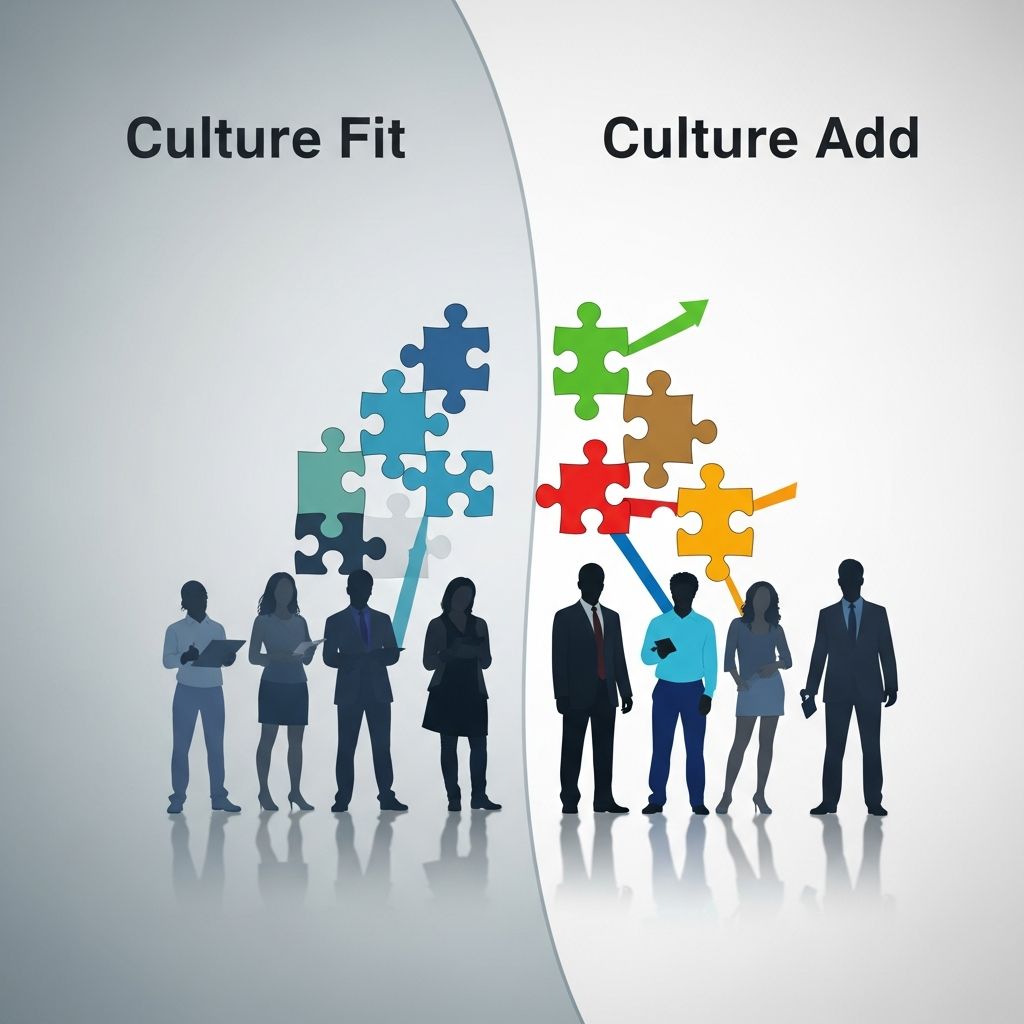
Hiring solely for culture fit once sounded like the gold standard. Today, more organizations and job seekers are shifting their focus to culture add—looking for what new people can contribute, not just how well they blend in.
This shift is not just a trend. It reflects deeper research on diversity, innovation, and organizational performance, showing that teams benefit when they intentionally add new perspectives instead of reproducing the same profile repeatedly.
What Do We Really Mean by Culture?
Before comparing culture fit and culture add, it helps to clarify what workplace culture is. In management research, culture is often described as the shared values, norms, and behaviors that shape “how things get done around here.”
- Values: The principles that guide decisions (for example, transparency, learning, customer focus).
- Norms: Unwritten rules about behavior (how people communicate, respond to conflict, or handle mistakes).
- Practices: The everyday routines, rituals, and systems (meeting style, feedback habits, recognition).
Culture influences who is hired, who is promoted, whose ideas are heard, and who feels safe to contribute—making it central to both organizational results and individual career growth.
Defining Culture Fit and Culture Add
| Aspect | Culture Fit | Culture Add |
|---|---|---|
| Core idea | Candidate aligns closely with the organization’s existing norms and style. | Candidate brings something new that enriches and stretches the culture while still aligning with core values. |
| Main focus | Similarity and smooth integration. | Differentiation and constructive tension. |
| Primary goal | Maintain harmony and reduce friction. | Increase innovation, adaptability, and inclusion. |
| Risk if misused | Homogeneity and bias toward people “like us.” | Potential short-term friction and integration challenges. |
What Is Culture Fit?
Culture fit typically refers to how well a candidate matches an organization’s current style, behaviors, and norms. In practice, this often shows up as hiring people who feel familiar—who think, talk, and work like the existing team.
The original goal of culture fit was not necessarily exclusion; it was to ensure alignment with shared values, which research shows does matter for commitment and performance. However, when fit is defined vaguely or socially (“someone I’d want to grab a drink with”), it can reinforce bias and reduce diversity of thought.
What Is Culture Add?
Culture add is a more intentional lens: it asks how a candidate will expand and strengthen the culture, not just blend into it. The emphasis shifts from likeness to complementarity—shared core values, but different perspectives, skills, and lived experiences.
- Candidates are evaluated on how they might challenge assumptions constructively.
- Teams intentionally look for gaps in experience, background, or thinking style.
- Hiring decisions balance value alignment with diversity in how work is approached.
Industry groups like SHRM and many HR practitioners now recommend shifting from “culture fit” to a more inclusive, additive approach that supports diversity, equity, and innovation.
Why Organizations Are Moving Toward Culture Add
Research on diverse teams and inclusive cultures shows measurable benefits:
- Companies with higher gender and ethnic diversity in leadership are more likely to outperform financially, according to large cross-industry analyses.
- Inclusive cultures foster psychological safety, which is strongly associated with learning behavior, error reporting, and innovation.
When “fit” is interpreted as “similarity,” organizations unintentionally narrow the range of voices at the table. Culture add pushes hiring teams to ask, “What perspective or experience do we not yet have—but need?”
Key Advantages of Hiring for Culture Add
- Greater diversity of thought: Seeking people who see problems differently helps avoid groupthink and leads to more creative solutions.
- Better problem solving: Teams with varied backgrounds and cognitive styles tend to outperform more homogenous groups on complex tasks.
- Stronger adaptability: Organizations with multiple perspectives are better equipped to respond to new markets, technologies, and customer needs.
- Improved inclusion: When “adding” is valued, people from underrepresented groups are less likely to feel pressure to assimilate or downplay their identities.
Risks of Misusing Culture Fit
Culture fit is not inherently negative. Evaluating values alignment can prevent toxic behavior and protect an ethical baseline. The challenge is that the term is often used loosely, masking subjective preferences.
Common pitfalls include:
- Similarity bias: Favoring candidates who look, talk, or have backgrounds similar to existing leaders, rather than those best suited for the role.
- Unclear criteria: Interviewers use gut feelings (“they just didn’t feel like a fit”) instead of explicit, behavior-based assessments.
- Penalizing difference: Treating different communication styles, work rhythms, or problem-solving approaches as “poor fit” even when they are compatible with the job.
These patterns can reduce diversity and reinforce systemic barriers for candidates from marginalized groups, which is why many experts encourage reframing culture from “fit” to “contribution.”
For Employers: How to Hire for Culture Add Without Losing Alignment
Organizations do not have to choose between cultural alignment and diversity. The goal is to protect core values while inviting diverse ways of living those values.
1. Clarify Your Non-Negotiable Values
Start by defining which values are essential to your mission and ethical standards, then translate them into observable behaviors. For example:
- Value: Accountability
- Behavioral examples: owns mistakes, follows through on commitments, documents decisions.
This prevents interviewers from confusing social similarity (same hobbies, alma mater, or personality) with genuine value alignment.
2. Identify Where You Need Cultural Additions
Map out your current team’s strengths and blind spots:
- Do you have many big-picture thinkers but few people who love detail and process?
- Are most leaders from a single industry, region, or educational background?
- Is communication dominated by one style—highly extroverted, highly direct, or highly cautious?
Then define what a “culture add” would look like for this role: perhaps someone from a different sector, a different demographic group, or someone who brings a new working style that complements the current mix.
3. Use Structured, Behavior-Based Interviews
Structured interviews—where each candidate receives the same, clearly defined questions—are more predictive of job performance and help reduce bias.
- Ask candidates to describe times they challenged the status quo constructively.
- Probe how they have contributed to improving a team’s collaboration, inclusion, or learning.
- Evaluate responses against a rubric tied to values and culture-add criteria, not personal intuition.
4. Involve Diverse Interviewers
When possible, include interviewers with different identities, functions, and tenures. Diverse panels are more likely to notice how a candidate might complement the broader organization, not just one team’s preferences.
5. Communicate That You Value Culture Add
Employer branding, job postings, and interview conversations should explicitly state that the organization:
- Values different viewpoints and experiences.
- Welcomes constructive challenge.
- Sees culture as evolving, not fixed.
This signals to candidates—especially those from underrepresented backgrounds—that they are not expected to simply blend in but to contribute meaningfully.
For Candidates: How to Position Yourself as a Culture Add
You can use the culture add mindset to evaluate potential employers and to present your strengths more effectively.
1. Research the Existing Culture
Gather clues from:
- Official materials: company values, mission statements, annual reports.
- Public interviews or talks from leaders.
- Employee reviews and networking conversations (treat these as data points, not absolute truth).
Look for recurring themes in how they describe collaboration, decision-making, risk-taking, and learning.
2. Map Your Own Values and Work Style
Clarify where you thrive and what you bring:
- What values matter most to you (e.g., impact, fairness, autonomy, growth)?
- How do you prefer to work (structured vs. flexible, solo vs. collaborative)?
- What unique experiences shape how you approach problems (industry shifts, career pivots, cross-cultural exposure)?
Being specific about your own cultural contribution makes it easier to assess whether a company is a healthy environment for you.
3. Connect the Dots Between You and the Organization
In applications and interviews, go beyond saying you are a “fit.” Instead, highlight:
- Shared values: “Your focus on continuous learning resonates with how I’ve built my career…”
- Unique contributions: “…and I’d add experience navigating change in highly regulated environments, which could help as you scale.”
Prepare examples that show how you have:
- Introduced a new idea or process that benefited the team.
- Bridged gaps between different departments, cultures, or perspectives.
- Helped make a group more inclusive or collaborative.
4. Ask Questions That Reveal Culture Add Readiness
During interviews, you can gauge whether the organization truly values culture add by asking:
- “Can you share a time when someone new changed how the team worked—for the better?”
- “How do you handle disagreements or pushback on established processes?”
- “What perspectives or skills are you hoping this role will add that you don’t already have?”
Listen for concrete examples rather than generic answers. Specific stories often indicate a genuinely evolving culture.
Balancing Stability and Change
Healthy organizations balance two forces:
- Stability: A shared foundation of values and expectations that create trust and predictability.
- Change: A steady flow of new ideas, people, and practices that keep the culture responsive and relevant.
Culture fit, when narrowly defined, overemphasizes stability. Culture add, when practiced thoughtfully, protects the foundation while keeping the organization open to transformation.
Frequently Asked Questions (FAQs)
Q: Is culture add always better than culture fit?
A: Neither concept is inherently better. Evaluating values alignment (a healthy side of culture fit) prevents harmful behavior, while emphasizing culture add helps avoid sameness and supports diversity and innovation. The most effective approach blends both: shared core values, plus complementary perspectives and skills.
Q: Can hiring for culture add create more conflict?
A: Yes, adding different perspectives can initially increase friction. However, when teams have clear values, psychological safety, and good conflict resolution norms, this tension tends to be productive, leading to better decisions and more robust solutions.
Q: How can small teams use culture add when they need fast alignment?
A: Small teams often need quick coordination, so alignment on mission and work ethic is critical. They can still apply culture add by intentionally bringing in complementary skills and backgrounds—such as someone with stronger process focus or different market knowledge—while keeping values non-negotiable.
Q: How do I know if I am a culture add for a company?
A: You are likely a culture add when you both share the organization’s core values and can clearly articulate specific ways you would expand its capabilities, perspectives, or practices—such as by bringing experience from a different sector, lived experience with a new customer segment, or a different way of approaching collaboration.
Q: What if a company still talks only about “culture fit” in interviews?
A: Many organizations still use the term “fit” even as they evolve their practices. Pay attention to how they define it. If interviewers talk about clear values and behavior-based expectations, that can be positive. If “fit” sounds like social similarity or personal comfort, it may signal a less inclusive environment.
References
- Culture Fit vs. Culture Add — Society for Human Resource Management (SHRM). 2022-05-10. https://www.shrm.org/topics-tools/tools/express-requests/culture-fit-vs-culture-add
- Culture Fit vs Culture Add: Which is Best for Your Business? — Factorial HR. 2023-04-21. https://factorialhr.com/blog/culture-fit-vs-culture-add/
- What Is Culture Add? Definition & Examples — AIHR. 2023-08-15. https://www.aihr.com/hr-glossary/culture-add/
- Culture Add vs. Culture Fit: Why Culture Add is the New Way Forward — TestGorilla. 2023-01-12. https://www.testgorilla.com/blog/culture-add-vs-culture-fit/
- Understanding the Difference Between Culture Add and Culture Fit — MLee Healthcare. 2022-09-19. https://mlee.com/making-the-difference-understanding-the-difference-between-culture-add-and-culture-fit

Medha Deb is an editor with a master's degree in Applied Linguistics from the University of Hyderabad. She believes that her qualification has helped her develop a deep understanding of language and its application in various contexts. Medha specializes in the areas of beauty, health, sports, and wellness and is committed to ensuring that the content on the website is…