
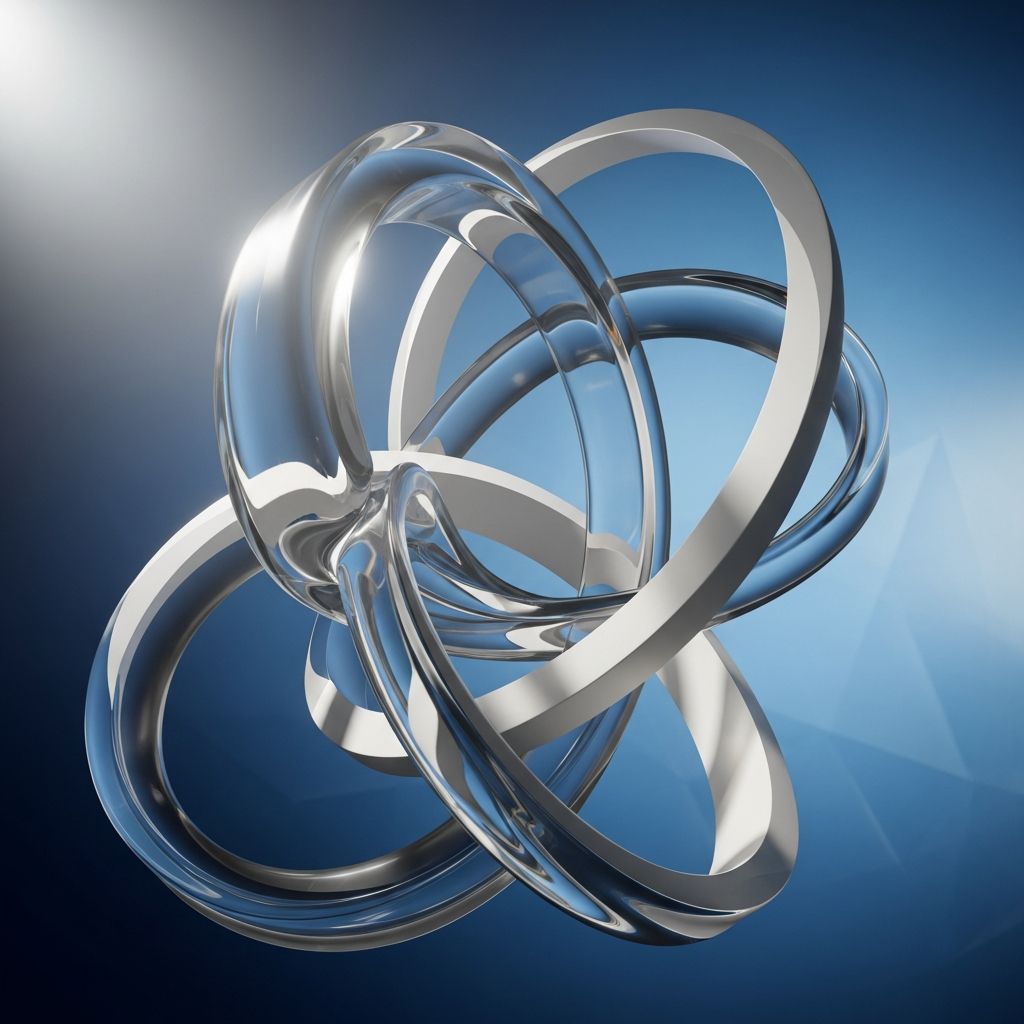
Curved shapes form the backbone of many geometric concepts, distinguishing themselves from straight-edged polygons by their smooth, flowing lines. These forms appear everywhere, from everyday objects like balls and cans to intricate natural patterns such as shells and galaxies. Understanding curved shapes enhances problem-solving in mathematics, engineering, and design, offering insights into volume, surface area, and spatial relationships.
Defining Curved Shapes: From 2D to 3D
A curved shape deviates from straight lines, creating smooth transitions without sharp corners. In two dimensions, curves include circles, ellipses, and parabolas, while three-dimensional versions extend to spheres, cylinders, and cones. Unlike flat surfaces on cubes or prisms, curved surfaces wrap around, providing uniformity or tapered forms.
Simple curves do not intersect themselves, and closed simple curves return to their starting point, enclosing an area. Polygons, though closed curves, use straight lines exclusively, setting them apart from true curved shapes like ovals or arcs.
Fundamental Curved Solids and Their Features
Common 3D curved shapes combine smooth surfaces with flat bases or exist entirely curved. Spheres represent the purest form, with every point equidistant from the center, featuring no edges or vertices.
- Sphere: Completely curved, like a basketball. Total surface area: \(4\pi r^2\), where \(r\) is the radius.
- Cylinder: Two flat circular bases connected by a curved lateral surface, as in a soda can. Lateral surface area: \(2\pi rh\), with \(h\) as height.
- Cone: Single flat base tapering to a point via a curved surface, resembling an ice cream cone. Lateral surface area: \(\pi rl\), where \(l\) is slant height.
- Hemisphere: Half-sphere with one flat circular face and one curved dome.
These shapes often blend flat and curved elements, unlike polyhedra, which rely solely on planes.
Advanced Curved Forms: Spirals and Cycloids
Beyond basics, logarithmic spirals captivate with self-similarity, appearing in nautilus shells and sunflowers. Each segment mirrors others at a constant angle, enabling endless growth without distortion.
Cycloids trace a point on a rolling circle’s rim, producing arcs and cusps. Variants include prolate (extended) and curtate (shortened) forms, visible in bicycle reflectors at night.
Epicycloids and hypocycloids arise from one circle rolling around another. A cardioid (heart-shaped) forms when radii match, while a 4:1 ratio yields the star-like astroid.
| Curve Type | Generation Method | Key Property | Example |
|---|---|---|---|
| Logarithmic Spiral | Equiangular growth | Self-similar sectors | Nautilus shell |
| Cycloid | Circle rolling on line | Arcs with cusps | Bicycle wheel path |
| Epicycloid (Cardioid) | Equal radii rolling | Heart shape | Perimeter 16R |
| Hypocycloid (Astroid) | 4:1 ratio inside roll | Star with 6R perimeter | Ladder envelope |
Curved Surfaces vs. Flat Surfaces: Key Distinctions
Flat surfaces lie on a single plane, like cube faces, while curved ones bend continuously. Spheres have uniform curvature; cylinders curve in one direction only.
Edges typically absent on pure curves, though cylinders and cones form circular edges where curves meet flats. Complex shapes like ellipsoids vary curvature across sections, mimicking eggs.
Real-World Applications of Curved Geometry
Curved shapes optimize designs in nature and technology. Domes and arches distribute weight efficiently; spheres minimize surface for volume, ideal for bubbles or planets.
In engineering, cylinders power engines, converting linear to rotational motion via pistons. Cycloids influenced early steam engine mechanisms for smooth motion conversion.
Nature favors curves: horns spiral logarithmically for strength; seeds pack via spirals for efficiency.
Calculating Properties of Curved Shapes
Measuring curved surfaces demands specific formulas. For spheres, surface area is \(4\pi r^2\); volume \( \frac{4}{3}\pi r^3 \).
Cylinders: total surface \(2\pi r(h + r)\); volume \(\pi r^2 h\). Cones mirror this with tapered dimensions.
Advanced curves like cycloids have perimeters independent of \(\pi\) in some cases, simplifying computations.
Visualizing and Identifying Curved Shapes
Distinguish by touch or sight: roll a sphere freely; a cylinder rolls linearly. In diagrams, count flat faces versus smooth wraps.
2D precursors include ovals (elongated circles), ellipses (oval-like with foci), and arcs (curve segments).
Challenges and Common Misconceptions
Many confuse cylinders as fully curved, overlooking flat ends. Spheres aren’t ’round cylinders’—they lack flats entirely.
Measuring requires unwrapping mentally: cylinder nets form rectangles; cones become sectors.
Curved Shapes in Art and Nature
Artists like M.C. Escher exploited spirals for impossible geometries. Nature’s logarithmic spirals ensure proportional growth, from galaxies to romanesco broccoli.
FAQs on Curved Shapes
What shapes have only curved surfaces?
Spheres, ellipsoids, tori, paraboloids, and hyperboloids feature purely curved exteriors without flats.
Do all curved shapes lack edges?
Pure curves like spheres have none, but hybrids like cones form edges where curves join bases.
How do curved surfaces appear in daily life?
Balloons (spherical), cans (cylindrical), party hats (conical), and rounded cups showcase them.
What’s the difference between a curve and a polygon?
Curves are smooth; polygons use straight segments, even if closed.
Can curved shapes be 2D?
Yes, circles, ellipses, and parabolas are 2D curved shapes.
References
- Which shapes have curved surfaces? — Answers.com. Accessed 2026. https://math.answers.com/geometry/Which_shapes_have_curved_surfaces
- Twisted Math and Beautiful Geometry — American Scientist. Accessed 2026. https://www.americanscientist.org/article/twisted-math-and-beautiful-geometry
- Flat and Curved Surface – Differences and Characteristics — Eduseed.in. Accessed 2026. https://eduseed.in/math/flat-and-curved-surface/
- What Is a Curve? Definition, Types, Shapes, Examples, Facts — SplashLearn. Accessed 2026. https://www.splashlearn.com/math-vocabulary/geometry/curve
- Simple Curves and Surfaces — OpenWA Pressbooks. Accessed 2026. https://openwa.pressbooks.pub/math132/chapter/simple-curves-and-surfaces/

Medha Deb is an editor with a master's degree in Applied Linguistics from the University of Hyderabad. She believes that her qualification has helped her develop a deep understanding of language and its application in various contexts. Medha specializes in the areas of beauty, health, sports, and wellness and is committed to ensuring that the content on the website is…