
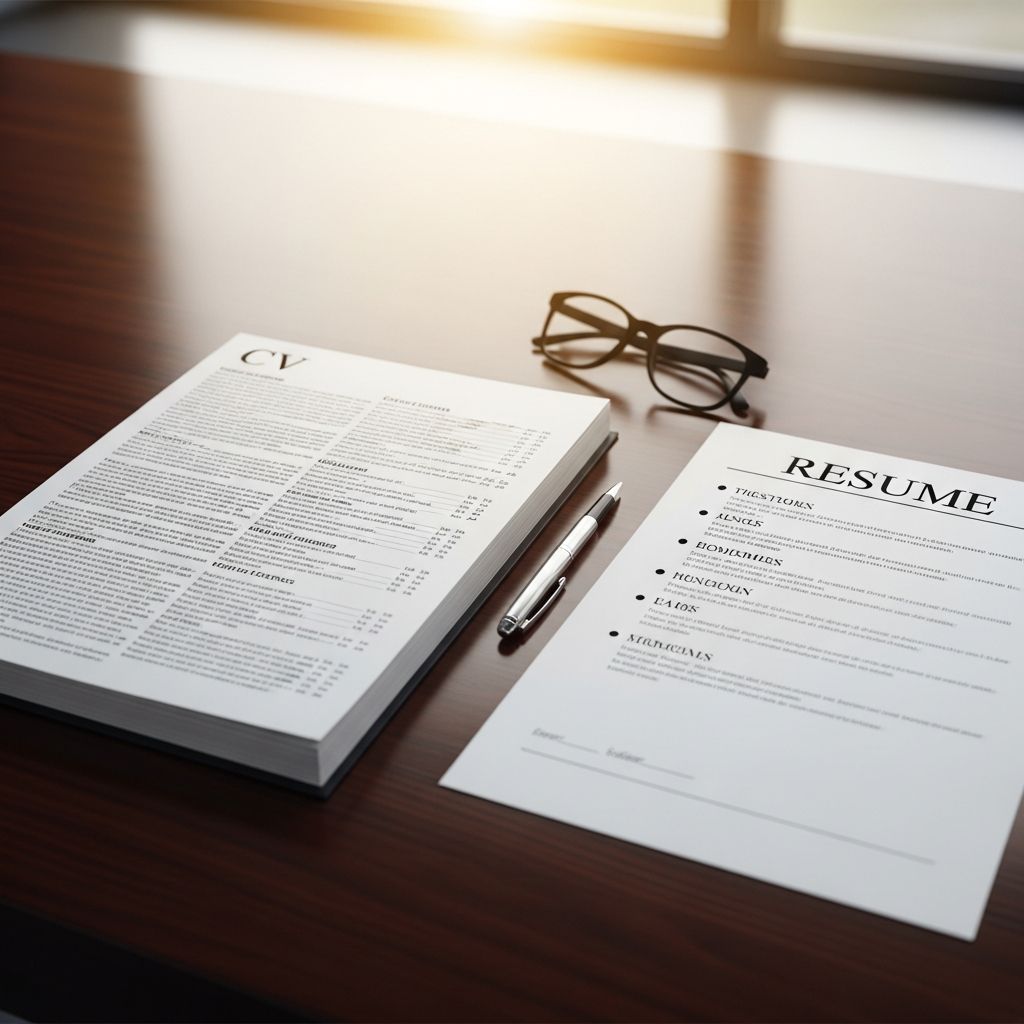
If you are applying for jobs, graduate school, or academic roles, you have probably encountered the terms CV and resume. They both summarize your background for decision-makers, but they are not interchangeable. Knowing which document to use, and how to build it, can be the difference between getting noticed and getting overlooked.
This guide explains, in clear language, how CVs and resumes differ, when to use each one, and how to adapt your document for different careers and countries.
Big Picture: How CVs and Resumes Differ
Both documents describe your qualifications, but they serve different purposes and follow different conventions.
| Aspect | CV (Curriculum Vitae) | Resume |
|---|---|---|
| Primary focus | Full record of academic and professional history, often with emphasis on research, teaching, and scholarly work. | Targeted summary of experience and skills relevant to a specific job. |
| Typical length | As long as needed; can run several pages for experienced candidates. | Usually 1 page; up to 2 pages for those with substantial experience. |
| Usage in the U.S. | Mainly for academia, research, medical, and some government roles. | Standard document for most jobs in business, nonprofits, and industry. |
| Regional language | In some countries, “CV” means what Americans call a resume. | Term used mainly in North America and parts of Asia-Pacific for a short job document. |
| Level of detail | Exhaustive: includes all relevant roles, publications, presentations, and academic achievements. | Selective: only information that supports the specific role you are targeting. |
Understanding the CV: A Career-Long Academic Record
The term curriculum vitae is Latin for “course of life,” which captures its purpose: to document your full professional and academic trajectory.
When a CV Is Usually Required
In the United States and similar job markets, you are most likely to use a CV when you are involved in:
- Faculty roles in universities and colleges (tenure-track or adjunct teaching).
- Postdoctoral positions and research scientist roles.
- Academic or industry research fellowships and grants.
- Medical and clinical positions that value research and teaching history.
- Certain government or international organization roles where detailed records are required.
Core Sections of a CV
While content can be tailored, a comprehensive CV frequently includes:
- Contact details (name, professional email, phone, and institutional affiliation when appropriate).
- Education with degrees, institutions, locations, dates, thesis titles, and advisors for graduate work.
- Academic appointments and professional positions, such as lecturer, research assistant, or professor roles.
- Research experience, often with project titles, methods, and key outcomes.
- Teaching experience, courses taught, levels (undergraduate/graduate), and responsibilities.
- Publications, including peer-reviewed articles, book chapters, books, and sometimes under-review manuscripts.
- Conference presentations and invited talks.
- Grants, fellowships, and awards with funding bodies and amounts where appropriate.
- Professional memberships in associations, societies, and committees.
- Service and leadership, such as editorial work, organizing conferences, or departmental roles.
- Relevant skills, including languages, technical tools, and lab techniques.
How a CV Grows Over Time
Candidates often begin with a relatively short CV (2–3 pages). As careers progress, new sections and entries are added rather than replacing older ones, so an experienced academic or clinician may have a CV running 10 pages or more.
The key principle is completeness: a CV should provide a full, chronological record of your academic and professional contributions so selection committees can evaluate depth and continuity of your work.
Understanding the Resume: Focused and Employer-Centered
A resume is a concise marketing document that connects your experience to a specific role or employer. Instead of listing everything you have done, it highlights what matters most for that particular opportunity.
Where Resumes Are Standard
Resumes are the default document for most roles outside of academic and pure research settings, particularly in:
- Corporate and startup roles (e.g., marketing, operations, software engineering, finance).
- Public sector and nonprofit positions not explicitly requiring a CV.
- Most internships, entry-level jobs, and campus recruiting programs.
Typical Resume Sections
While formats vary, most effective resumes contain:
- Contact information with a professional email and, optionally, a LinkedIn profile.
- Professional summary or headline that quickly conveys your role and value to employers.
- Work experience in reverse chronological order, emphasizing measurable impact and relevant responsibilities.
- Skills section with job-related technical and interpersonal abilities.
- Education with degrees and institutions; for experienced candidates, this section is usually shorter than on a CV.
- Optional sections such as certifications, volunteer work, projects, or professional affiliations directly related to the role.
Why Resumes Must Be Targeted
Recruiters and hiring managers often scan resumes in seconds rather than minutes. Career services and employer surveys consistently indicate that brevity and relevance are essential: many U.S. employers prefer a one-page resume for early-career candidates, extending to two pages only if the additional information clearly adds value.
That means you should:
- Remove unrelated roles or details that distract from the position you want.
- Emphasize achievements that align with the job description.
- Use keywords that match the posting to improve screening by applicant tracking systems (ATS).
Regional Differences: How CV and Resume Mean Different Things Abroad
One of the most confusing aspects is that the same word can mean different things depending on where you apply.
North America
- United States and Canada
- “Resume” usually means the short, targeted document used for almost all non-academic jobs.
- “CV” refers specifically to a full academic or research record.
Europe, UK, and Other Regions
- United Kingdom and much of Europe
- The word “CV” is commonly used for the short job-application document that closely resembles a U.S. resume.
- Academic CVs still exist and can be longer, but context usually clarifies which is meant.
- Australia, New Zealand, South Africa
- “CV” and “resume” are often used interchangeably for a brief application document.
Because of these regional nuances, always pay attention to job location and employer instructions. If you are unsure whether they want a short resume-style document or a full academic CV, check the organization’s careers page, talk to a recruiter, or contact their HR office for clarification.
Side-by-Side: Key Differences You Should Remember
To quickly recall how CVs and resumes compare, keep these distinctions in mind:
- Scope
- CV: Comprehensive record of your career, especially academic achievements.
- Resume: Only material that supports your candidacy for a specific job.
- Length
- CV: No strict limit; grows with your experience.
- Resume: Typically 1–2 pages, especially in North American markets.
- Primary audience
- CV: Admissions committees, hiring committees in academia, research institutes, and some medical institutions.
- Resume: Recruiters and hiring managers in business, government, and nonprofits.
- Update strategy
- CV: Add new activities while keeping your historical record.
- Resume: Adapt and sometimes remove older items to maintain relevance.
How to Decide: Do You Need a CV or a Resume?
If a job posting or program application does not explicitly state which document is required, ask yourself these questions:
- Is this an academic or research-focused opportunity? If yes, a CV is often more appropriate.
- Will a hiring committee need to evaluate publications, presentations, or grant history? If yes, provide a CV.
- Is it a corporate or nonprofit job? If yes, a resume is usually expected.
- How long will reviewers spend on each application? High-volume industry hiring favors short, scannable resumes.
- What does the local market call the document? In many countries, “CV” in a job ad refers to a resume-style document.
Adapting Your CV and Resume for Maximum Impact
Whether you are maintaining a long CV or refining a one-page resume, thoughtful tailoring makes a difference.
Tips for a Strong Academic CV
- Organize sections clearly and use consistent formatting for titles, institutions, and dates.
- Group related content (e.g., publications by type or chronological order).
- Highlight peer-reviewed work, major grants, and invited talks near the top when they are central to your field.
- Include teaching evaluations, supervision of students, or curriculum design if teaching is part of the role.
- Update your CV regularly so you do not forget new activities, even minor presentations or poster sessions.
Tips for a High-Impact Resume
- Start with a focused summary describing your role, years of experience, and a few core strengths that match the posting.
- Use bullet points that emphasize achievements, such as cost savings, process improvements, or growth metrics.
- Prioritize your most recent and most relevant roles; older or unrelated experience can be shortened or removed.
- Mirror the language of the job description where accurate, particularly for skills and job titles.
- Make the document easy to skim: clear headings, consistent fonts, and sufficient white space.
Common Mistakes When Choosing Between a CV and a Resume
Applicants often run into trouble not because their experience is lacking, but because the format does not match expectations. Avoid these pitfalls:
- Using a long CV for a corporate role where recruiters expect a brief resume. This can signal that you do not understand industry norms.
- Submitting a short resume for a faculty job when committees need to evaluate your full scholarly record.
- Sending the same document everywhere without tailoring for role, sector, and country.
- Including excessive personal details (photo, marital status, date of birth) in regions where this is discouraged or irrelevant.
- Leaving out key academic evidence (publications, grants, teaching) from a CV, or crowding a resume with them when they are not relevant.
Frequently Asked Questions (FAQs)
Q: Can I use a CV instead of a resume for every job?
In most North American industries, submitting a multi-page CV for a standard job is not recommended. Employers typically expect a short resume and may only skim the first page when screening large numbers of applicants.
Q: Is a two-page resume acceptable?
Yes, a two-page resume can be appropriate for candidates with substantial, relevant experience or advanced careers, as long as every section adds clear value to the target role.
Q: Do students need a CV or a resume?
Students and new graduates usually start with a one-page resume for internships and entry-level roles. They may create a CV if they pursue graduate school, academic research, or fellowships that require detailed academic information.
Q: Can I maintain both a CV and a resume?
Maintaining both is often the best strategy. Many professionals keep a detailed CV or master document and then build short, tailored resumes from it for specific jobs.
Q: How often should I update my CV or resume?
Update your documents whenever you complete a significant project, earn a new credential, publish work, or change roles. Regular updates make it easier to apply quickly when opportunities arise.
References
- Difference Between Curriculum Vitae and Resume — Southern New Hampshire University (SNHU). 2023-01-19. https://www.snhu.edu/about-us/newsroom/career/difference-between-curriculum-vitae-and-resume
- Resume vs. CV (Curriculum Vitae): Key Differences — Indeed Career Guide. 2023-05-15. https://www.indeed.com/career-advice/resumes-cover-letters/difference-between-resume-and-cv
- The Difference Between a Resume and a Curriculum Vitae — University of Arizona, Student Engagement & Career Development. 2022-06-20. https://career.arizona.edu/blog/2022/06/20/the-difference-between-a-resume-and-a-curriculum-vitae/
- CV vs. Resume Guide — Princeton University Center for Career Development (PDF). 2020-09-01. https://careerdevelopment.princeton.edu/sites/g/files/toruqf1041/files/media/cv_vs._resume_guide_1.pdf
- What’s the Difference Between a Resume and a CV? — Oak Ridge Institute for Science and Education (ORISE). 2021-03-30. https://orise.orau.gov/internships-fellowships/blog/resume-vs-cv.html

- Integrated M.A. in Applied Linguistics, University of Hyderabad
- 5+ years in editorial, instructional, SEO, and research-based writing
Sneha is a relationships and lifestyle writer with a strong foundation in applied linguistics and certified training in relationship coaching. She brings over five years of writing experience to theskillvault, crafting thoughtful, research-driven content that empowers readers to build healthier relationships, boost emotional well-being, and embrace holistic living. Her writing and insights reflect the belief that beauty, happiness, and wellness…