
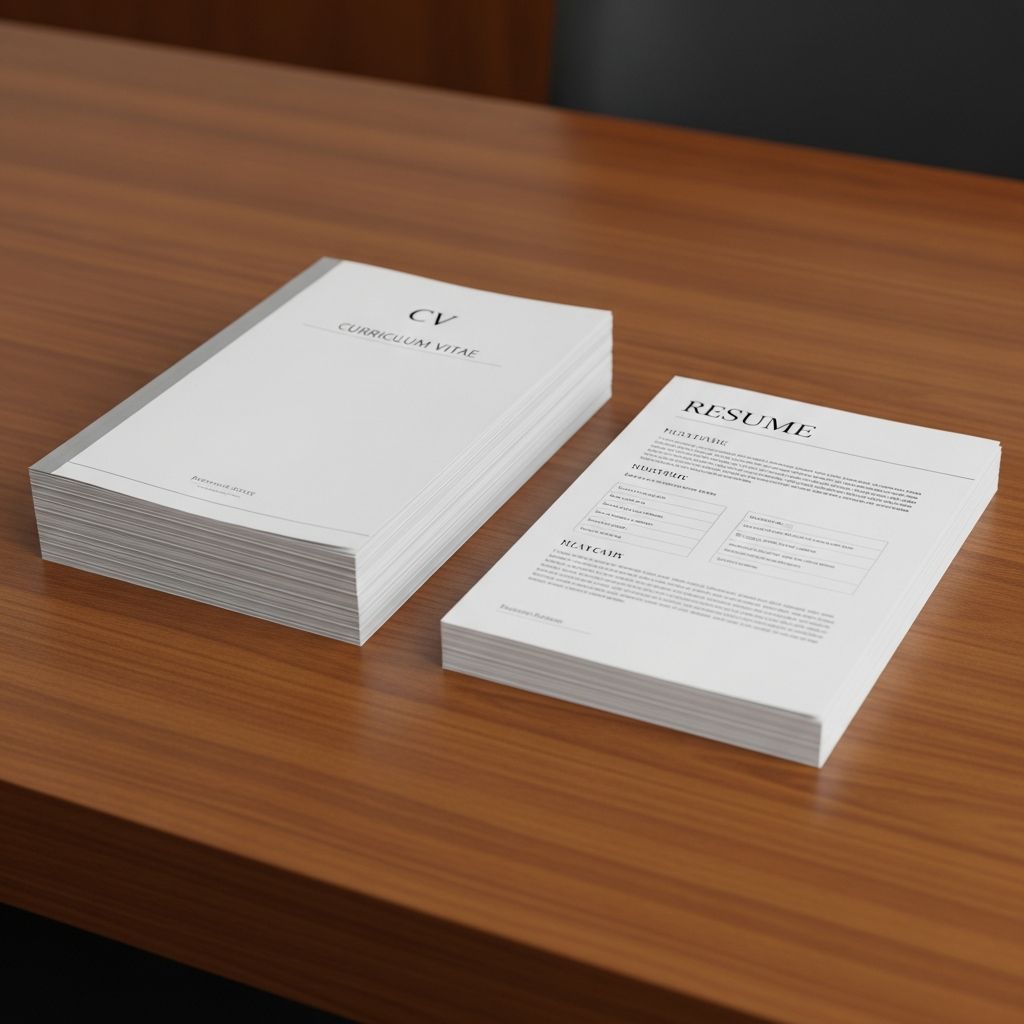
Understanding Two Essential Career Documents
When preparing for a job search, professionals frequently encounter two distinct document types designed to present their qualifications: the curriculum vitae (CV) and the resume. While both serve the fundamental purpose of communicating your professional background to potential employers, they differ significantly in scope, depth, and application. Understanding these distinctions is crucial for anyone navigating today’s competitive job market, regardless of their career stage or industry focus.
The choice between a CV and a resume isn’t arbitrary. It depends on your geographic location, the industry you’re targeting, and the specific role you’re pursuing. Using the wrong document type can undermine your application before an employer even reviews your qualifications. Conversely, selecting the appropriate format demonstrates professionalism and familiarity with industry norms.
Fundamental Distinctions Between the Two Formats
Document Length and Scope
One of the most immediately apparent differences between these two documents involves their physical length. A resume functions as a targeted, concise snapshot of your professional identity, typically constrained to a single page for early-career professionals and extending to a maximum of two pages for those with substantial experience. This brevity forces applicants to carefully curate their accomplishments and present only the information most relevant to the position at hand.
A curriculum vitae operates under entirely different constraints. With no predetermined length limitations, a CV expands to accommodate your complete professional narrative. Entry-level candidates might produce a CV spanning two to three pages, while experienced researchers or academics can develop documents extending to ten pages or beyond. This extended format allows for comprehensive documentation of your entire career trajectory, including every significant achievement and contribution.
Content Architecture and Information Hierarchy
The types of information prioritized in each document reveal fundamental differences in purpose. A resume emphasizes your most impressive accomplishments within specific roles, focusing on quantifiable achievements and skills directly applicable to the target position. The content selection process is deliberately selective, highlighting only those experiences that strengthen your candidacy for a particular job.
A CV, by contrast, serves as a comprehensive historical record. It documents your complete academic journey, research initiatives, teaching experiences, conference presentations, and published work. Rather than filtering information for relevance to a specific role, a CV maintains consistency regardless of the position you’re pursuing. Each new application uses the same fundamental document, with perhaps minor adjustments but without the extensive customization characteristic of resume development.
Customization and Flexibility
Resumes demand customization for each application. Effective resume writing involves analyzing the job description, identifying required competencies, and restructuring your document to emphasize relevant experiences. This might mean reordering sections, rephrasing accomplishments using industry-specific terminology, or highlighting particular skill sets while downplaying others. The resume becomes a marketing tool tailored to each opportunity.
CVs maintain a consistent structure throughout your career. While you might add new accomplishments as your career progresses, the fundamental organization and presentation remain largely unchanged. This consistency makes sense in academic and research contexts where the full breadth of your scholarly contributions matters regardless of the specific position or grant opportunity.
Content Elements: What Goes Into Each Document
Resume Components
A well-constructed resume typically begins with a professional summary or objective statement that immediately communicates your value proposition. This section should distill your professional identity into a brief paragraph addressing what you bring to the organization.
Following this introduction, a resume presents work experience in reverse-chronological order, detailing your most recent positions first. For each role, you should include your job title, employer name, employment dates, and accomplishments achieved during that tenure. The emphasis falls on measurable outcomes rather than routine responsibilities.
An additional skills section allows you to highlight capabilities most relevant to the target position. These might include technical proficiencies, software expertise, language fluency, or specialized certifications. Educational background typically appears toward the end of a resume, unless you’re an early-career professional with limited work history.
Resumes may also include volunteer experience, relevant professional memberships, or personal projects if space permits and these elements strengthen your candidacy. However, extraneous information that doesn’t directly support your application for the specific role should be excluded.
CV Inclusions
A curriculum vitae encompasses everything in a resume but adds extensive additional sections reflecting academic and research contributions. Beyond work experience and education, a CV documents:
Research and scholarly work: Detailed descriptions of research projects, methodologies employed, and outcomes achieved across your career. This section demonstrates the depth and progression of your intellectual contributions.
Publications and presentations: A comprehensive list of articles, papers, book chapters, and conference presentations organized chronologically or by category. This section forms a crucial component for academics and researchers, providing tangible evidence of scholarly impact.
Teaching experience: Courses taught, institutional affiliations, student mentorship roles, and curriculum development work. This section is particularly important for academic positions.
Awards and recognition: Academic honors, research awards, fellowship recipients, and professional distinctions. These credentials validate your standing within your field.
Professional associations and memberships: Involvement with professional organizations, committee participation, and leadership roles within academic communities.
Languages and additional competencies: Detailed information about language proficiency levels, technical expertise, and specialized skills beyond what appears on a resume.
Grants and funding: Research grants received, funding amounts, and project descriptions demonstrating your ability to secure competitive resources.
Geographic and Industry Applications
United States Context
Within the United States employment landscape, resumes dominate most job applications across business, technology, marketing, engineering, and service industries. A resume is the default expectation for positions in the private sector and most public-sector roles. Employers reviewing American applications typically expect to receive and evaluate resumes rather than more extensive CVs.
However, specific American sectors prioritize CVs. Academic institutions, medical facilities, research laboratories, and government research positions regularly require curriculum vitae submissions. If you’re applying for faculty positions, postdoctoral fellowships, or research grants through American institutions, a CV becomes essential regardless of the sector.
International Standards
Outside the United States, curriculum vitae usage becomes standard regardless of industry or sector. In the United Kingdom, Europe, Asia, and other regions globally, CV submission is the norm for virtually all job applications. International job seekers must recognize that what Americans call a resume is essentially what much of the world terms a CV. Understanding these geographic distinctions prevents the embarrassing mistake of submitting the wrong document format to international employers.
Industry-Specific Expectations
Certain industries developed their own conventions regarding which document format is standard. Creative industries sometimes prefer portfolios alongside resumes. Legal positions may require additional documentation beyond either format. Medical positions frequently demand CVs due to the regulatory and academic nature of healthcare credentials. Researching industry norms within your specific field provides guidance when job postings don’t explicitly specify which format to submit.
Strategic Document Selection Guide
When a Resume is Appropriate
Submit a resume when applying for industry positions, corporate roles, government positions outside research sectors, and most positions in business-focused organizations. Resume submissions work well for positions emphasizing recent experience, practical skills, and immediate job readiness. If you’re changing careers, a resume allows you to reframe your background to highlight transferable competencies relevant to your new direction.
When a CV Becomes Necessary
Curriculum vitae submissions are required for academic appointments, research positions, postdoctoral opportunities, and grant applications. If you’re pursuing positions that value your complete scholarly record, publication history, or research contributions, a CV is essential. International applications almost universally require CV format regardless of position type.
Frequently Asked Questions
Q: Can I use a resume for an academic position that requests a CV?
A: No. Using a resume when a CV is requested signals unfamiliarity with academic conventions and may result in your application being immediately rejected. Always submit the document format specifically requested.
Q: Should I include personal interests on a resume or CV?
A: Resumes should exclude personal interests unless directly relevant to the position. CVs may include hobbies and interests if they demonstrate expertise related to your field or show well-rounded professional development.
Q: How often should I update my CV or resume?
A: Update your resume before each job application, tailoring it to the specific position. Update your CV annually or whenever you achieve significant professional milestones, publications, or accomplishments.
Q: Is a one-page resume always necessary?
A: For early-career professionals, one page is standard. Experienced professionals with ten or more years of relevant experience may justify two pages, but avoid exceeding this limit for resume submissions.
Q: Can references appear on both documents?
A: Resumes typically omit references unless explicitly requested, instead noting they’re available upon request. CVs may include references but often list them on a separate page.
References
- CV vs. Resume – 5+ Key Differences in 2025 — Novo Resume. 2025. https://novoresume.com/career-blog/cv-vs-resume-what-is-the-difference
- Resume vs. CV (Curriculum Vitae): Key Differences — Indeed.com. 2024. https://www.indeed.com/career-advice/resumes-cover-letters/difference-between-resume-and-cv
- CV vs. Resume: Key Differences, Examples & Expert Tips — My Perfect Resume. 2024. https://www.myperfectresume.com/career-center/resumes/basics/cv-vs-resume
- Curriculum Vitae (CV) vs. Resume: What’s the Difference? — Southern New Hampshire University. 2024. https://www.snhu.edu/about-us/newsroom/career/difference-between-curriculum-vitae-and-resume
- The Difference Between a Resume and a Curriculum Vitae (CV) — Penn West University Career Services. 2022. https://career.pennwest.edu/blog/2022/08/10/the-difference-between-a-resume-and-a-curriculum-vitae-cv/

- Integrated M.A. in Applied Linguistics, University of Hyderabad
- 5+ years in editorial, instructional, SEO, and research-based writing
Sneha is a relationships and lifestyle writer with a strong foundation in applied linguistics and certified training in relationship coaching. She brings over five years of writing experience to theskillvault, crafting thoughtful, research-driven content that empowers readers to build healthier relationships, boost emotional well-being, and embrace holistic living. Her writing and insights reflect the belief that beauty, happiness, and wellness…