
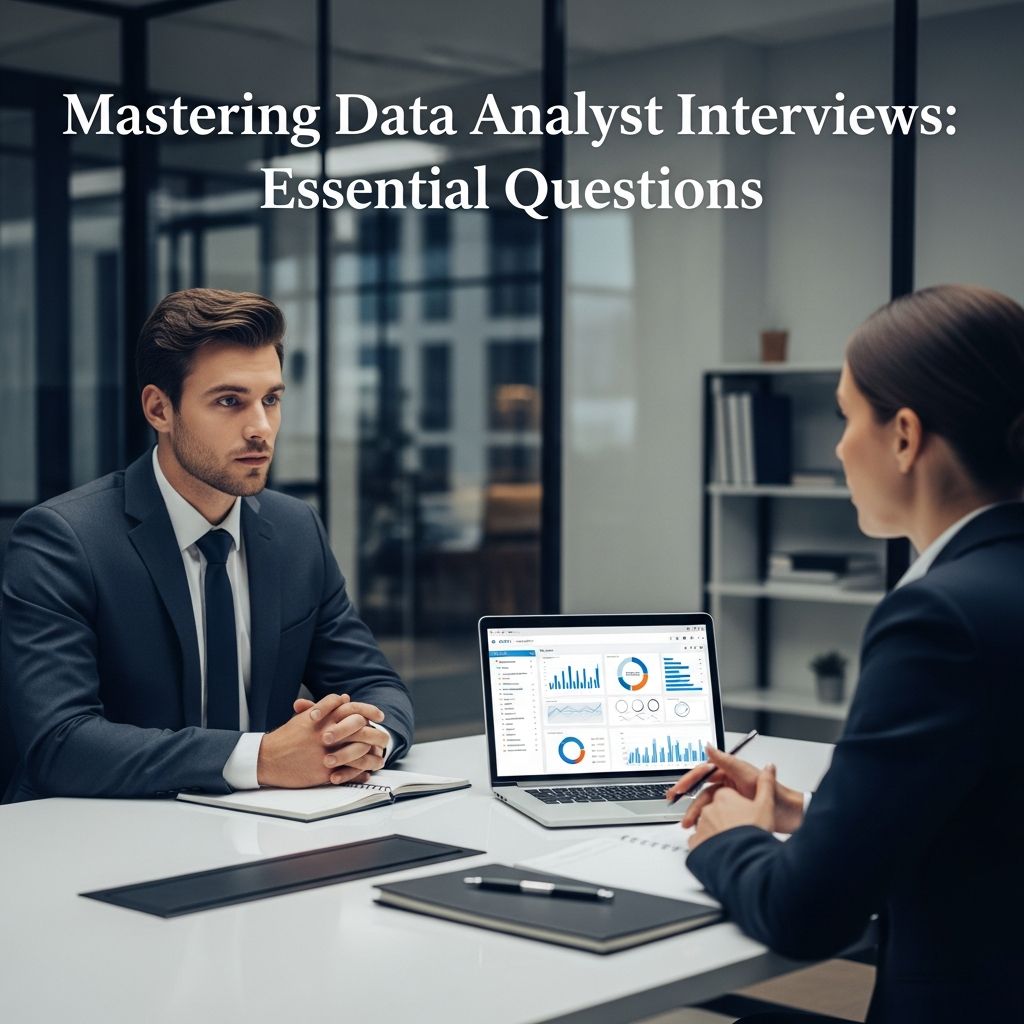
Data analyst positions have become increasingly competitive in today’s job market. Organizations seeking to hire data professionals need to evaluate not only your technical proficiency but also your problem-solving approach, communication skills, and ability to translate business challenges into analytical insights. Understanding the types of questions you’ll face and preparing thoughtful, structured responses can significantly improve your interview performance.
Understanding What Interviewers Are Evaluating
When hiring managers interview data analysts, they’re assessing multiple dimensions of your capability. Beyond surface-level technical knowledge, they want to understand your analytical thinking process, your capacity to work with complex datasets, and how you handle ambiguity and real-world constraints. The questions asked are typically designed to reveal your hands-on experience, your familiarity with industry-standard tools, and your ability to communicate findings to both technical and non-technical audiences.
Interviewers also evaluate your adaptability and learning mindset. The data landscape evolves rapidly, and organizations value professionals who stay current with emerging techniques and tools. Your responses should demonstrate that you actively pursue professional development and apply new methodologies to solve business problems.
Technical Foundations: SQL and Database Manipulation
SQL proficiency remains non-negotiable for most data analyst roles. You should be prepared to discuss and write queries that demonstrate mastery of core concepts. Common SQL-focused interview tasks include:
- Writing queries using GROUP BY clauses and aggregate functions to summarize data
- Applying JOIN operations (INNER, LEFT, RIGHT) to combine data from multiple tables
- Using window functions to calculate running totals or rank records within partitions
- Identifying and removing duplicate records using DISTINCT or other deduplication strategies
- Debugging existing queries to identify and correct logical or syntax errors
When answering SQL questions, explain your reasoning as you write. Walk the interviewer through your thought process, discussing why you chose specific functions, how you filtered data, and what assumptions you made about the underlying schema. This demonstrates both technical capability and clear communication.
Data Manipulation and Python Proficiency
Many organizations expect data analysts to have working knowledge of Python, particularly libraries like pandas for data manipulation and cleaning. You may be asked about your experience with Python projects, the types of datasets you’ve processed, and how you’ve used automation to scale your analysis.
Key Python and pandas concepts you should be comfortable discussing include:
- Data reshaping operations such as pivoting, unpivoting, and merging datasets
- Handling missing values through imputation or removal strategies
- Filtering, sorting, and grouping data to prepare for analysis
- Working with large datasets that exceed available memory through chunking or sampling approaches
If asked about specific projects, focus on the business context, the size and complexity of the data, and the impact of your analysis on decision-making.
Statistical Knowledge and Hypothesis Testing
Data analysts must understand fundamental statistical concepts to draw valid conclusions from data. Interviewers commonly ask about hypothesis testing, confidence intervals, p-values, and the critical distinction between correlation and causation.
Be prepared to explain these concepts in both technical and business-friendly language. For example, when discussing p-values, explain that they represent the probability of observing your results if the null hypothesis were true, and discuss how this informs business decisions rather than just reporting the number.
You should also demonstrate familiarity with:
- Statistical methods appropriate for different data types and business questions
- A/B testing design and interpretation, including sample size calculation and significance thresholds
- Time series analysis techniques for detecting trends and seasonality
- Clustering algorithms and when to apply them to customer segmentation or similar problems
Data Wrangling and Quality Assurance
Real-world data is messy. Interviewers want to understand your approach to data cleaning, validation, and quality assurance. When asked about handling incomplete or suspicious data, discuss your methodology for identifying anomalies, understanding root causes, and deciding whether to remove, impute, or flag problematic records.
Common data quality challenges include:
- Missing values caused by data entry errors, system failures, or legitimate gaps
- Outliers that may represent genuine extremes or data quality issues
- Duplicate records arising from multiple data sources or processing errors
- Inconsistent formatting or encoding across datasets
- Data drift where patterns or distributions change over time
Demonstrate that you don’t simply delete problematic data without investigation. Instead, explain how you document decisions, validate your cleaning assumptions, and ensure that your final dataset accurately reflects the business reality.
Business Analysis and Case Study Questions
Many interviews include open-ended case studies or business scenarios. You might be asked to estimate monthly sales for a hypothetical scenario, design a dashboard to track marketing ROI, or analyze why a key metric suddenly declined.
To excel in these questions:
- Start by clarifying the business objective and defining key metrics
- Articulate your assumptions explicitly so the interviewer understands your reasoning
- Break complex problems into manageable components
- Discuss data sources and limitations that would affect your analysis
- Propose actionable insights rather than just reporting numbers
For example, if asked to analyze a sudden drop in conversion rate, discuss how you’d segment the data by traffic source, device type, or user cohort to isolate the problem. Explain how you’d prioritize hypotheses based on available data and business context.
Communication and Stakeholder Engagement
Technical expertise alone isn’t sufficient. Interviewers assess your ability to communicate complex findings to non-technical stakeholders. You may be asked how you’d present data to executives, translate statistical concepts into business language, or handle situations where stakeholders request analyses that contradict your findings.
When answering these questions, emphasize:
- Translating statistical concepts into business impact (e.g., instead of reporting a 0.05 p-value, explain the business confidence in the result)
- Choosing appropriate visualizations that tell a clear story without overwhelming detail
- Anticipating questions and preparing supporting analysis
- Maintaining data integrity while remaining open to stakeholder perspectives
Behavioral Questions and Professional Growth
Expect behavioral questions that reveal your work style, resilience, and professional development approach. Prepare specific examples using the STAR method (Situation, Task, Action, Result) that demonstrate:
- How you’ve overcome challenges in complex data projects
- Times when you identified errors in your analysis and corrected them
- Instances where your analysis influenced important business decisions, with quantified impact
- How you prioritize multiple competing requests from different stakeholders
- Your approach to staying current with new data tools and techniques
Choose examples that show ownership, problem-solving ability, and positive outcomes. Quantify results whenever possible—did your analysis increase revenue by a percentage, reduce costs, or improve efficiency?
Preparing for Role-Specific Variations
Interview questions often vary by company size and industry. Startups typically emphasize end-to-end ownership, quick pivots, and delivering impact with limited resources. Questions may focus on building dashboards quickly, working with incomplete data, and wearing multiple hats.
In contrast, large technology companies often emphasize scale and optimization. Expect deeper dives into handling massive datasets, optimizing query performance, and working within complex data infrastructure.
Industry-specific roles require domain knowledge. Healthcare data analysts should understand regulatory requirements and common healthcare metrics. Financial analysts need familiarity with regulatory compliance and financial instruments. Tailor your preparation by researching the company’s industry and typical analytical challenges.
Building Your Competitive Edge
Beyond answering questions correctly, demonstrate your analytical mindset throughout the interview. When presented with ambiguous questions, state your assumptions and explain your logic. Discuss trade-offs—why you chose one approach over another, given time and resource constraints.
Walk the interviewer through your portfolio, highlighting projects that showcase the specific skills the role requires. If the position emphasizes dashboard development, feature your visualization work. If it requires advanced statistics, highlight a project using statistical modeling.
Key Technical Skills Comparison
| Skill Area | Core Competencies | Interview Focus |
|---|---|---|
| SQL | JOINs, GROUP BY, window functions, query optimization | Write queries from scratch; debug existing code |
| Python/Pandas | Data cleaning, reshaping, automation | Discuss real projects; explain approach to complex tasks |
| Statistics | Hypothesis testing, confidence intervals, A/B testing | Translate concepts to business language |
| Visualization | Dashboard design, storytelling with data | Portfolio examples; discuss design choices |
| Communication | Presenting to stakeholders, documentation | STAR method; real examples with impact |
Frequently Asked Questions About Data Analyst Interviews
Q: What’s the most common technical question in data analyst interviews?
A: SQL queries remain the most frequently asked technical question. You’ll likely be asked to write or debug SQL code that retrieves or manipulates data. Prepare by practicing queries involving joins, aggregations, and filtering on realistic datasets.
Q: How should I answer questions about my greatest weakness?
A: Choose a genuine area where you’ve grown or are still developing, and demonstrate your commitment to improvement. For example, you might discuss how you’ve strengthened your communication skills by presenting findings to stakeholders, or how you’re deepening your statistical knowledge through coursework.
Q: Should I memorize answers to common questions?
A: No. Memorized responses sound robotic and don’t allow you to adapt to follow-up questions. Instead, prepare bullet-point outlines of your key experiences and practice explaining them conversationally. This allows you to remain authentic while staying focused and organized.
Q: How can I stand out if I’m early in my career?
A: Emphasize projects from academic coursework, internships, or personal analysis that demonstrate your analytical thinking and tool proficiency. Discuss your enthusiasm for learning, your awareness of industry trends, and your understanding of how data analysis drives business value.
Q: What if I don’t know the answer to a technical question?
A: Be honest. Explain your thought process for approaching the problem, discuss what information would help you solve it, and ask clarifying questions. Interviewers often value your problem-solving approach more than whether you immediately know the answer.
Q: How important is portfolio review in the interview?
A: Very important. Your portfolio demonstrates your practical abilities with real data and tools. Prepare to discuss 2–3 projects in depth, explaining your role, the business context, technical challenges, and measurable outcomes. Be ready to discuss what you’d do differently with hindsight.
Q: What’s the best way to prepare for behavioral questions?
A: Develop 5–6 detailed STAR stories covering different themes: overcoming challenges, identifying errors, quantifying impact, managing stakeholder conflicts, and continuous learning. Practice delivering these stories concisely in 60–90 seconds.
References
- 15 Data Analyst Interview Questions and Answers — Coursera. 2025. https://www.coursera.org/articles/data-analyst-interview-questions-and-answers
- 15 Data Analyst Interview Questions and Answers — Deel. 2025. https://www.deel.com/blog/data-analyst-interview-questions/
- 49 Data Analytics Interview Questions (With Sample Answers) — Indeed. 2025. https://www.indeed.com/career-advice/interviewing/analytics-questions
- Top 30 Most Common Data Analyst Interview Questions You Should Prepare For — Verve Copilot. 2025. https://www.vervecopilot.com/interview-questions/top-30-most-common-data-analyst-interview-questions-you-should-prepare-for
- 22 Data Analyst Interview Questions: How to Prepare — DataCamp. 2025. https://www.datacamp.com/blog/how-to-prepare-for-a-data-analyst-interview

Medha Deb is an editor with a master's degree in Applied Linguistics from the University of Hyderabad. She believes that her qualification has helped her develop a deep understanding of language and its application in various contexts. Medha specializes in the areas of beauty, health, sports, and wellness and is committed to ensuring that the content on the website is…