
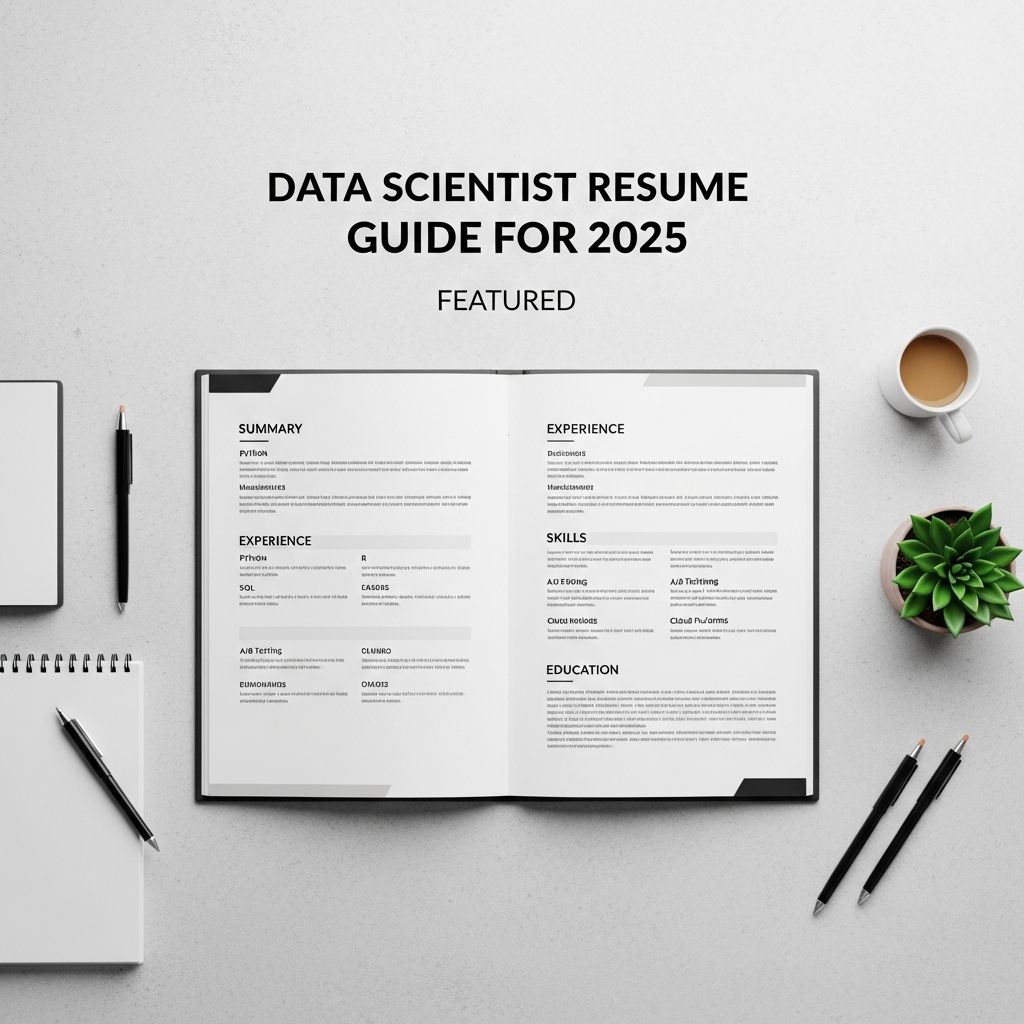
Data science is one of the most competitive tech fields, and a strong resume is often the only chance you get to prove you can turn data into business value. This guide walks you through everything you need to know to build a modern, results-driven data scientist resume that gets interviews.
Understanding What Recruiters Look For
Before writing a single line, you need to know how hiring managers and applicant tracking systems (ATS) evaluate data science resumes. Research on data science hiring shows that most resumes are scanned for seconds, not minutes, and are quickly filtered by automated systems based on keywords and formatting.
- Clear evidence of impact: business metrics, model performance, cost savings, or efficiency gains.
- Core technical stack: languages like Python or R, SQL, machine learning libraries, and data tools.
- Ability to ship work: end-to-end projects, not just classroom exercises.
- Communication skills: proven experience explaining insights to non-technical stakeholders.
- Clean layout and ATS-friendly formatting: simple structure, standard section names, and consistent styling.
Ideal Structure for a Data Scientist Resume
Most successful data science resumes follow a similar high-level structure. You can adjust order based on your background (for example, prioritizing projects if you have little experience), but keep the overall flow simple and logical.
| Section | Purpose |
|---|---|
| Header & Contact | Make it easy to identify you and reach you quickly. |
| Professional Summary | Position yourself in 3–4 concise, impact-oriented sentences. |
| Experience | Demonstrate business outcomes, not just tasks. |
| Projects | Highlight end-to-end work, especially if you are early-career. |
| Skills | Show tools, languages, and methods aligned to the job. |
| Education | Summarize degrees, majors, and relevant coursework. |
| Extras (optional) | Certifications, publications, competitions, or languages. |
Crafting a Strong Resume Header
Your header should be compact, professional, and scannable. Avoid including excessive personal details; many countries discourage or legally restrict sensitive information on resumes.
- Include: full name, target title (e.g., Data Scientist, Machine Learning Engineer), email, phone, city/region, portfolio or GitHub.
- Avoid: photos, full address, date of birth, or unrelated personal data.
Using a professional email and linking to a real portfolio with reproducible code significantly increases your credibility, especially for junior candidates.
Writing a Compelling Professional Summary
The summary at the top of your resume is your elevator pitch. For experienced candidates, it should emphasize years of experience, domains of expertise, and measurable wins. For newcomers, it should highlight core skills, education, and relevant projects.
Tips for an Effective Summary
- State your experience level (e.g., entry-level, mid-level, senior).
- Mention focus areas: NLP, computer vision, experimentation, recommendation systems, etc.
- Include 1–2 quantifiable results (e.g., “improved forecast accuracy by 15%”).
- Reference key tools listed in the job description (e.g., Python, SQL, TensorFlow).
- Keep it to 3–4 sentences max and avoid generic buzzwords.
Showing Impact in Your Experience Section
In data science, experience is less about your job title and more about how your work changed business outcomes. Recruiters prefer bullet points that quantify the results of your models and analyses instead of listing generic responsibilities.
Structuring Each Role
- Line 1: Job title, employer, location, and dates (month/year).
- Line 2+: 3–6 bullet points focused on quantifiable achievements.
To make each bullet powerful, a widely used technique is the CAR method: Challenge – Action – Result.
- Challenge: Briefly state the problem (e.g., churn, fraud, forecast error).
- Action: Summarize the methods and tools you used.
- Result: Close with a number (e.g., revenue gain, error reduction, saved hours).
Examples of Strong Achievement Bullets
- Optimized a demand-forecasting model using gradient boosting, cutting mean absolute error by 18% and improving inventory planning.
- Built an end-to-end churn prediction pipeline in Python and SQL that enabled targeted retention campaigns and reduced monthly churn by 6%.
- Created executive dashboards in a BI tool to track marketing performance, leading to a 12% increase in ROI across paid channels.
Highlighting Data Science Projects
Projects are crucial for students, career changers, and self-taught data scientists. Evidence shows that well-documented projects demonstrating real-world datasets and reproducible code are strong predictors of hiring outcomes.
What a Good Project Entry Includes
- Project name and brief one-line goal.
- Data: where it came from, size, and type (tabular, text, images, etc.).
- Stack: languages, libraries, frameworks, and platforms (e.g., Python, scikit-learn, PyTorch, SQL, Spark).
- Contribution: especially important for group or open-source projects.
- Results: metrics or business insight (e.g., uplift, accuracy, time saved).
Whenever possible, link to a repository or live demo. Recruiters often skim code and documentation to verify depth of knowledge, particularly for junior roles.
Designing a Focused Skills Section
Your skills section should not be a random list of every tool you have tried once. Instead, it needs to align tightly to the target role and reflect both breadth and depth.
Core Skill Categories
- Programming: Python, R, SQL, sometimes Scala or Java.
- Machine Learning & Stats: supervised/unsupervised learning, model evaluation, feature engineering, experimentation.
- Data Handling: data wrangling, relational databases, APIs, big-data tools.
- Visualization: libraries and BI tools for storytelling with data.
- Cloud & MLOps (for advanced roles): model deployment, monitoring, CI/CD.
Place the most job-relevant skills near the top and use consistent naming so ATS software can recognize them.
Education and Certifications That Matter
Many data scientists hold degrees in statistics, computer science, mathematics, or related fields, but alternative paths are increasingly common. Focus your education section on degrees and coursework that strengthen your candidacy for the specific role.
- List degree, major, institution, and graduation date.
- Include relevant coursework only if you lack experience (e.g., probability, linear algebra, machine learning, databases).
- Add selected certifications or nano-degrees that demonstrate hands-on work with industry tools.
For experienced candidates, this section can be shorter and placed after experience and skills.
Optional Sections That Can Set You Apart
Once you have the core sections in place, consider a few optional areas that can differentiate you from other applicants.
- Competitions: Kaggle rankings or hackathons with notable placements.
- Publications: peer-reviewed papers or technical blog posts.
- Open-Source: meaningful contributions to data or ML libraries.
- Languages: especially useful for global companies or regional roles.
Optimizing for Applicant Tracking Systems (ATS)
Most mid- to large-sized employers use ATS software to filter resumes before human review. Even in data science roles, strong candidates can be rejected automatically if their resume is not machine readable.
ATS-Friendly Practices
- Use standard section headings like “Experience”, “Projects”, and “Skills”.
- Avoid complex layouts (columns, text boxes, heavy graphics).
- Match keywords from the job description (tools, methods, domain terms).
- Submit in PDF or DOCX format, depending on employer guidance.
- Use simple fonts and keep your resume to 1–2 pages.
Tailoring Your Resume to Each Data Science Role
There is no single perfect resume that works for every job. Top candidates customize their resume for each posting by mirroring the employer’s priorities and language.
- Study the job description and highlight repeated skills or responsibilities.
- Reorder your skills and projects so the most relevant items appear first.
- Swap in role-specific keywords like “A/B testing”, “recommendation systems”, or “time-series forecasting”.
- Emphasize industry context similar to the employer’s domain (e.g., e-commerce, finance, healthcare).
Common Mistakes to Avoid
Even strong data scientists lose opportunities due to avoidable resume issues. Research on resume screening consistently shows that clarity and relevance matter more than volume of information.
- Overstuffed technical lists with tools you cannot discuss confidently.
- Vague bullets like “analyzed data” with no context or result.
- Typos and grammar errors, which quickly undermine credibility.
- Irrelevant experience that pushes key content onto a third page.
- Missing metrics in roles where impact should be measurable.
Frequently Asked Questions (FAQs)
Q: How long should a data scientist resume be?
Most early-career and mid-level data scientists should aim for a concise one-page resume. Senior candidates with extensive experience and publications may reasonably use two pages, but clarity is more important than length.
Q: Do I need a PhD to get a data scientist role?
No. Many employers now hire candidates with bachelor’s or master’s degrees plus strong projects, internships, and hands-on skills. What matters most is your ability to turn messy data into actionable, measurable results.
Q: How many projects should I include?
For junior candidates, including 3–5 high-quality projects is typical. Focus on diverse problem types (classification, regression, NLP, forecasting) and emphasize end-to-end pipelines over toy examples.
Q: Should I list all programming languages I have ever used?
No. Only list languages and tools that you can comfortably discuss in an interview and that appear in the job description. Depth in a few core tools is more impressive than a long, shallow list.
Q: How can career changers make their resume competitive?
Career changers should spotlight transferable skills such as quantitative analysis, domain expertise, stakeholder communication, and problem-solving, and back them up with well-documented data science projects. A focused skills section and tailored summary can help bridge the gap between prior roles and data science.
References
- Crafting the Perfect Data Scientist Resume in 2025: A Complete Guide — Pass4sure Blog. 2024-05-10. https://www.pass4sure.com/blog/crafting-the-perfect-data-scientist-resume-in-2025-a-complete-guide/
- Building a Stand-out Data Scientist Resume [Ultimate Guide For 2025] — DataCamp. 2024-02-06. https://www.datacamp.com/blog/tips-to-build-your-data-scientist-resume
- Data Scientist Resume – Sample & Guide for 2025 — Novoresume. 2024-01-15. https://novoresume.com/career-blog/data-scientist-resume
- A Comprehensive Optimization Guide for Your Data Scientist Resume — TripleTen. 2024-03-20. https://tripleten.com/blog/posts/how-to-optimize-your-data-science-resume
- Building a Data Science Resume That Gets You the Job — 365 Data Science. 2023-09-12. https://365datascience.com/career-advice/job-interview-tips/data-science-resume/
- Data Science Resume Examples and Template — IGotAnOffer. 2023-11-01. https://igotanoffer.com/en/advice/data-science-resume-examples

- Integrated M.A. in Applied Linguistics, University of Hyderabad
- 5+ years in editorial, instructional, SEO, and research-based writing
Sneha is a relationships and lifestyle writer with a strong foundation in applied linguistics and certified training in relationship coaching. She brings over five years of writing experience to theskillvault, crafting thoughtful, research-driven content that empowers readers to build healthier relationships, boost emotional well-being, and embrace holistic living. Her writing and insights reflect the belief that beauty, happiness, and wellness…