
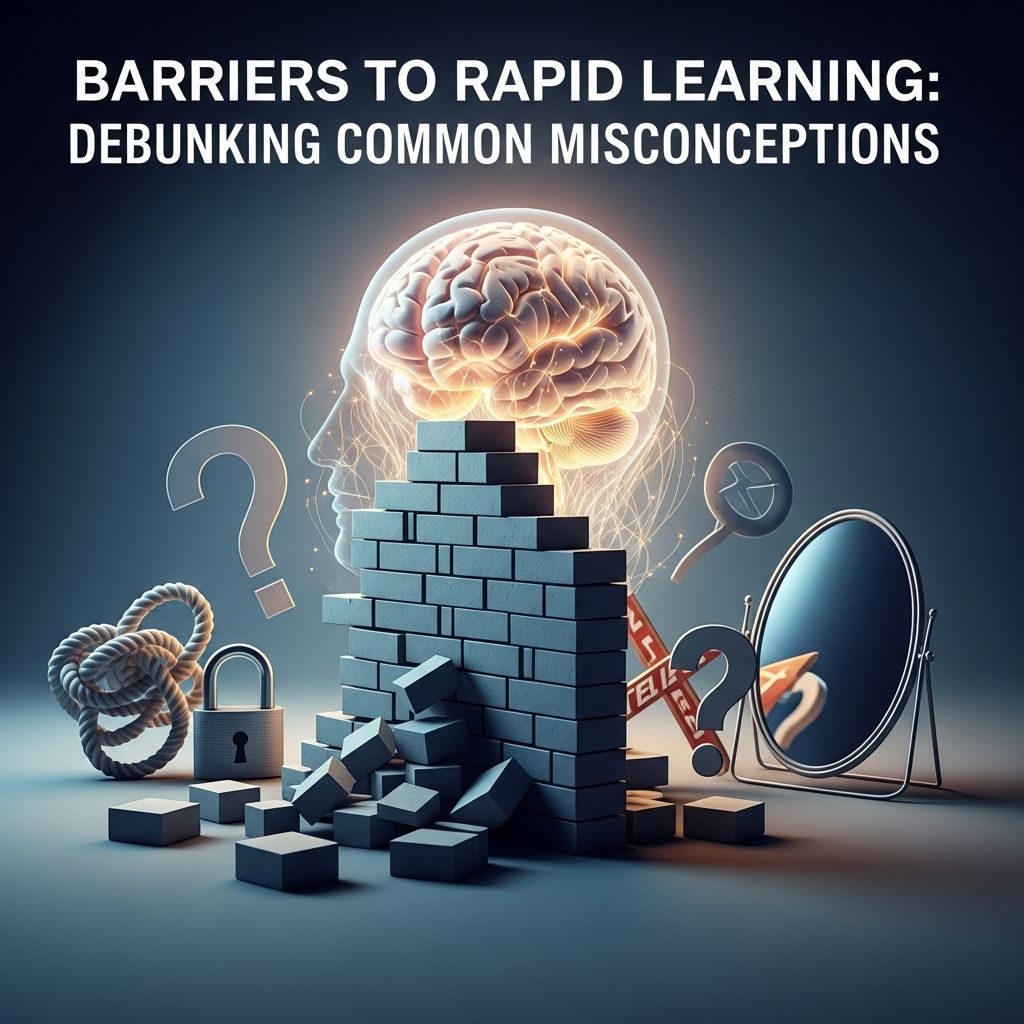
The journey toward mastery and skill acquisition is fraught with misconceptions that lead people astray. Many individuals operate under assumptions about how learning works that are not only ineffective but actively counterproductive. These false beliefs, often reinforced by popular culture and conventional wisdom, can significantly impede progress and waste precious time and effort. By identifying and dismantling these myths, learners can redirect their energy toward strategies that actually produce results.
The Illusion of Tailored Learning Styles
One of the most pervasive myths in educational circles is the notion that individuals possess distinct learning styles—such as visual, auditory, or kinesthetic preferences—and that matching instruction to these preferences dramatically enhances comprehension and retention. This belief has become so entrenched in mainstream education that many institutions design curricula around the assumption that personalizing content delivery to a student’s learning style preference will unlock faster achievement.
The reality, however, tells a different story. Research demonstrates that while people may indeed have preferences for how they receive information, these preferences do not translate into superior learning outcomes when accommodated. The kernel of truth underlying this misconception is straightforward: individuals do prefer certain modalities of information delivery. Yet preference and effectiveness are entirely different phenomena. A person might prefer visual presentations, but they do not necessarily learn the material more quickly or retain it more effectively when information is delivered visually compared to verbally.
The troubling consequence of this myth is that educators invest significant resources in diagnosing students’ supposed learning styles and tailoring instruction accordingly, efforts that yield no empirical benefit in terms of academic achievement. Rather than pursuing this approach, learners should focus on the actual variable that matters: the quality and quantity of practice required to achieve mastery, which varies by individual but not by preference for information modality.
Working Memory Training as a Shortcut to Intelligence
Another widespread misconception holds that training working memory—the cognitive system responsible for temporarily holding and manipulating information—can serve as a universal enhancement tool for academic and cognitive performance. Parents, educators, and learners have invested in working memory training programs with hopes of boosting reading ability, mathematical proficiency, and general intelligence.
While it is true that individuals differ in working memory capacity, and that working memory capacity correlates with learning speed on novel tasks, training working memory does not transfer these benefits to real-world academic outcomes. Studies employing rigorous methodologies consistently show minimal evidence that working memory training improves performance in reading, mathematics, or spelling—the very skills people hope to enhance. The training may produce near-transfer effects, meaning practice on working memory tasks improves subsequent working memory tasks, but it fails to produce far-transfer effects that would benefit academic achievement.
This distinction between near and far transfer is crucial. Just because someone becomes skilled at a particular training exercise does not mean that skill generalizes to other domains. Understanding this limitation prevents learners from wasting time and resources on interventions with no proven educational value.
The Myth That Speed Determines Success
A particularly damaging misconception is that learning speed is a fixed trait—that some people are simply fast learners while others are slow, and this difference is immutable. This belief often manifests as the assumption that being a “quick learner” is synonymous with being intelligent or capable, while struggling to grasp concepts quickly signals deficiency.
Research from Carnegie Mellon University’s Human Computer Interaction Institute challenges this assumption fundamentally. When students are provided with equivalent learning opportunities and engage actively with material through feedback and questioning, learning rates converge remarkably. The observed differences in how quickly students reach educational milestones often reflect differences in starting point and prior knowledge rather than differences in inherent learning capacity. A student who begins algebra with stronger foundational mathematics will naturally progress faster than a peer starting from further behind, but this does not mean the second student is a slower learner in any fixed sense.
The implication is profound: achievement gaps frequently stem from unequal access to quality learning opportunities, not from differences in learners’ fundamental capacities. When environments are structured to provide active engagement, immediate feedback, and appropriate scaffolding, students progress at surprisingly similar rates regardless of their initial position.
The Assumption That More Practice Always Produces Better Results
A related but distinct misconception is that additional practice beyond what is necessary to achieve mastery continues to produce proportional gains. Some learners and educators assume that grinding through extra repetitions after competency is reached will somehow deepen understanding or accelerate future learning on advanced material.
The evidence suggests otherwise. Once a student achieves mastery on a particular learning task, the trajectory of improvement flattens significantly. The impact of individual differences in working memory capacity—which influences learning speed—diminishes substantially after a task is learned to sufficient proficiency. Continuing to drill that specific skill beyond mastery represents a missed opportunity to advance to more complex material.
Conversely, the corollary misconception—that bright students require minimal practice—is equally problematic. While some learners may need less practice than others to achieve mastery, each learner must still receive enough practice to reach competency before advancing. The key is matching practice volume to the individual’s actual needs, not to assumptions about their general ability or learning speed.
Underestimating the Power of Active Engagement
Many learners operate under the false assumption that passive consumption of information—reading textbooks, watching lectures, reviewing notes—is an efficient path to mastery. This approach feels productive because it involves exposure to material, but research consistently demonstrates that active engagement produces dramatically superior outcomes.
When learners actively work with material, answer questions, and receive immediate feedback, retention and understanding deepen substantially compared to passive observation or reading. Yet many educational environments and self-directed learning approaches default to passive consumption because it requires less cognitive effort and feels less challenging. The counterintuitive truth is that the struggle associated with active learning—retrieving information from memory, applying it to problems, receiving corrective feedback—is precisely what drives faster and more durable learning.
This misconception often coexists with another false belief: that learning should feel easy. In reality, productive learning involves productive struggle. When material is too easy, little learning occurs. When it is at the appropriate difficulty level and requires active problem-solving, learning accelerates.
The Fixed Trait Misconception About Learning Capacity
A foundational misconception underlying all others is the belief that learning capacity itself is largely fixed and inherited. This perspective suggests that people are born with a certain potential for acquiring skills, and while some development is possible, fundamental differences in learning capacity are immutable.
While genetics certainly influence aspects of cognitive function, the research on neuroplasticity and learning demonstrates that capability is far more malleable than this belief suggests. Different students may require different amounts of practice to achieve mastery on specific tasks, but this variation should be viewed not as an indicator of fixed capacity but as a variable requiring adjustment in instructional strategy.
The practical consequence of holding this misconception is that learners experiencing initial difficulty may prematurely conclude they lack capacity for a domain. Rather than persisting with additional practice—the very mechanism that could enable them to develop automaticity and eventually progress to advanced material—they may abandon the effort. In contrast, recognizing learning speed as influenced by multiple modifiable factors rather than fixed capacity encourages persistence and deliberate practice.
Structuring Effective Learning: What Actually Works
Given that these misconceptions are indeed false, what learning approaches actually produce faster and more effective results?
- Individualize practice volume, not delivery modality: Assess how much practice each specific learner needs to achieve mastery on each specific task, rather than attempting to match information presentation to learning style preferences.
- Prioritize active engagement: Structure learning environments to require active problem-solving, answer generation, and immediate feedback rather than passive information consumption.
- Advance upon mastery, not preset timelines: Move learners to advanced material immediately after they demonstrate competency, rather than continuing practice beyond necessity.
- Optimize for learning conditions: Focus on creating favorable learning environments characterized by clear objectives, appropriate difficulty, active involvement, and timely feedback.
- Distinguish between preference and performance: Acknowledge learner preferences while designing instruction around evidence-based effectiveness rather than preference alignment.
Frequently Asked Questions
Q: If learning style matching doesn’t work, why is it so widely taught?
A: The learning styles concept arose from genuine observations that people have preferences in how they receive information. However, the leap from preference to effectiveness was never empirically validated. The myth persists partly due to institutional inertia and confirmation bias—educators may notice that when they match instruction to preferences, engaged students perform well, attributing this to the match rather than to the engagement itself.
Q: Can working memory be improved at all?
A: Working memory can be temporarily expanded through practice on specific tasks, but these improvements do not transfer to untrained domains. Rather than focusing on working memory training, learners are better served by developing effective strategies that reduce working memory load, such as taking organized notes or breaking complex problems into components.
Q: Does this mean fast and slow learners don’t exist?
A: Fast and slow learners do exist in relative terms—some individuals require more practice than others to achieve mastery on particular tasks. However, these differences are not fixed traits that generalize across all domains. A person might learn mathematics slowly but acquire language skills quickly. Additionally, providing improved learning conditions can narrow or eliminate observed speed differences.
Q: How much practice is actually enough?
A: The amount of practice needed varies by individual and by task. The benchmark is mastery—the ability to perform the skill accurately and with appropriate automaticity. Once this standard is achieved, continuing to practice that specific skill yields diminishing returns.
Q: Can someone actually surpass their genetic potential for learning?
A: Research indicates that through deliberate practice, optimal learning conditions, and persistent effort, individuals can reach their genetic potential and may exceed initial predictions of what was thought possible. Genetic factors set broad parameters, but within those parameters, achievement is highly modifiable through behavior and environment.
References
- People Differ in Learning Speed, Not Learning Style — Justin Skycak. Accessed January 19, 2026. https://justinmath.com/people-differ-in-learning-speed-not-learning-style/
- The Myth of the Fast Learner — Carnegie Mellon University News. March 31, 2023. https://www.cmu.edu/news/stories/archives/2023/march/the-myth-of-the-fast-learner
- No Need for Speed — Harvard Graduate School of Education. Accessed January 19, 2026. https://www.gse.harvard.edu/ideas/ed-magazine/19/08/no-need-speed

Medha Deb is an editor with a master's degree in Applied Linguistics from the University of Hyderabad. She believes that her qualification has helped her develop a deep understanding of language and its application in various contexts. Medha specializes in the areas of beauty, health, sports, and wellness and is committed to ensuring that the content on the website is…