
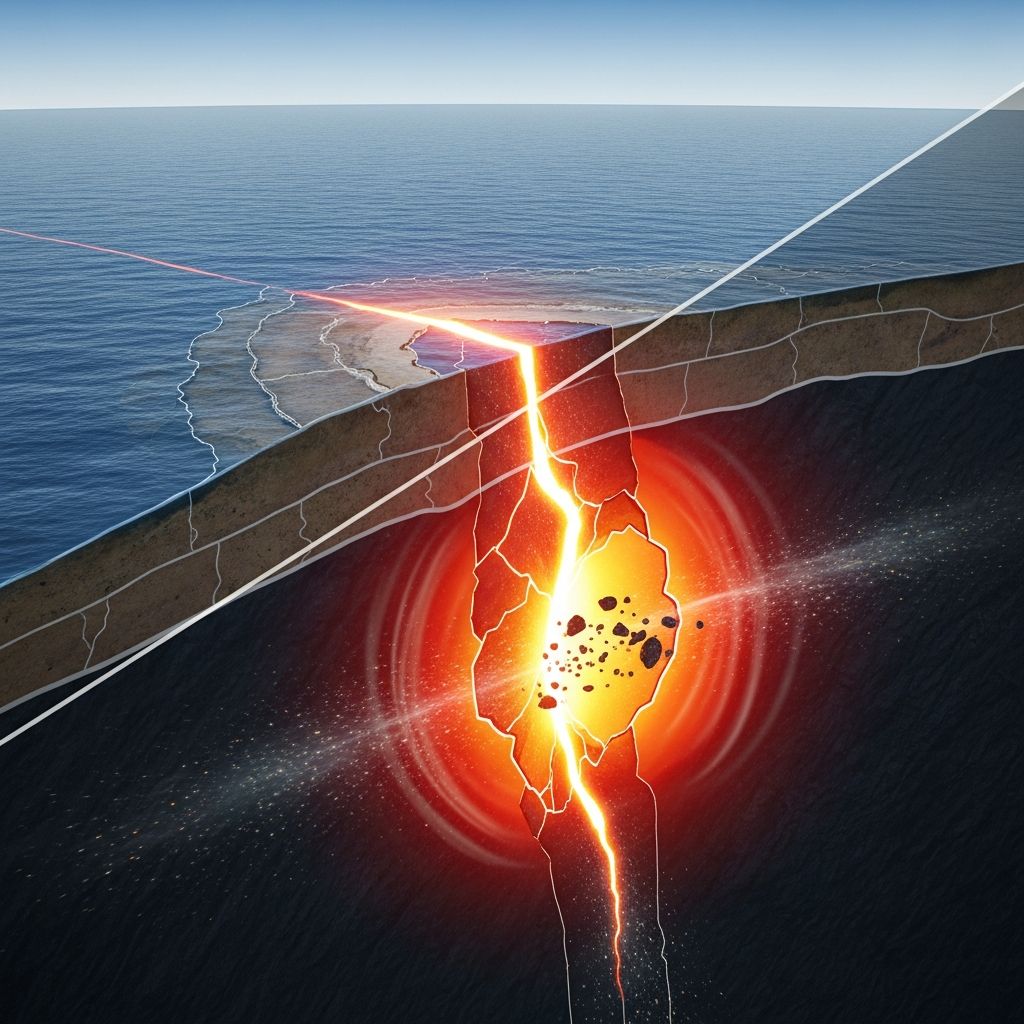
Deep earthquakes represent one of the most intriguing phenomena in seismology, challenging conventional ideas about how rocks break under extreme conditions. Unlike typical shallow tremors that shake the surface, these events originate at depths exceeding 300 kilometers, where immense pressures and temperatures should prevent brittle failure. Yet, they occur regularly, providing vital clues about Earth’s internal dynamics.
Defining Depth in Seismic Terms
Seismologists classify earthquakes by hypocenter depth: shallow (0-70 km), intermediate (70-300 km), and deep-focus (over 300 km, up to 700 km). Deep-focus events are rare outside subduction zones, where oceanic plates plunge into the mantle. Approximately two-thirds of them cluster in the Tonga-Kermadec zone near New Zealand, highlighting their ties to specific tectonic settings.
These quakes produce distinct seismic signatures. Their body waves travel through the mantle with less distortion than shallow waves, yielding sharp peaks on seismograms but minimal surface shaking. This makes them harder to feel at the surface but easier to pinpoint precisely.
Subduction Zones: The Exclusive Domain
Subduction zones are the primary theaters for deep seismicity. Here, one tectonic plate overrides another, forcing cold oceanic lithosphere deep into the hot mantle. This process creates Wadati-Benioff zones—linear bands of hypocenters tracing the descending slab.
Deep earthquakes delineate these slabs, revealing convection patterns in the upper mantle. From 1964 to 1986, they accounted for nearly 25% of global events, underscoring their prevalence despite depth constraints.
- Key subduction hotspots: Tonga-Kermadec, Japan Trench, Peru-Chile Trench.
- Slab characteristics: Age, shape, and thermal state influence seismicity patterns.
- Strain localization: High strain rates where slabs bend and fold trigger most events.
Stress Regimes Across Depths
Stress orientations vary with depth in subducting slabs. Intermediate-depth quakes (100-300 km) show tensile stress along subduction direction, as if the slab’s weight pulls it downward. At over 400 km, compressive stress dominates, suggesting slabs encounter resistance.
| Depth Range | Stress Type | Implied Mechanism |
|---|---|---|
| 70-300 km (Intermediate) | Tensile (down-dip) | Slab pull from overlying weight |
| >400 km (Deep) | Compressive (down-dip) | Resistance from stiff mantle |
| 250-300 km | Ambiguous | Seismicity minimum |
Recent analyses of over 415 magnitude 5.8+ events (50-350 km) reveal higher fracture energies and radiation efficiency with depth and slip amount, indicating unique rupture processes.
Leading Hypotheses for Deep Rupture
At depths beyond 70 km, frictional sliding fails due to high pressure and temperature promoting ductile flow. Deep quakes demand alternative brittle mechanisms.
Dehydration Embrittlement in Intermediate Depths
Hydrated minerals like serpentine release water at ~100 km, weakening surrounding rock via pore fluid pressure. This reduces effective stress, enabling fracture despite high confinement. Analogous to induced seismicity from wastewater injection, this explains many intermediate events but struggles at greater depths where fluids dissipate.
Phase Transformations: The Deep Frontier
Around 300-400 km, mantle minerals like olivine transform to denser spinel, shrinking volume and generating implosive stress at phase boundaries. Metastable olivine in cold slabs persists to 410 km before sudden transition, potentially nucleating quakes.
Though promising due to depth coincidence, critics note it doesn’t fully account for observed rupture dynamics.
Role of Fluids: A New Paradigm
Recent NSF-funded research challenges fluid scarcity assumptions. Evidence suggests subducted hydrous phases transport water to 300-700 km, facilitating slip via weakening. Carnegie scientists’ models integrate this with intermediate-depth insights.
Strain-Driven Deformation
UC Davis simulations link quakes to high strain rates in bending slabs, constraining dynamics regardless of exact trigger.
Global Distribution and Patterns
Deep seismicity maps slab geometry: colder, older slabs host more events due to rigidity. Variations within zones tie to volcanism and slab curvature.
- Tonga-Kermadec: Deepest recorded quakes (~670 km).
- Pacific Ring of Fire: Dominates global tally.
- Intrazone variability: Fault properties shift with slab parameters.
Scientific and Practical Implications
Deep quakes illuminate mantle structure, convection, and plate tectonics. They validate slab subduction models and inform mineral physics under extreme conditions.
Though less surface-threatening, they enhance global monitoring networks, aiding tsunami warnings from linked shallow events. Studying them refines probabilistic hazard models.
Recent Advances in Research
Post-2019 studies catalog source parameters, revealing depth-dependent energies. Eos reports on 16-year datasets show slab-controlled rupture styles. AGU Advances highlights fluid evidence, overturning dehydration limits. Numerical models emphasize strain.
Frequently Asked Questions (FAQs)
What causes earthquakes deeper than 300 km?
Deep earthquakes stem from subduction zone processes like dehydration embrittlement, phase transitions, and fluid-weakened faults, enabling brittle failure in high-pressure environments.
Are deep earthquakes dangerous?
They rarely cause surface damage due to depth but contribute to understanding tectonics and can link to volcanic activity or tsunamis via slab connections.
Where do most deep quakes occur?
Primarily in subduction zones, with Tonga-Kermadec hosting ~66% of deep-focus events.
How do scientists study them?
Via global seismic networks analyzing body waves, source spectra, and models of slab dynamics.
Can deep quakes happen outside subduction zones?
Extremely rare; they are almost exclusively subduction-linked.
Future Directions in Deep Seismology
Emerging tech like dense arrays and AI-driven waveform inversion promise finer rupture details. Lab simulations of mantle conditions and targeted field campaigns in key zones will test hypotheses. Integrating geochemistry could confirm fluid presence.
These efforts may resolve century-old riddles, enhancing plate tectonic theory and hazard assessment.
References
- Probing the Source Properties of Deep Earthquakes — Eos.org. 2023-approx. https://eos.org/research-spotlights/probing-the-source-properties-of-deep-earthquakes
- The Mystery of Deep Earthquakes — Berkeley Science Review. 2019-05-21. https://www.berkeleysciencereview.com/article/2019/05/21/the-mystery-of-deep-earthquakes
- Deep-focus Earthquake — Wikipedia (informational). N/A. https://en.wikipedia.org/wiki/Deep-focus_earthquake
- What Causes the Deep Earth’s Most Mysterious Earthquakes? — NSF.gov. 2023-approx. https://www.nsf.gov/news/what-causes-deep-earths-most-mysterious
- New Clues to Deep Earthquake Mystery — UC Davis. 2023-approx. https://www.ucdavis.edu/curiosity/news/new-clues-deep-earthquake-mystery
- Deep-focus Earthquakes — EBSCO Research Starters. N/A. https://www.ebsco.com/research-starters/earth-and-atmospheric-sciences/deep-focus-earthquakes
- The Science of Earthquakes — USGS.gov. 2024-approx. https://www.usgs.gov/programs/earthquake-hazards/science-earthquakes

Medha Deb is an editor with a master's degree in Applied Linguistics from the University of Hyderabad. She believes that her qualification has helped her develop a deep understanding of language and its application in various contexts. Medha specializes in the areas of beauty, health, sports, and wellness and is committed to ensuring that the content on the website is…