
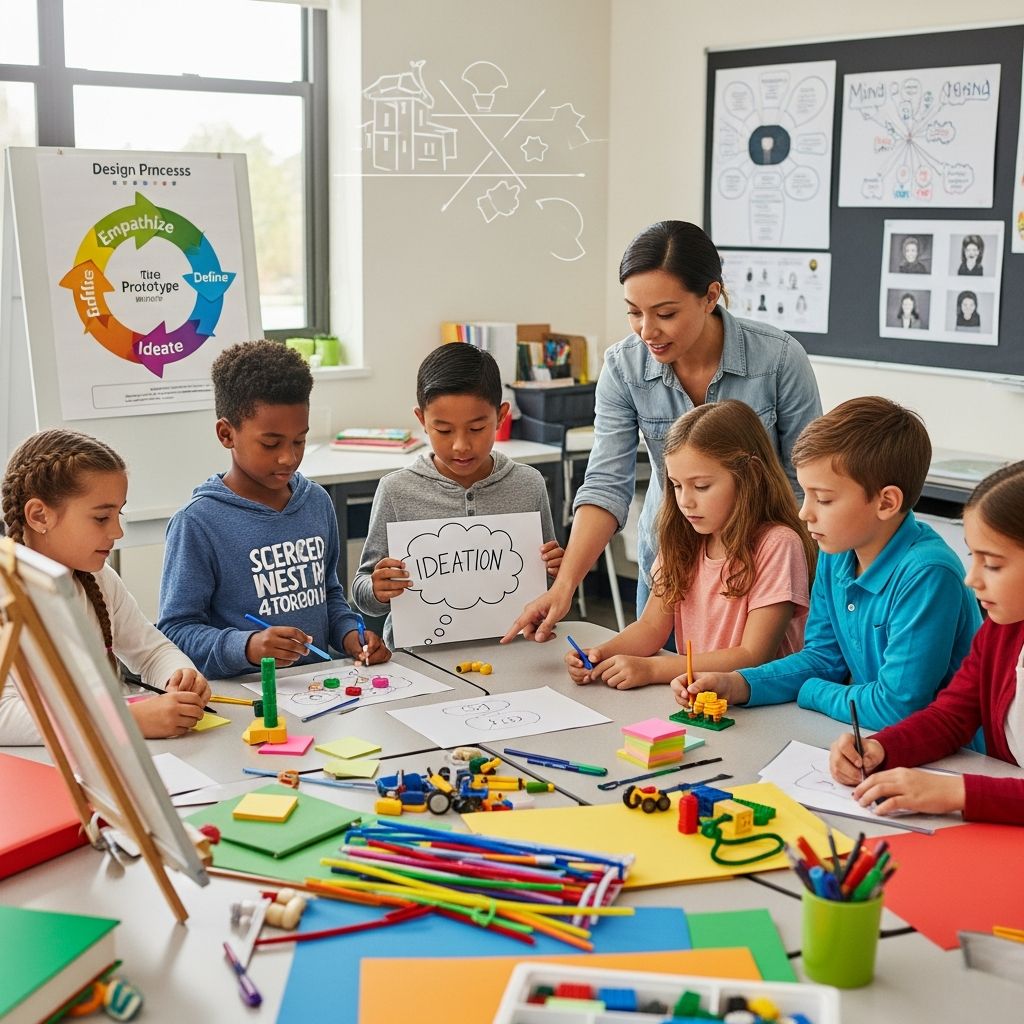
Design thinking emerges as a powerful methodology in education, shifting traditional teaching paradigms toward human-centered innovation. This approach equips educators and students with tools to address complex challenges through empathy, ideation, and iteration, fostering environments where creativity thrives alongside practical problem-solving.
Understanding the Essence of Design Thinking in Learning Environments
At its core, design thinking is a non-linear, iterative process that prioritizes user needs—here, students and teachers—over rigid structures. Originating from product design, it adapts seamlessly to education by encouraging deep empathy to uncover hidden needs, divergent thinking for idea generation, rapid prototyping for testing concepts, and reflective feedback loops for refinement. In classrooms, this translates to moving beyond rote memorization to authentic, real-world applications that resonate with learners’ lived experiences.
Educators adopting this mindset report heightened student engagement, as lessons evolve from passive reception to active co-creation. For instance, teachers facilitate empathy interviews where students map peers’ perspectives, revealing insights into learning barriers that standardized curricula often overlook. This foundational shift builds adaptive capacity, enabling schools to navigate evolving demands like diverse learner needs and technological integration.
Core Stages of Implementing Design Thinking
Design thinking unfolds in five interconnected phases, each building on the last to create robust solutions. Here’s how they manifest in educational settings:
- Empathize: Immerse in students’ worlds through observation, interviews, and shadowing to grasp emotions, motivations, and pain points.
- Define: Synthesize findings into clear, user-focused problem statements, avoiding assumptions.
- Ideate: Brainstorm wildly without judgment, generating a breadth of ideas to spark innovation.
- Prototype: Build tangible, low-fidelity models—sketches, storyboards, or mockups—to test assumptions quickly.
- Test: Gather feedback iteratively, refining prototypes based on real user interactions.
These stages form a cycle, not a straight line, allowing educators to revisit earlier steps as new insights emerge. Research shows this flexibility disrupts outdated change models, promoting nuanced, context-specific strategies over one-size-fits-all reforms.
Building Empathy: The Heart of Student-Centered Design
Empathy serves as the bedrock, transforming abstract challenges into personal narratives. Tools like empathy maps—dividing insights into what students think, feel, say, and do—help teachers uncover unspoken needs. One effective practice involves student shadowing, where educators spend time mirroring a learner’s day to identify environmental or instructional friction points.
In practice, a middle school teacher might use empathy interviews to explore why certain students disengage during group work. Responses reveal preferences for visual aids over verbal instructions, leading to redesigned activities with integrated multimedia. This human-centered lens not only boosts motivation but also cultivates emotional intelligence, preparing students for collaborative futures.
| Empathy Tool | Purpose | Classroom Example |
|---|---|---|
| Empathy Map | Visualize user perspectives | Chart student reactions to math tasks |
| Interview Guide | Elicit qualitative data | Ask ‘What frustrates you in science labs?’ |
| Shadowing | Observe in context | Follow a student through a full class period |
Ideation and Prototyping: Sparking Creative Solutions
Once empathy illuminates the problem, ideation unleashes creativity. Classrooms buzz with ‘yes, and…’ brainstorming sessions, where no idea is dismissed prematurely. Students generate dozens of solutions to challenges like ‘How might we make history lessons interactive?’—ranging from VR simulations to peer-led debates.
Prototyping follows, emphasizing speed over perfection. Simple materials like paper, markers, and recyclables enable quick builds. A prototype for a collaborative writing tool might start as a cardboard mockup of an app interface, tested in minutes for usability. This hands-on approach demystifies failure, framing it as data for iteration rather than defeat.
Studies highlight how such practices benefit underserved learners most, as they encourage persistence and revision—key to overcoming achievement gaps.
Real-World Case Studies: Design Thinking in Action
Across grade levels, design thinking yields transformative results. In a sixth-grade study, students trained in feedback-seeking and multi-outcome exploration outperformed peers on subsequent challenges, revising work more thoroughly and avoiding premature conclusions. Low-achieving students showed the greatest gains, demonstrating equity potential.
High school leadership teams, using design thinking workshops, reframed district-wide issues. By empathizing with teachers via focus groups, they crafted tailored professional development, moving from generic plans to responsive, evolving initiatives. Participants noted ‘nuanced’ solutions that colleagues embraced, contrasting static annual reviews.
Another example: educators redesigned classroom spaces per design principles, shifting from rows to flexible zones signaling collaboration. This physical empathy—aligning environments with desired behaviors—enhanced interaction and metacognition.
Overcoming Barriers: From Mindset Shifts to Systemic Change
Despite promise, entrenched norms challenge adoption. Traditional hierarchies position principals as sole change agents, sidelining teacher input. Design thinking counters this by democratizing the process, yet requires professional learning to interrogate biases.
A year-long workshop revealed mindset evolution: participants gained deeper self-awareness and contextual insight, though actions lagged due to systemic inertia. Facilitators stress critical reflection, embedding self-regulation strategies like goal-setting and failure reframing to bridge mindset and practice.
Policy implications urge sustained support—multi-year training, not workshops—to build capacity for complex challenges like equity and tech integration.
Practical Strategies for Everyday Classroom Integration
- Start small: Dedicate 20 minutes weekly to a micro-challenge, like redesigning recess feedback.
- Co-design with students: Involve learners in planning units for ownership.
- Leverage tools: Use free kits from organizations like IDEO for structured entry.
- Measure impact: Track engagement via pre/post empathy surveys.
- Scale up: Form cross-grade teams for school-wide prototypes.
These steps embed design thinking without overhauling schedules, yielding immediate engagement boosts.
Frequently Asked Questions (FAQs)
How does design thinking differ from project-based learning?
Design thinking emphasizes iterative empathy and prototyping, while project-based learning focuses on sustained inquiry toward deliverables; they complement each other effectively.
Is design thinking suitable for young elementary students?
Yes, simplified versions with storytelling and play-based prototypes work well from kindergarten, building foundational skills.
What resources are needed to start?
Minimal: paper, markers, and time; digital tools like Jamboard enhance remote collaboration.
Can it address standardized testing pressures?
Absolutely—it reframes tests as prototypes, fostering deeper understanding that improves performance.
How to train teachers new to this?
Begin with self-prototyping personal challenges, then observe peer models for low-risk entry.
Future Horizons: Scaling Design Thinking Across Education
As schools face post-pandemic recovery and AI disruptions, design thinking positions education for resilience. Integrating self-regulated learning—goal-setting, challenge-seeking—amplifies its pedagogy, ensuring long-term efficacy. Districts scaling via LED networks report ‘bigger-than-us’ lessons, connecting classrooms to communities for authentic impact.
Ultimately, this catalyst invites educators to view change as co-creative journey, not top-down directive, promising vibrant, equitable learning ecosystems.
References
- Stuck in this wheel: The use of design thinking for change in educational organizations — Retna, K. S., et al. 2022-08-01. https://pmc.ncbi.nlm.nih.gov/articles/PMC9360732/
- What is Design Thinking in Education? — Designing Schools. 2023-05-15. https://designingschools.org/what-is-design-thinking-in-education/
- What Is Design Thinking? — Edutopia. 2022-11-10. https://www.edutopia.org/what-is-design-thinking-for-educators
- Design Thinking Has a Pedagogy Problem… And a Way Forward — Schell, J. 2021-09-20. https://designcreativetech.utexas.edu/design-thinking-has-pedagogy-problem-way-forward
- Five Ways to Use Design Thinking as a Solutionary Educator — Humane Education. 2023-02-14. https://humaneeducation.org/five-ways-to-use-design-thinking-as-a-solutionary-educator/

Medha Deb is an editor with a master's degree in Applied Linguistics from the University of Hyderabad. She believes that her qualification has helped her develop a deep understanding of language and its application in various contexts. Medha specializes in the areas of beauty, health, sports, and wellness and is committed to ensuring that the content on the website is…