
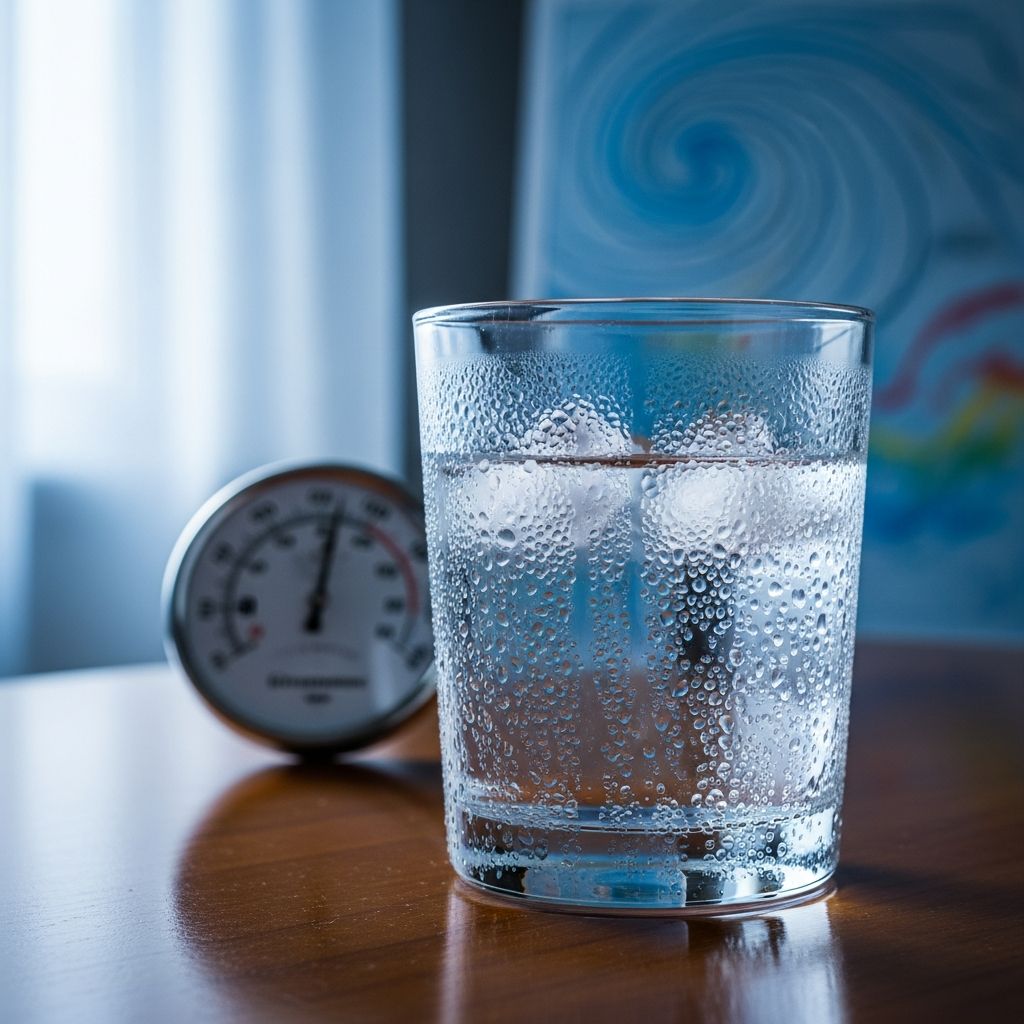
The dew point represents the temperature at which air, under constant pressure, becomes fully saturated with water vapor, prompting condensation into liquid water or dew. This metric surpasses relative humidity in accuracy for assessing atmospheric moisture, directly indicating the air’s water content regardless of temperature fluctuations.
Defining Dew Point in Atmospheric Science
In essence, dew point is the critical threshold where cooling air leads to 100% relative humidity, causing water vapor to transition from gas to liquid form. Unlike relative humidity, which varies with air temperature, dew point remains stable as it reflects absolute humidity—the actual quantity of moisture present. For instance, air holding a fixed amount of water vapor will condense upon reaching its dew point temperature, forming dew on surfaces or fog in the atmosphere.
When temperatures drop below freezing, this point shifts to the frost point, where water vapor deposits directly as ice crystals rather than melting into liquid first. This distinction proves vital in cold climates, influencing everything from road safety to agricultural planning.
How Dew Point Differs from Relative Humidity
Relative humidity measures moisture relative to the maximum the air can hold at a given temperature, often misleading as it rises simply when air cools without gaining moisture. Dew point, conversely, provides a direct humidity gauge: higher values signal more moisture, making it superior for comfort prediction and energy assessments.
| Dew Point Range (°C) | Dew Point Range (°F) | Comfort Perception | Relative Humidity at 32°C (90°F) |
|---|---|---|---|
| Over 27 | Over 80 | Extremely humid, oppressive | 73%+ |
| 24–26 | 75–79 | Very humid, sticky | 62–72% |
| 21–24 | 70–74 | Humid, uncomfortable | 52–61% |
| 18–21 | 65–69 | Somewhat humid | 44–51% |
| 16–18 | 60–64 | Comfortable | 37–43% |
| 13–16 | 55–59 | Quite dry | 31–36% |
| 10–12 | 50–54 | Dry | 26–30% |
This table illustrates dew point’s reliability: at 20°C (68°F), discomfort sets in for most, independent of air temperature.
Calculating and Measuring Dew Point
Professionals measure dew point using hygrometers, which chill a mirror until dew forms, then detect via optics or conductivity. Calculation involves formulas linking temperature, pressure, and mixing ratios: Relative Humidity = (Actual Mixing Ratio / Saturation Mixing Ratio) × 100, where dew point aligns with 100% RH.
In practice, meteorologists derive it from air temperature and relative humidity via approximation equations, such as Magnus-Tetens formulas for precision. Industrial sensors, like those from Vaisala, employ chilled mirror technology for trace moisture detection down to -80°C.
- Mirror-based hygrometers: Gold standard for accuracy, observing condensation directly.
- Capacitive sensors: Measure humidity changes correlating to dew point, ideal for real-time monitoring.
- Pressure effects: Higher pressure elevates dew point; systems account for this in compressed air applications.
Dew Point’s Role in Weather Prediction
Dew point forecasts nighttime lows, as air cools to this temperature near the ground, often yielding dew or fog. High dew points (above 21°C/70°F) signal potential thunderstorms by fueling atmospheric instability. Meteorologists track it for severe weather alerts, aviation hazards like fog, and frost warnings impacting travel and farming.
During summer, dew points above 18°C (65°F) predict muggy conditions, guiding cooling demands; below 13°C (55°F), air feels crisp and invigorating.
Practical Impacts on Daily Comfort and Health
Human perception ties closely to dew point: values over 24°C (75°F) feel oppressive, spurring sweat evaporation struggles and heat stress risks. Athletes and outdoor workers monitor it for heat index equivalents, where high dew points amplify dangers.
In homes, understanding dew point prevents mold by maintaining indoor levels below 16°C (60°F), balancing ventilation and dehumidification.
Industrial and Technical Applications
In compressed air systems, dew point ensures dryness: refrigerant dryers achieve +5°C (41°F), desiccants reach -40°C (-40°F) or lower to avert corrosion. Oil and gas sectors use it for pipeline integrity, preventing hydrate formation.
HVAC designs target dew points for efficiency, as high values increase cooling loads. Aviation relies on it for instrument precision and frost risk assessment.
Advanced Uses: Frost Point and Beyond
Beneath 0°C, frost point governs ice deposition, critical for winter road treatments and aircraft de-icing. In labs, cloud point analogs apply to liquids, aiding petroleum quality control.
Climate studies leverage dew point trends to track humidity shifts, informing drought or flood models.
Frequently Asked Questions
What does a high dew point indicate?
A high dew point means the air holds substantial moisture, often leading to muggy, uncomfortable conditions and higher storm risks.
Is dew point better than relative humidity for forecasts?
Yes, dew point directly measures moisture content, making it more reliable for comfort, energy use, and weather stability predictions.
How do you lower dew point in a building?
Use dehumidifiers, air conditioning, or desiccants to remove moisture, targeting below 16°C (60°F) for mold prevention.
Can dew point be higher than air temperature?
No, dew point is always equal to or lower than air temperature; equality signals saturation.
Why is dew point crucial for aviation?
It predicts fog, frost, and low visibility, essential for safe takeoffs, landings, and flight planning.
References
- Dew point – Wikipedia — Wikipedia Contributors. 2023-10-15. https://en.wikipedia.org/wiki/Dew_point
- What is dew point and how to measure it? — Vaisala. 2019-09-01. https://www.vaisala.com/en/blog/2019-09/what-dew-point-and-how-measure-it
- Dew Point Definition and How to Measure It for Industries — Process Sensing Technologies. 2023-01-01. https://www.processsensing.com/en-us/blog/dew-point-definition-and-how-to-measure-it-for-industries.htm
- Dew Point Definition and Measurement in Compressed Air Systems — Renkeer. 2024-01-01. https://www.renkeer.com/dew-point/
- Dew Point vs Humidity — National Weather Service. 2023-06-20. https://www.weather.gov/arx/why_dewpoint_vs_humidity
- What is Dew Point? Definition, Formula & Examples — Study.com. 2024-02-15. https://study.com/academy/lesson/video/what-is-dew-point-definition-formula-calculation.html

Medha Deb is an editor with a master's degree in Applied Linguistics from the University of Hyderabad. She believes that her qualification has helped her develop a deep understanding of language and its application in various contexts. Medha specializes in the areas of beauty, health, sports, and wellness and is committed to ensuring that the content on the website is…