
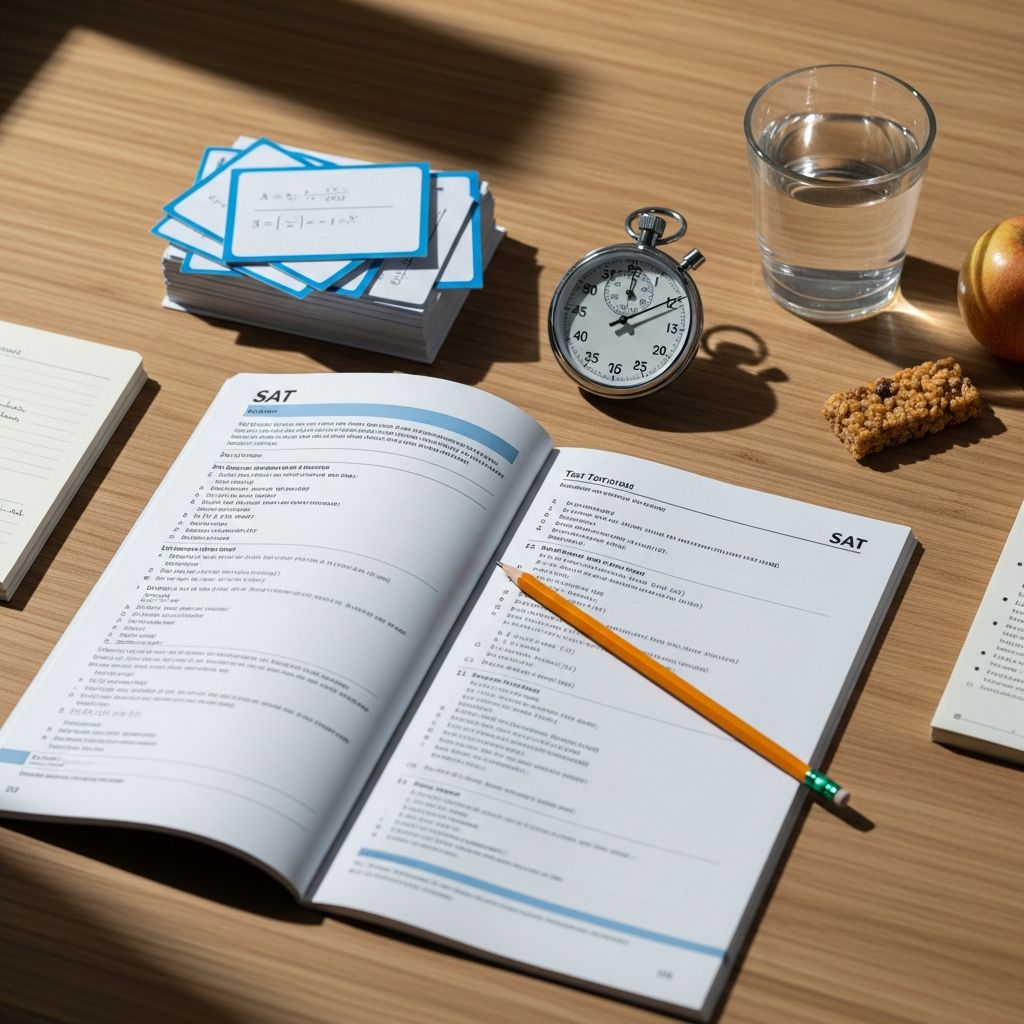
The SAT remains a pivotal step toward college admissions, demanding not just knowledge but smart execution under pressure. Success hinges on blending rigorous preparation with tactical test-taking approaches that maximize efficiency and minimize errors. This guide draws from expert insights to equip you with actionable methods for every phase, from initial study sessions to the final question.
Building a Solid Foundation Through Smart Practice
Effective preparation starts with understanding the test’s structure and simulating real conditions. The digital SAT features adaptive modules in Reading and Writing, plus Math, with built-in tools like timers and eliminators. Begin by familiarizing yourself with these via official resources.
Take full-length practice tests under timed conditions to build stamina. Opt for paper versions when possible to mimic the exam environment closely, allowing self-scoring for immediate feedback. Analyze every mistake: identify patterns in weak areas, such as grammar rules or algebraic concepts, and target them with focused drills.
- Schedule 1-2 full practice exams weekly, reviewing scores to track progress.
- Use the Student Question Bank for skill-specific practice on recurring question types.
- Pair with free tools like Khan Academy for personalized lessons tied to your performance.
Practice isn’t just repetition; it’s refinement. Simulate test-day logistics, like bubbling answers in batches to save time, and note how anxiety affects pacing. Over time, this acclimates you to pressure, reducing real-exam jitters.
Optimizing Your Study Routine for Peak Retention
Avoid cramming; spaced repetition and active recall yield better results. Dedicate sessions to one section daily: mornings for Math when analytical skills peak, evenings for Reading to hone comprehension.
Track time per question during drills—aim for 1:11 in Reading/Writing and 1:35 in Math. If a problem stumps you, flag it and return later, ensuring easy points aren’t missed.
| Section | Time per Question | Practice Goal |
|---|---|---|
| Reading & Writing | ~1 min 11 sec | Complete 8-9 in 10 min |
| Math | ~1 min 35 sec | Complete 6-7 in 10 min |
Incorporate breaks using techniques like Pomodoro: 25 minutes focused work, 5-minute rest. This sustains concentration without burnout.
Pre-Test Rituals: The Night and Morning Before
The day before, prioritize rest over last-minute review. Limit study to 30 minutes max, focusing on weak spots via flashcards. Avoid screens; opt for light reading or a walk to wind down.
Pack essentials: ID, admission ticket, watch, layered clothing, snacks, water. A watch helps track pacing independently of the built-in timer.
Morning of: Wake early with a shower to fully alert. Fuel with a balanced breakfast—protein, complex carbs, avoid heavy sugars. Do light exercise like jumping jacks for 10-15 minutes to oxygenate your brain and elevate mood.
- Arrive 30 minutes early to settle nerves.
- Deep breaths: Inhale 4 counts, hold 4, exhale 4.
- Visualize success: Recall a strong practice run.
Conquering Reading and Writing: Precision Over Speed
Reading/Writing modules test comprehension, grammar, and rhetoric. Use the built-in highlighter and annotator liberally—mark key phrases, transitions, and evidence.
For passages: Read questions first to guide focus. Predict answers in your words before options appear, then match or eliminate. Keywords like “however,” “thus,” or “primarily” signal shifts; circle them.
Strategy: Skim intro/summary blurbs for context. Tackle easier questions first—vocabulary-in-context or short grammar—building momentum. For tough ones, guess and flag; no penalty exists.
Elimination is key: Cross off extremes (always/never), out-of-scope info, or mismatches to passage. Aim to narrow to two, then choose.
Grammar and Editing Tactics
Standard English questions reward pattern recognition: subject-verb agreement, modifier placement, parallelism. Read aloud mentally; awkward phrasing flags errors. For rhetoric, assess purpose—does it strengthen, concise, or transition smoothly?
Exceling in Math: Tools and Logical Flow
Math covers algebra, geometry, trig, and data. Desmos calculator is integrated—master it via practice for graphing, regressions.
Approach: Scan for quick wins like plug-ins or arithmetic. Write equations on scrap paper; draw diagrams for geometry. Batch bubble to maintain flow.
- Permitted: Built-in Desmos, annotation, eliminator.
- Skip multi-step if time-tight; return post-easy ones.
- Check units, signs in answers.
For word problems, translate to variables: Let x = unknowns, set equations. Practice under timer to balance accuracy/speed.
Mastering Time and Pacing Under Pressure
Pacing prevents panic. Use the timer: Hide initially to avoid distraction, check at 10-min marks. Every question equals points—prioritize volume.
Flag-and-skip rule: 30 seconds max per question initially. Circle in booklet, bubble in groups of 5-10.
Endgame: 2 minutes left? Bubble all flags randomly if needed—better than blanks.
Managing Stress and Staying Focused
Anxiety spikes with unfamiliarity; practice erodes it. Positive self-talk: “I’ve prepped for this.” Physical cues like stretching between modules reset.
If stuck, move—fresh eyes later often reveal solutions. Stay hydrated; use breaks for deep breathing.
Digital SAT Specifics: Leverage the Tech
Adaptive format means Module 2 adjusts difficulty—strong first module unlocks harder (higher-scoring) questions. Tools enhance: Option Eliminator speeds choices; liner notes clarify.
Practice on Bluebook app for interface familiarity. Battery life? Centers provide devices.
Frequently Asked Questions (FAQs)
What if I run out of time on a module?
Answer every question—guess on flags. No penalty, and partial credit isn’t scored, but attempts count toward scaling.
Should I guess on unknowns?
Always. With 4 choices, random guess is 25% right; elimination boosts to 50%.
How much sleep night before?
7-9 hours. Consistent bedtime prevents insomnia; tired brains falter on logic.
Paper vs. digital practice?
Both, but paper simulates bubbling; digital hones tools. Official Bluebook for authenticity.
Best last-week focus?
Timed sections, error logs, pacing drills. Light review only day prior.
Long-Term Score Improvement Roadmap
Week 1-4: Diagnostic + full practices. Week 5-8: Targeted drills. Final week: 2-3 mocks + review.
Target 100+ point gains via consistency. Official scores guide goal-setting.
Post-test: Scores in days; superscore policies vary—retake if needed.
References
- 5 Must-Know SAT Reading Tips — Kaplan Test Prep. 2023. https://www.kaptest.com/study/sat/5-must-know-sat-reading-tips/
- Last-Minute SAT Test Tips — The Princeton Review. 2023. https://www.princetonreview.com/college-advice/sat-cram-tips
- 7 SAT Strategies From Someone Who Scored a 1600 — Learner. 2023. https://www.learner.com/secret-sat-strategies
- Last Minute Tips For The SAT From A Perfect Scorer — PrepPros – SAT & ACT Test Prep (YouTube). 2025. https://www.youtube.com/watch?v=m3PvNYRGVJk
- Top Digital SAT® Exam Strategies — Barron’s Educational Series. 2024. https://www.barronseduc.com/blogs/sat/post/top-digital-sat-exam-strategies
- Top 10 Test Taking Tips for the Digital SAT — College Board Blog. 2024-04-04. https://blog.collegeboard.org/top-10-test-taking-tips-digital-sat
- Practice and Preparation — College Board (SAT Suite). 2026. https://satsuite.collegeboard.org/practice

Medha Deb is an editor with a master's degree in Applied Linguistics from the University of Hyderabad. She believes that her qualification has helped her develop a deep understanding of language and its application in various contexts. Medha specializes in the areas of beauty, health, sports, and wellness and is committed to ensuring that the content on the website is…