
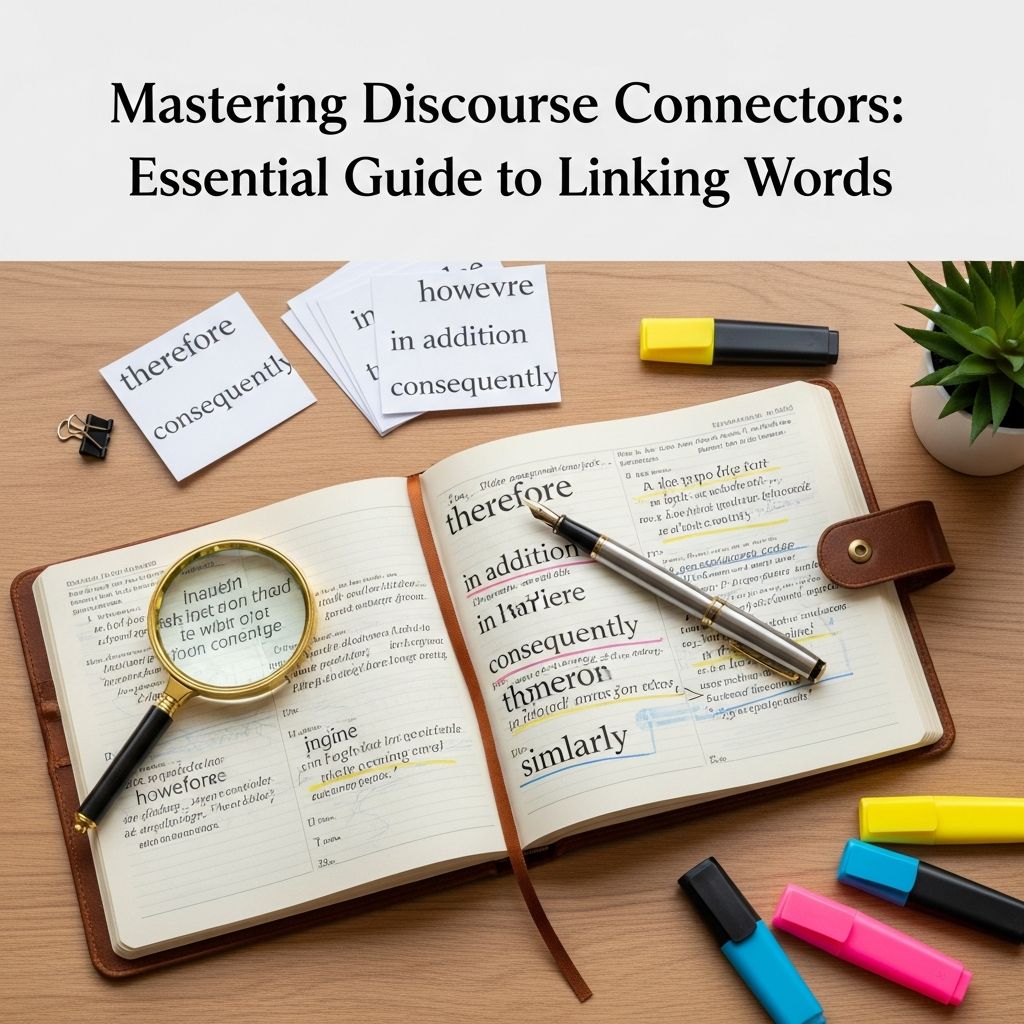
Understanding Discourse Connectors and Their Role in Writing
Effective writing relies on more than just individual sentences strung together. The glue that holds ideas together and guides readers through your thoughts comes in the form of discourse connectors, also known as linking words or transition phrases. These linguistic tools serve as signposts that help readers navigate from one concept to another, making your writing more cohesive, professional, and easier to comprehend.
Discourse connectors function as bridges between ideas, sentences, and paragraphs. When used strategically, they prevent the jarring sensation of abrupt topic changes and create a logical progression of thought. Whether you’re writing an academic essay, professional report, or creative piece, understanding and mastering these connectors is fundamental to producing polished, readable work.
The importance of these linguistic devices extends beyond mere aesthetics. Research in cognitive psychology suggests that readers process information more efficiently when ideas are explicitly connected. By using appropriate discourse connectors, writers signal to their audience what type of relationship exists between concepts, allowing readers to anticipate the direction of the argument and stay engaged throughout the text.
The Foundation: Four Primary Categories of Discourse Connectors
While discourse connectors appear in numerous forms and serve many functions, linguists have identified four fundamental categories that encompass most common usage. Understanding these primary categories provides a foundation for recognizing and selecting appropriate connectors for any writing situation.
The first category comprises additive connectors, which signal that additional information is being introduced. These connectors reinforce ideas and expand on previously stated points without contradiction. The second category includes adversative connectors, which highlight opposition, contrast, or unexpected relationships between ideas. The third encompasses causal connectors, which establish cause-and-effect relationships and demonstrate how one idea leads to or results from another. Finally, sequential connectors organize information chronologically or logically, clarifying the order and structure of ideas within your work.
Additive Connectors: Expanding Your Ideas
Additive connectors allow writers to accumulate information, introduce supporting evidence, and reinforce their arguments. These connectors create a sense of building momentum, where each new statement adds weight to the overall point. Common examples include additionally, furthermore, moreover, in addition, and also. Each of these serves slightly different purposes within the additive category.
When you use additive connectors, you’re telling your reader that what follows is connected to what came before, contributing to the same general direction of thought. For instance, you might write: “The research demonstrated significant improvements in efficiency. Furthermore, participants reported increased job satisfaction.” Here, the second finding strengthens the overall positive assessment without contradicting the first finding.
Adversative Connectors: Managing Contradictions and Contrasts
Adversative connectors handle situations where ideas diverge, conflict, or present unexpected complications. These connectors prepare readers for a shift in perspective or the introduction of limiting factors. Words and phrases in this category include however, nevertheless, on the other hand, conversely, and in contrast.
Adversative connectors are particularly valuable when you need to acknowledge counterarguments or present alternative viewpoints. For example: “The traditional approach has proven cost-effective for decades. However, emerging technologies now offer solutions that are both more efficient and environmentally sustainable.” This structure validates the old approach while signaling that new information challenges or complicates the previous statement.
Causal Connectors: Establishing Relationships and Consequences
Causal connectors reveal the logical relationships between ideas, showing how one concept leads to, causes, or results from another. This category includes connectors such as because, since, therefore, consequently, as a result, and hence. These connectors are essential for explaining reasoning, supporting arguments, and demonstrating the implications of your points.
In academic and professional writing, causal connectors often appear when explaining methodology, discussing implications, or building logical arguments. A typical usage might be: “The survey received responses from over two hundred participants. Consequently, the findings provide robust statistical significance for our conclusions.” Here, the causal connector links the sample size directly to the reliability of the results.
Sequential Connectors: Creating Order and Structure
Sequential connectors organize information in time-based or logical progression. These include first, second, next, subsequently, finally, and meanwhile. Sequential connectors are invaluable for creating clear structure within essays, reports, and instructional writing.
These connectors serve multiple functions. They can enumerate steps in a process, organize arguments by priority, or track chronological development. For example: “The project unfolded in three distinct phases. Initially, the team conducted extensive market research. Subsequently, prototypes were developed and tested. Finally, the most promising design was selected for full production.”
Beyond the Basics: Extended Connector Functions
While the four primary categories provide essential organization, writers benefit from understanding additional specific functions that connectors perform within these broader categories.
Exemplification and Illustration Connectors
These connectors introduce specific examples that support general statements. Phrases such as for instance, for example, to illustrate, and specifically signal that concrete evidence or detailed cases are about to be presented. These connectors help bridge the gap between abstract concepts and real-world applications. When writing “The company has successfully implemented sustainable practices. For instance, their manufacturing facility now operates entirely on renewable energy sources,” the connector clearly marks the transition from general claim to specific evidence.
Comparison and Similarity Connectors
Connectors in this function highlight parallels and similarities between ideas. Words like similarly, likewise, in the same way, and by the same token indicate that two concepts share important characteristics. These connectors help readers recognize patterns and relationships. For example: “The first study found significant correlation between exercise and mental health. Similarly, the subsequent research confirmed this relationship across different demographic groups.”
Clarification and Explanation Connectors
When you need to restate ideas more clearly or provide additional explanation, clarification connectors like that is, in other words, to clarify, and to put it another way prove invaluable. These connectors acknowledge that you’re restating something for enhanced understanding without introducing new information. They demonstrate that you’re addressing potential confusion.
Concession and Qualification Connectors
These connectors acknowledge limitations, exceptions, or partial truths. Phrases such as granted, certainly, to be sure, and although signal that you’re making allowances for opposing viewpoints or qualifying your statements. They demonstrate intellectual honesty and nuanced thinking. For instance: “While previous methods had limitations, they nevertheless contributed valuable insights to our current understanding.”
Emphasis and Intensification Connectors
When you need to strengthen a point or underscore its importance, emphasis connectors like indeed, certainly, without doubt, and in fact serve this function. These connectors signal to readers that what follows deserves particular attention. Usage might appear as: “The findings were not merely interesting; they were, in fact, revolutionary in their implications for the field.”
Summary and Conclusion Connectors
As writing reaches its endpoint, summary connectors like in summary, in brief, to sum up, and in conclusion help wrap up discussions and draw final statements. These connectors signal that you’re moving toward closure and help readers understand that supporting details are being synthesized into key takeaways.
Strategic Placement and Usage Patterns
Knowing which connector to use matters less than understanding where and how to use it effectively. Discourse connectors can appear at the beginning of sentences, embedded within sentences, or at the start of new paragraphs.
Beginning a sentence with a connector immediately signals the relationship between ideas: “Furthermore, this approach offers additional advantages.” Placing a connector mid-sentence creates flow while emphasizing the relationship: “This approach, moreover, offers additional advantages.” Embedding connectors within complex sentences requires careful punctuation but can create sophisticated prose.
Writers should avoid overusing connectors, which can make prose feel mechanical or artificial. Strategic selection means using connectors where relationships between ideas are complex or where readers might otherwise miss connections. Sometimes, punctuation alone or context makes the relationship clear, rendering an explicit connector unnecessary.
Avoiding Common Pitfalls with Discourse Connectors
Even with good intentions, writers sometimes misuse or overuse connectors in ways that undermine their writing quality. Understanding common mistakes helps prevent them.
- Redundancy: Using multiple connectors that convey the same relationship wastes words and weakens impact. Choose one appropriate connector rather than combining similar ones.
- Imprecise selection: Choosing a connector that doesn’t accurately reflect the relationship between ideas confuses readers. For example, using “therefore” when “however” is appropriate fundamentally changes meaning.
- Isolation from context: Connectors derive their power from clear preceding information. Without establishing what ideas are being connected, even the perfect connector fails.
- Excessive formality: While connectors enhance writing, overloading text with academic-sounding phrases creates stilted, difficult prose.
- Inconsistent usage: Fluctuating between formal and informal connectors without reason creates stylistic jarring and suggests careless writing.
Discourse Connectors in Different Writing Contexts
The appropriateness and frequency of connector usage varies across writing contexts. Academic writing typically employs connectors more formally and frequently than creative writing. Professional reports benefit from clear structural signposting that connectors provide. Blog posts and journalistic writing often use connectors more sparingly to maintain accessible tone.
Understanding your audience and purpose helps determine appropriate connector density. Academic readers expect explicit logical relationships marked by connectors, while general audiences may find excessive formal connectors off-putting. Adjusting connector usage to match context demonstrates writing maturity and audience awareness.
Building Proficiency with Discourse Connectors
Developing natural, effective use of discourse connectors requires practice and attention. Readers of well-written texts unconsciously absorb effective connector usage. Writers can accelerate this learning by actively noting connectors encountered in quality writing and experimenting with them in their own work.
Keeping a reference list of connectors organized by category and function provides a valuable resource during writing. However, true proficiency comes not from memorization but from understanding the relationships connectors signal and selecting them intuitively based on meaning rather than formula.
Quick Reference: Connector Categories and Examples
| Category | Function | Common Examples |
|---|---|---|
| Additive | Adding information and reinforcing ideas | Furthermore, moreover, additionally, in addition, also |
| Adversative | Highlighting contrast and opposition | However, nevertheless, on the other hand, conversely |
| Causal | Showing cause and effect relationships | Therefore, consequently, as a result, hence, because |
| Sequential | Organizing information chronologically or logically | First, next, subsequently, finally, meanwhile |
| Exemplification | Introducing specific examples | For instance, for example, to illustrate, specifically |
| Comparison | Highlighting similarities | Similarly, likewise, in the same way, by the same token |
| Clarification | Restating ideas for clarity | That is, in other words, to clarify, to put it another way |
| Emphasis | Strengthening and underscoring points | Indeed, certainly, without doubt, in fact |
| Summary | Drawing together key points | In summary, in brief, to sum up, in conclusion |
Frequently Asked Questions About Discourse Connectors
Q: How many discourse connectors should I use in an essay?
A: There’s no magic number. The frequency depends on your writing style, purpose, and audience. Academic writing typically uses connectors more liberally than creative writing. Generally, aim for one connector every two to four sentences on average, but prioritize clarity over formula.
Q: Can I use the same connector multiple times in one essay?
A: Yes, but use variety to maintain reader engagement. If you use “however” five times in a short essay, readers may find it repetitive. Mix connectors that serve similar functions to maintain freshness while preserving clarity.
Q: Are some connectors too informal for academic writing?
A: Yes. Connectors like “anyway,” “besides,” and “still” are acceptable in many contexts but may be considered too informal for formal academic papers. When in doubt, consult your style guide or use more formal alternatives.
Q: How do I know which connector to choose when several seem appropriate?
A: Consult a thesaurus or connector guide to understand subtle differences in meaning. For example, “however” emphasizes contrast, while “nevertheless” emphasizes concession despite preceding information. Choose based on the precise relationship you want to convey.
Q: Can a paragraph begin with a connector?
A: Yes. Starting a paragraph with a connector effectively links it to previous content. This technique is common in academic and professional writing to show how new paragraphs relate to preceding ideas.
Q: What if my writing feels fine without connectors?
A: Connectors are tools for enhancing clarity and flow, not requirements. If your writing is clear and well-organized without them, you’re not obligated to add them. However, strategic connector use almost always improves professional and academic writing quality.
Conclusion: Mastering the Art of Cohesion
Discourse connectors represent one of the most powerful yet underutilized tools in a writer’s toolkit. By understanding the four primary categories and their extended functions, writers can craft prose that guides readers effortlessly from one idea to the next. The difference between writing that confuses and writing that clarifies often comes down to how effectively ideas are connected through strategic use of linking words and phrases.
Developing proficiency with discourse connectors requires conscious attention and practice, but the investment pays dividends across all forms of writing. Whether composing academic essays, professional reports, or persuasive pieces, the ability to select and deploy appropriate connectors demonstrates writing maturity and communicative skill. By incorporating the strategies and categories discussed here, writers can significantly enhance the quality, professionalism, and impact of their work.
References
- Transition Words & Phrases | List & Examples — Scribbr. Accessed 2026-04-04. https://www.scribbr.com/academic-writing/transition-words/
- 92 Essay Transition Words to Know, With Examples — Grammarly. Accessed 2026-04-04. https://www.grammarly.com/blog/academic-writing/essay-transition-words/
- Common Transition Words and Phrases — The Writing Studio, Vanderbilt University. Accessed 2026-04-04. https://www.vanderbilt.edu/writing/resources/handouts/transitions/
- Transitional Words & Phrases — Smart Words. Accessed 2026-04-04. https://www.smart-words.org/linking-words/transition-words.html
- Effective Transition Words for Research Papers — Wordvice. Accessed 2026-04-04. https://blog.wordvice.com/common-transition-terms-used-in-academic-papers/
- Transitional Devices — Purdue Online Writing Lab. Accessed 2026-04-04. https://owl.purdue.edu/owl/general_writing/mechanics/transitions_and_transitional_devices/transitional_devices.html

- Integrated M.A. in Applied Linguistics, University of Hyderabad
- 5+ years in editorial, instructional, SEO, and research-based writing
Sneha is a relationships and lifestyle writer with a strong foundation in applied linguistics and certified training in relationship coaching. She brings over five years of writing experience to theskillvault, crafting thoughtful, research-driven content that empowers readers to build healthier relationships, boost emotional well-being, and embrace holistic living. Her writing and insights reflect the belief that beauty, happiness, and wellness…