
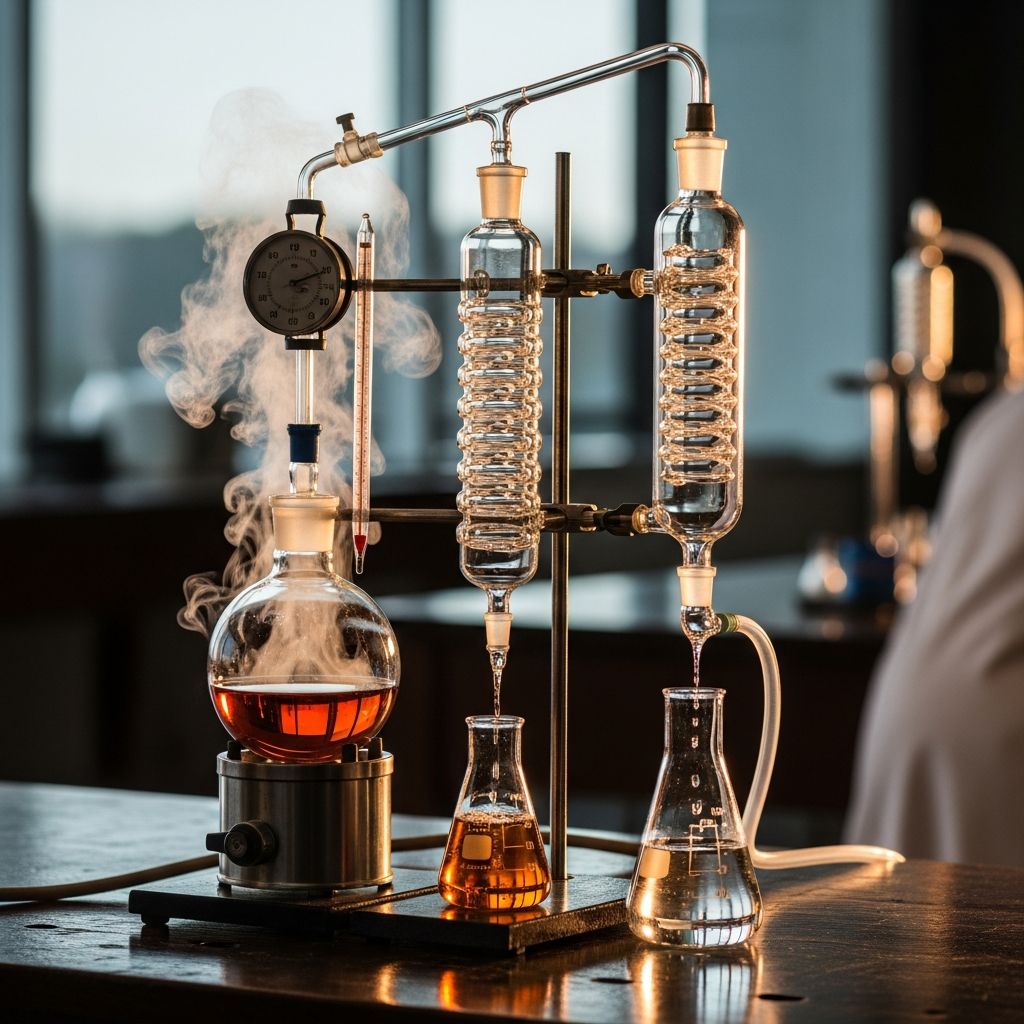
Distillation stands as one of humanity’s oldest and most versatile techniques for separating and purifying liquids. By harnessing differences in boiling points, this process transforms impure mixtures into valuable, clean products essential across industries and households alike. From ancient alchemists distilling perfumes to modern refineries processing crude oil, distillation’s principles remain unchanged yet continually refined for efficiency.
Core Principles Driving Distillation
At its heart, distillation exploits the varying volatilities of substances within a liquid mixture. When heated, components with lower boiling points vaporize first, leaving higher-boiling impurities behind. This vapor, richer in the desired substance, is then cooled and condensed into a purer liquid known as the distillate.
The process relies on fundamental thermodynamics: Raoult’s law dictates vapor composition over a liquid, ensuring separation when boiling points differ significantly—ideally by at least 25°C for simple setups. Evaporation selectively frees low-boiling molecules, while condensation reunites them as liquid, yielding purity unattainable through filtration alone.
Essential Steps in the Distillation Workflow
Performing distillation follows a precise sequence to maximize yield and purity. Here’s a breakdown:
- Preparation: Calibrate thermometers using ice baths (0°C) and boiling water (100°C) to ensure accuracy. Fill the distillation flask no more than two-thirds with the mixture to prevent boil-overs.
- Heating: Apply gentle heat via Bunsen burner or hotplate, monitoring temperature to hit the target boiling point steadily.
- Vaporization and Collection: Vapors rise into the condenser, cooled by circulating water, forming droplets that drip into a receiving flask.
- Monitoring and Termination: Stabilize temperature, collect fractions, and stop before higher-boiling impurities distill.
Cold water must flow counter-current in the condenser—from outlet to inlet—for optimal cooling efficiency.
Types of Distillation Techniques
Distillation variants suit different mixture complexities. Simple distillation works for wide boiling point gaps, like purifying seawater.
| Type | Best For | Key Feature |
|---|---|---|
| Simple Distillation | Large boiling point differences (>25°C) | Basic vapor-to-condenser path; quick but less pure |
| Fractional Distillation | Close boiling points (e.g., crude oil) | Fractionating column allows repeated vapor-liquid cycles for refinement |
| Vacuum Distillation | Heat-sensitive compounds | Reduced pressure lowers boiling points, preventing decomposition |
| Steam Distillation | Essential oils, immiscible liquids | Steam lowers effective boiling points without high heat |
Fractional distillation shines in multi-component separations, as vapors equilibrate multiple times in column trays or packing, mimicking repeated distillations.
Laboratory Distillation Apparatus Explained
A standard lab setup includes:
- Distilling Flask: Round-bottom for even heating, often with stirrer to avoid superheating.
- Thermometer: Positioned where vapors exit to track true temperature.
- Condenser: Liebig or Allihn types with water jacket; Vigreux columns add fractionation.
- Receiving Flask: Collects distillate, sometimes vacuum-adapted.
- Supports: Clamps and stands for safety.
For beverages, specialized columns like rectifiers and analyzers use trays and agitators for precise alcohol separation.
Industrial-Scale Distillation Powerhouses
Beyond labs, massive columns—up to 100 meters tall—process petrochemicals continuously. Petroleum refining separates gasoline (40-200°C), kerosene, and diesel via fractional towers. Pharmaceutical plants purify solvents, while beverage distilleries yield spirits through multi-run cycles: pre-run (impurities), mid-run (pure ethanol), post-run (tails).
Key industrial tweaks include reflux ratios—returning condensed vapor to enhance separation—and automation for steady-state operation.
Real-World Applications Across Sectors
Purifying Water and Essentials
Distillation desalinates seawater, producing fresh water by evaporating pure H2O while leaving salts. Home stills distill rainwater for drinking.
Energy and Fuels
Crude oil yields 40-50% gasoline via atmospheric and vacuum distillation in refineries. Bioethanol production ferments sugars then distills to 95% purity.
Food and Beverages
Whiskey, vodka, and rum emerge from pot or column stills, separating ethanol (78°C) from water (100°C) and congeners. Essential oils like lavender steam-distill for perfumes.
Chemicals and Pharma
Solvent recovery recycles acetone or ethanol; high-purity reagents ensure drug safety.
Challenges and Optimization Strategies
Common pitfalls include azeotropes—mixtures resisting further purification, like 95% ethanol-water—or thermal decomposition. Solutions: add entrainers to break azeotropes or use molecular sieves.
Efficiency metrics like HETP (Height Equivalent to a Theoretical Plate) guide column design; more plates mean better separation. Energy recovery via heat exchangers cuts costs in large plants.
Safety Protocols in Distillation
- Use anti-bump granules or stirring to prevent violent boiling.
- Ensure condensers are water-filled to avoid vapor escape.
- Ventilate to handle flammable vapors; no open flames near ethanol.
- Wear PPE: goggles, gloves, lab coat.
Scale-up amplifies risks—industrial leaks have caused explosions—demanding sensors and fail-safes.
Historical Evolution of Distillation
Alexander of Tralles (6th century) refined early stills for remedies. Jabir ibn Hayyan advanced fractional methods in the 9th century. Industrial booms followed 19th-century petroleum demand, birthing continuous columns. Today, AI optimizes reflux, but basics endure.
Frequently Asked Questions (FAQs)
What is the main goal of distillation?
To separate liquid mixtures into purer components based on boiling point differences through evaporation and condensation.
Can distillation purify seawater completely?
Yes, it removes salts and minerals effectively, though energy-intensive; ideal for remote areas.
How does fractional distillation differ from simple?
Fractional uses a column for multiple vaporizations, suiting close-boiling mixtures like petroleum fractions.
Is distillation energy-efficient industrially?
Modern plants recover 90%+ heat via exchangers, but initial heating remains costly.
Why monitor temperature precisely?
To distill only the target component, avoiding impurities with nearby boiling points.
Future Innovations in Distillation Technology
Membrane distillation hybrids cut energy by 50%, solar-powered stills aid developing regions, and reactive distillation combines reaction-separation for greener chemistry. Microfluidic chips miniaturize labs-on-chips for pharma.
Distillation’s adaptability ensures its role in sustainable processes, like capturing CO2 or purifying biofuels.
References
- Distillation | Definition, Process & Types — Study.com. 2023. https://study.com/learn/lesson/distillation-process.html
- Distillation in the Beverage Industry: An Introduction — BrauBeviale. 2023-10-12. https://www.braubeviale.com/en-US/industry-insights/distillation-in-the-beverage-industry-an-introduction/
- Distillation — Britannica. 2025-03-15. https://www.britannica.com/science/distillation
- Distillation Definition: Complete Guide — Buflovak. 2024-06-20. https://buflovak.com/blog/distillation-definition/
- What is the Distillation Process? — Chemicals.co.uk. 2024-02-10. https://www.chemicals.co.uk/blog/what-is-the-distillation-process
- 5: Distillation — Chemistry LibreTexts. 2024-11-05. https://chem.libretexts.org/Bookshelves/Organic_Chemistry/Organic_Chemistry_Lab_Techniques_(Nichols)/05:_Distillation

Medha Deb is an editor with a master's degree in Applied Linguistics from the University of Hyderabad. She believes that her qualification has helped her develop a deep understanding of language and its application in various contexts. Medha specializes in the areas of beauty, health, sports, and wellness and is committed to ensuring that the content on the website is…