
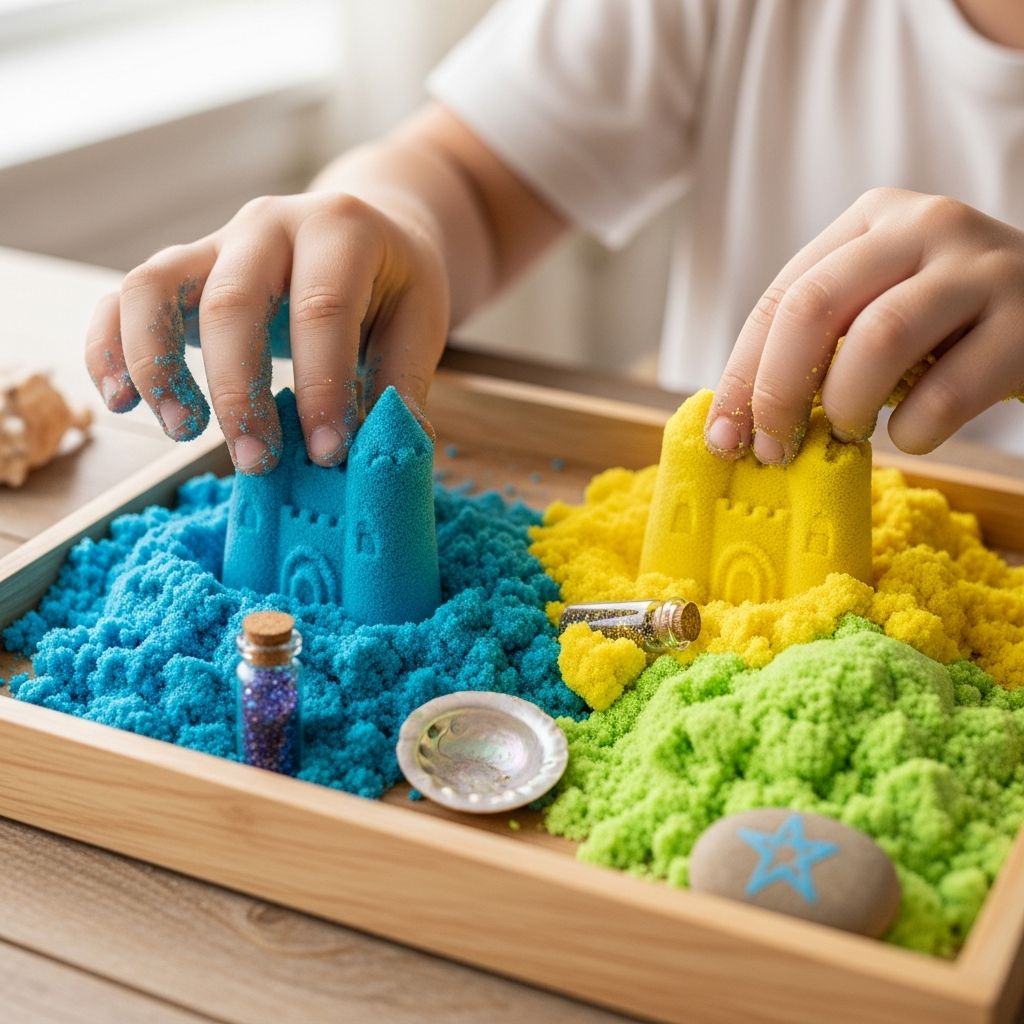
Transform ordinary household items into a captivating play material that defies gravity and holds intricate shapes. This homemade version mimics commercial kinetic sand, providing a silky texture that sticks to itself yet releases cleanly from hands and surfaces. Ideal for young explorers, it fosters sensory development, fine motor skills, and boundless imagination without the mess of traditional sand.
Why Magical Moldable Sand Captivates Children
Sensory play materials like magical sand engage multiple senses simultaneously. The smooth, flowing consistency stimulates touch receptors, while the ability to sculpt tunnels, castles, and creatures encourages problem-solving and creativity. Studies from child development experts highlight how such activities enhance neural connections in growing brains, promoting language skills through descriptive play and emotional regulation via calming manipulation. Unlike wet sand that dries out or scatters, this version maintains its properties indefinitely when stored properly, making it a staple for rainy days or therapeutic sessions.
Parents appreciate its non-toxic nature and low cost—often under $5 per batch—compared to store-bought options exceeding $20. It’s versatile for indoor use, fitting into bins, trays, or even sensory tables, and adapts to themes like ocean adventures or space missions with added colors.
Essential Ingredients for Success
The beauty of DIY magical sand lies in its simplicity. Core components create a balance of flow and structure through a process called “thixotropy,” where the material stiffens under pressure but liquifies when relaxed. Here’s what you’ll need:
- Fine play sand or craft sand: Provides the base grit; avoid coarse beach sand to prevent irritation.
- Cornstarch or all-purpose flour: Acts as a dry binder for moldability; cornstarch yields a silkier feel.
- Oil (vegetable, baby, or mineral): Lubricates particles, enabling flow without stickiness; light oils prevent greasiness.
- Optional colorants: Food coloring, powdered pigments, or pre-colored sand for vibrant hues.
- Tools: Large mixing bowl, whisk, spoon, gloves (for color mixing), and airtight storage container.
Proportions follow a reliable 5:3:1 ratio—5 parts sand, 3 parts cornstarch, 1 part oil—scalable for any batch size. This ensures consistency across recipes.
Step-by-Step Classic Recipe: The 5-3-1 Wonder
This foundational method produces professional-grade results with minimal effort. Yields about 4 cups, enough for two children.
- Prepare the dry base: In a spacious bowl, combine 5 cups fine play sand and 3 cups cornstarch. Whisk vigorously for 2-3 minutes until uniformly blended, breaking up clumps. This step ensures even distribution, preventing oily pockets.
- Incorporate the liquid: Drizzle 1 cup oil slowly while stirring continuously. Use a sturdy spoon initially; as it thickens, switch to hands (wear gloves if coloring). Knead for 5 minutes until the mix feels like wet beach sand—holds shapes but crumbles softly.
- Test and adjust: Scoop a handful; it should flow through fingers yet pack firmly. Too dry? Add oil 1 tablespoon at a time. Too sticky? Sprinkle cornstarch sparingly.
- Infuse color (optional): Divide into portions, add 5-10 drops gel food coloring per cup, and knead until vibrant. For glitter effects, mix in craft glitter before oil.
- Store for longevity: Transfer to an airtight container. It remains playable for months; refresh with a spritz of oil if needed.
Playtime ideas: Build sandcastles, create “quicksand” pits for toys, or layer colors for marbled effects. Cleanup is effortless—vacuum or wipe surfaces, as it doesn’t cling.
Variations to Spark Creativity
| Recipe Type | Key Ingredients Ratio | Unique Texture | Best For |
|---|---|---|---|
| Flour-Based Moon Sand | 8:1 flour to oil | Soft, crumbly, pastry-like | No-sand households; baking-themed play |
| Dish Soap Kinetic Boost | Sand + cornstarch + dish soap + water | Ultra-smooth, stretchy | Store-bought mimic; quick refresh |
| Oil-Light Version | 2:1 sand to cornstarch + 1/4 cup oil | Less greasy, firmer hold | Sensory-sensitive kids |
| Gluten-Free Rice Flour | Same as moon sand, sub rice flour | Fine, silky flow | Allergy-friendly play |
Each variation tweaks sensory input: Moon sand crumbles like lunar regolith, ideal for space pretend play, while dish soap versions add a bubbly sheen. Experiment with scents—add essential oils like lavender for calming sessions.
Safety Guidelines and Best Practices
While non-toxic, supervise young children to prevent ingestion. Wash hands post-play; oils can stain fabrics if not stored sealed. For allergies, opt for mineral oil over nut-based. Educational tip: Discuss states of matter—solid yet fluid—tying into STEM learning. U.S. Consumer Product Safety Commission notes such DIY crafts are safe when using food-grade ingredients. Avoid eyes and mouth; if contact occurs, rinse thoroughly.
Storage pro tip: Layer parchment paper between colors in containers to prevent bleeding. Shelf life exceeds 6 months in cool, dry spots.
Educational Benefits Backed by Research
Beyond fun, magical sand aids development. Occupational therapists recommend it for tactile defensiveness, improving hand-eye coordination through scooping and shaping. A study from the American Occupational Therapy Association links sensory bin play to enhanced focus and reduced anxiety in preschoolers. Integrate math by measuring ratios or science by exploring why oil enables flow (surface tension reduction between grains).
Frequently Asked Questions (FAQs)
What if my sand is too crumbly?
Add oil incrementally while kneading; aim for a damp, packable feel without wetness.
Can I use beach sand?
No—it’s too coarse and may harbor bacteria; stick to fine play or craft sand from stores.
How do I color it naturally?
Mix in powdered spices like turmeric (yellow) or beet powder (pink) before oil.
Does it dry out over time?
Rarely, if sealed; knead in a few drops of oil to revive.
Is it safe for toddlers under 2?
Best for ages 3+ due to small parts risk; supervise closely.
Advanced Play Ideas and Extensions
Elevate play with themed kits: Ocean—blue sand, shells, toy fish; Construction—yellow sand, trucks, ramps. Combine with water tables for “magic mud” hybrids or freeze colored portions for textured ice blocks. Host sensory parties with personalized batches. For educators, incorporate into curricula: Measure volume in containers or predict color mixing outcomes.
Incorporate tech: Film slow-motion sculpting videos to discuss physics. Community tip: Double batches for group playdates, dividing into stations for collaborative builds.
References
- Product Safety Guidelines for Children’s Toys — U.S. Consumer Product Safety Commission. 2023-01-15. https://www.cpsc.gov/s3fs-public/Childrens_Toys.pdf
- Sensory Play and Child Development — American Occupational Therapy Association. 2024-05-20. https://www.aota.org/practice/clinical-topics/sensory-integration
- DIY Moon Sand Recipe — BBC Good Food. 2022-07-10. https://www.bbcgoodfood.com/howto/guide/moon-sand
- DIY Kinetic Sand Ratio — Eating Richly. 2023-03-12. https://eatingrichly.com/kinetic-sand-recipe/
- Moldable Play Sand Instructions — One Little Project. 2021-11-05. https://onelittleproject.com/moldable-play-sand-recipe/
- DIY Kinetic Sand for Sensory Play — Minnesota Children’s Museum. 2024-02-28. https://mcm.org/diy-kinetic-sand/

Medha Deb is an editor with a master's degree in Applied Linguistics from the University of Hyderabad. She believes that her qualification has helped her develop a deep understanding of language and its application in various contexts. Medha specializes in the areas of beauty, health, sports, and wellness and is committed to ensuring that the content on the website is…