
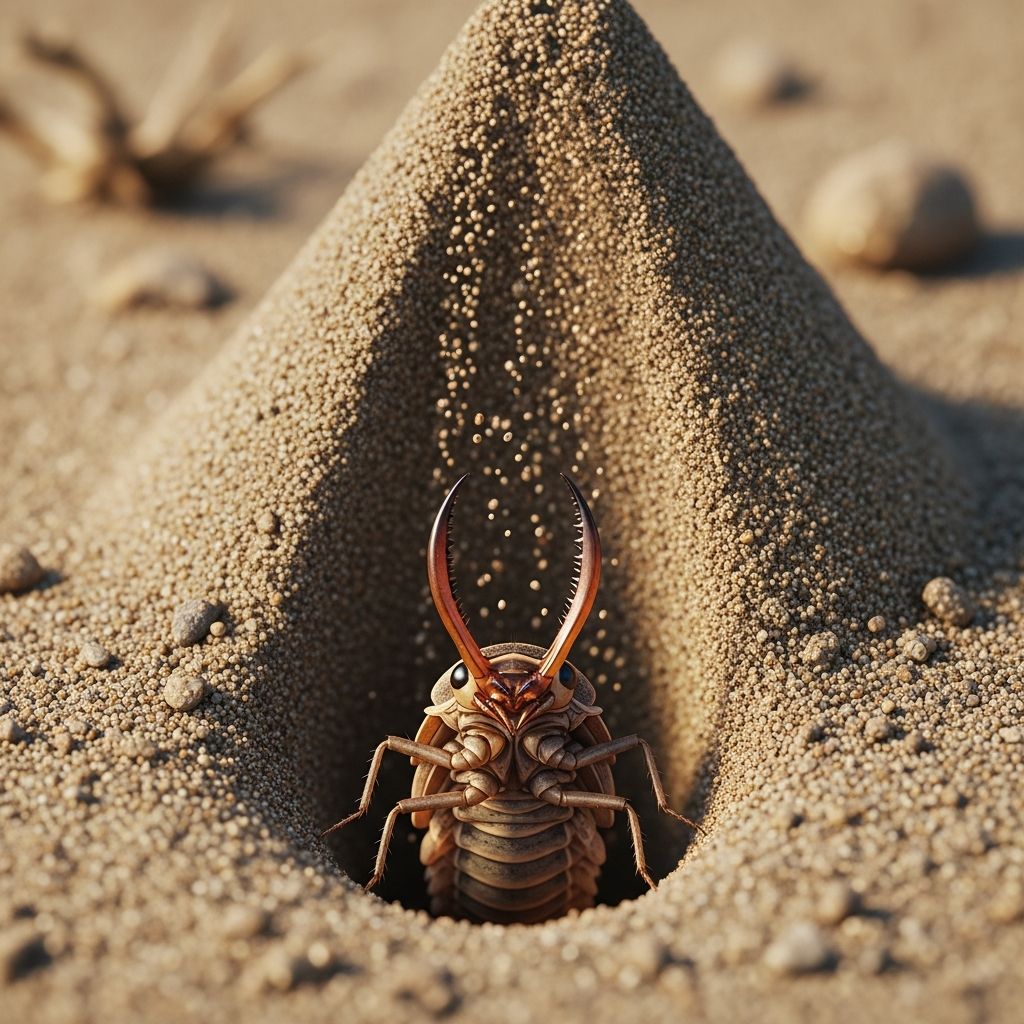
Doodlebugs represent one of nature’s most ingenious predators, known for crafting funnel-shaped pits in loose soil to ensnare unsuspecting insects. These larvae of antlions in the family Myrmeleontidae demonstrate remarkable patience and engineering prowess in their quest for survival.
The Origins of the Name and Widespread Recognition
The term “doodlebug” evokes images of playful scribbles, yet it perfectly captures the meandering trails left by these larvae as they navigate sandy terrains in search of optimal pit locations. Emerging in American folklore around 1866, the name stuck due to the distinctive, cursive-like patterns they etch into the ground.
Across North America, from the sandy woodlands of northern New England to the sun-baked soils of Florida, doodlebugs thrive in dry, loose environments. With approximately 100 species in the region and 2,000 worldwide, they belong to the order Neuroptera, a group of net-winged insects.
Physical Characteristics of the Larval Stage
Doodlebug larvae present a starkly unassuming yet formidable appearance. Measuring up to half an inch in length, their plump, oval bodies are mottled in shades of gray and brown, blending seamlessly with soil. Covered in tiny bristles, these structures aid in anchoring during prey capture.
The most striking feature is their oversized, sickle-shaped mandibles—hollow pincers equipped with spines. These jaws serve dual purposes: grasping victims and injecting paralytic toxins laced with digestive enzymes that liquefy internal tissues for easy consumption.
- Body length: Up to 0.5 inches
- Coloration: Mottled gray-brown for camouflage
- Mandibles: Long, clawed, venom-injecting
- Legs: Six, short and sturdy for backward movement
- Surface texture: Bristly for soil grip
Unlike many insects, doodlebugs primarily move in reverse, a adaptation suited to their pit-dwelling lifestyle.
Engineering the Perfect Ambush Pit
Constructing a pit is a masterful display of instinctual behavior. The larva selects a spot in dry, sandy soil—often under shelter like road edges or building overhangs—then backs in while spiraling downward. Using its head and mandibles, it flings sand outward in a rapid 15-minute process, forming a cone 1-3 inches wide and deep.
Positioned at the bottom with only jaw tips exposed, the doodlebug waits motionlessly. Vibrations from a wandering ant trigger action: if the prey teeters on the edge, the larva flicks sand to induce a landslide, hastening the fall.
| Pit Construction Stages | Description |
|---|---|
| Site Selection | Chooses loose, dry sand based on texture and microclimate, not prey density |
| Excavation | Backward spiral digging with head flips; completes in ~15 minutes |
| Positioning | Buries at apex, jaws up; remains still for days |
| Maintenance | Repairs edges if disturbed; relocates if unsuccessful |
Hungry larvae opt for smaller pits targeting tiny prey, while larger pits accommodate diverse sizes. Poor locations prompt relocation, leaving those signature doodle trails.
Hunting Tactics and Prey Preferences
Ants form the primary menu, but small spiders, beetles, and other invertebrates also fall victim. Upon capture, the mandibles pierce the exoskeleton, injecting enzymes that paralyze and predigest. The doodlebug then siphons the liquefied remains, discarding the husk.
This extraoral digestion is efficient, allowing survival without food for months. Voracious appetites drive frequent molts as the larva grows, sometimes over 1-3 years.
- Primary prey: Ants (high protein)
- Secondary: Small insects, spiders
- Detection: Seismic vibrations
- Escape prevention: Sand flicking
- Digestion time: Minutes to hours
From Larva to Adult: Metamorphosis Unveiled
After years underground, the mature larva constructs a silk-and-sand cocoon, entering pupation for about a month. The adult antlion emerges— a delicate creature with 2.5-inch tent-like wings folding over a slender 1.5-inch body, clubbed antennae distinguishing it from dragonflies.
Nocturnal and clumsy fliers, adults haunt tall grasses at dusk, seeking mates. Females lay up to 80 eggs singly in sandy nooks, perpetuating the cycle. Shifting to pollen and nectar diets, they live 25-45 days, a stark contrast to their predatory youth.
Ecological Significance and Habitat Insights
Doodlebugs contribute to ecosystems by controlling ant populations, indirectly benefiting plants and other fauna. Thriving in disturbed sands—beaches, dunes, trails—they indicate healthy, loose-soil environments.
In North Carolina, Florida, Missouri, and beyond, species like Myrmeleon immaculatus dominate. They pose no threat to humans or gardens, earning beneficial status.
Observing Doodlebugs in the Wild
Spot pits in sunny, protected sands during warm months. Gently tap edges to simulate prey; watch the flicking response. Avoid harming—many relocate naturally. Children delight in these “sand monsters,” fostering nature appreciation.
Winter sees them dormant underground, resuming activity in spring.
Common Misconceptions Clarified
Despite monstrous looks, doodlebugs aren’t harmful. Adults aren’t predatory, debunking myths of flying killers. Not all antlions dig pits; only Myrmeleon genus specializes in this.
Frequently Asked Questions (FAQs)
Are doodlebugs dangerous to humans?
No, their jaws can’t penetrate skin, and they ignore large creatures.
How long do doodlebugs live as larvae?
1-3 years, depending on food availability.
What do adult antlions eat?
Pollen, nectar, and occasionally tiny soft insects.
Can I keep a doodlebug as a pet?
Possible short-term in sand with ants, but release for natural pupation.
Why do they throw sand at prey?
To destabilize and pull victims into the pit faster.
Conservation and Future Research
While common, habitat loss from development threatens populations. Citizen science tracks distributions, aiding understanding of Neuroptera diversity. Future studies may explore pit efficiency variations and climate impacts.
References
- Doodlebug, Doodlebug, Are You at Home? The Outside Story — Northern Woodlands. 2023-06-15. https://northernwoodlands.org/outside_story/article/doodlebugs
- Weekly “What is it?”: Doodlebugs — UF/IFAS Extension Escambia County. 2024-09-26. https://blogs.ifas.ufl.edu/escambiaco/2024/09/26/weekly-what-is-it-doodlebugs/
- Doodlebugs — NCpedia. 2022-01-01. https://www.ncpedia.org/doodlebugs
- Antlion — Wikipedia (references primary sources). 2026-04-01. https://en.wikipedia.org/wiki/Antlion
- “Doodlebugs” (Antlions) — Bug Eric. 2014-10-20. https://bugeric.blogspot.com/2014/10/doodlebugs-antlions.html
- Antlion Larvae (Doodlebug Larvae) — Missouri Department of Conservation. 2025-01-15. https://mdc.mo.gov/discover-nature/field-guide/antlion-larvae-doodlebug-larvae

Medha Deb is an editor with a master's degree in Applied Linguistics from the University of Hyderabad. She believes that her qualification has helped her develop a deep understanding of language and its application in various contexts. Medha specializes in the areas of beauty, health, sports, and wellness and is committed to ensuring that the content on the website is…