
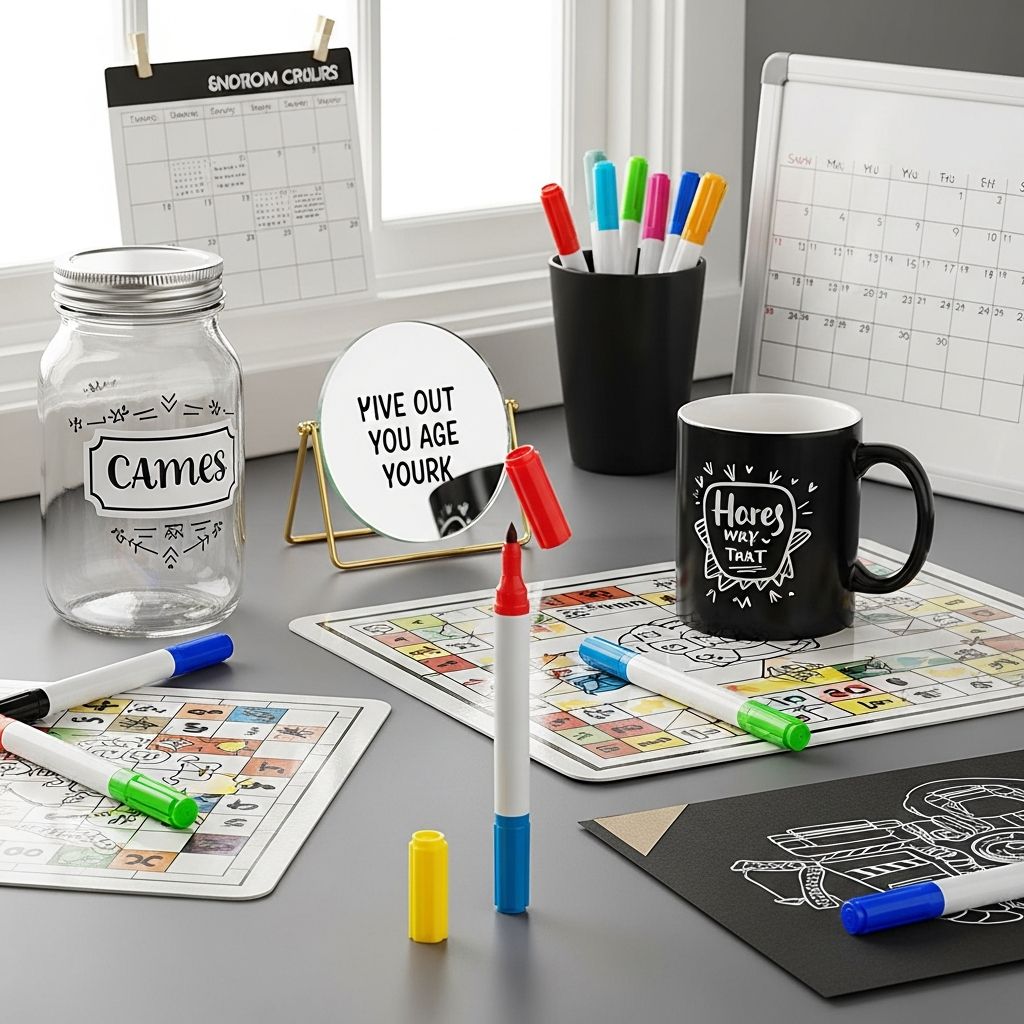
Dry erase markers have evolved far beyond their traditional role in classrooms and conference rooms. These versatile writing instruments offer endless possibilities for organization, creativity, and problem-solving in nearly every area of daily life. The ability to write on smooth surfaces and easily erase content makes them ideal for temporary labeling, brainstorming, and creative expression. Whether you’re looking to streamline your home management, enhance your professional workspace, or unleash your artistic side, dry erase markers provide a practical and cost-effective solution. This comprehensive guide explores the many innovative ways you can incorporate dry erase markers into your routine and unlock their full potential.
Kitchen and Pantry Organization Systems
One of the most practical applications for dry erase markers lies within the kitchen environment. The kitchen presents unique organizational challenges, from managing food storage to tracking expiration dates and maintaining inventory. Dry erase markers offer a reusable solution that adapts as your needs change.
Food container labeling represents one of the most valuable uses of dry erase markers in the kitchen. When you prepare meals in advance or store leftovers, identifying contents becomes essential for food safety and efficient meal planning. By marking containers, freezer bags, and storage jars with dates and descriptions, you create a system that prevents waste and ensures you use items before they spoil. Unlike permanent markers or labels, dry erase markings can be quickly updated when you change the contents or need to relabel items. This flexibility makes it particularly useful for those who regularly rotate their pantry stock or practice meal preparation.
Beyond simple labeling, dry erase markers can help you maintain a running inventory of pantry items. Create a checklist directly on a smooth kitchen surface—such as laminated cardstock attached to your pantry door or a whiteboard installed near your refrigerator—to track staple items that need replenishing. As you use products, simply wipe away the checkmark and add new items as they run low. This visual system encourages more efficient grocery shopping and reduces the likelihood of duplicate purchases.
Enhancing Educational Environments and Student Success
Educational settings provide fertile ground for dry erase marker applications that extend far beyond taking classroom notes. Students and educators alike benefit from the interactive nature of these markers, which encourage experimentation and risk-taking without the permanent consequences of traditional writing instruments.
In classroom environments, dry erase markers facilitate dynamic teaching methods that promote deeper learning. Teachers can use these markers to illustrate concepts, work through mathematical problems, or display diagrams that students can quickly modify and improve upon. The ability to erase and revise encourages students to engage with material more actively, asking questions and suggesting alternatives without worrying about making mistakes. This creates a more collaborative learning environment where participation feels safer and more inclusive.
For student projects and presentations, dry erase markers serve as powerful brainstorming tools. When working on group assignments, students can sketch ideas on portable dry erase surfaces, allowing the entire team to visualize concepts before committing to final designs. This iterative approach reduces paper waste while fostering creativity and collaborative problem-solving skills. Students can experiment with different color combinations, layouts, and organizational schemes, refining their ideas through multiple iterations before creating their final submission.
Art education particularly benefits from dry erase markers. Drawing practice becomes less intimidating when students can continuously erase and redraw without accumulating failed attempts. Teachers can use these markers to demonstrate techniques like contour drawing or perspective drawing, allowing students to follow along and practice in real-time. The environmental benefits are substantial as well, with educators reporting reduced paper consumption and easier cleanup when incorporating dry erase materials into their curricula.
Professional Workspace Productivity and Team Collaboration
The corporate environment has long recognized the value of dry erase markers for communication and coordination. However, their applications extend well beyond the standard whiteboard meeting room. Dry erase markers serve as catalysts for productive teamwork and effective project management across various professional settings.
During brainstorming sessions, dry erase markers facilitate the visualization of ideas in real-time. Team members can contribute thoughts, build upon existing concepts, and see connections between different ideas as they’re written out. This visual collaboration process often generates more creative solutions than traditional verbal brainstorming, as it accommodates different communication styles and allows for simultaneous contribution from multiple participants. The ability to quickly erase unsuccessful directions without feeling wasteful encourages teams to explore unconventional ideas.
Project management and task tracking benefit significantly from dry erase implementation. Creating visual timelines, progress indicators, and task checklists on whiteboard surfaces provides team members with constant visibility into project status. As tasks are completed and erased, remaining work becomes more apparent, maintaining team focus and motivation. This transparent tracking system reduces miscommunication and ensures everyone understands their responsibilities and deadlines. Teams report increased accountability and more efficient project completion when using dry erase tracking systems.
Meeting facilitation improves when facilitators use dry erase markers to capture key discussion points, action items, and decisions. Participants can see their contributions documented in real-time, which validates their input and maintains focus. The visual record created during the meeting can be photographed for distribution to absent team members or for archival purposes, reducing the need for extensive meeting notes.
Artistic Expression and Design Experimentation
Artists and designers discover immense value in dry erase markers as tools for exploring ideas without pressure. The low-stakes nature of markings that can be easily erased creates psychological freedom that enhances creative output and artistic development.
Temporary sketches and design iterations become faster and more productive with dry erase markers. Visual artists can experiment with composition, color combinations, and focal points on portable surfaces before committing to permanent media. This exploratory phase often leads to stronger final designs, as artists have tested various approaches and refined their vision through multiple iterations. Graphic designers similarly benefit from the ability to mock up layouts and typography treatments quickly, evaluating different directions without investing significant time in digital mockups.
Craft projects and DIY decorations represent another area where dry erase markers shine. Seasonal decorations, party preparations, and special event displays can be enhanced with temporary dry erase artwork on glass surfaces, mirrors, or ceramic items. This approach allows people to customize their environment for specific occasions without making permanent changes. Once the event concludes, simply wiping away the designs restores surfaces to their original state, making this method both practical and environmentally conscious.
Glass jars, windows, and mirrors become canvases for creative expression when dry erase markers are applied. Holiday decorations, motivational messages, and decorative patterns can be added and removed seasonally or as desired. This flexibility makes it easy to refresh your environment’s aesthetic without the commitment of permanent changes or the waste associated with disposable decorations.
Event Planning and Temporary Venue Signage
Event professionals leverage dry erase markers to create flexible, adaptable signage systems that accommodate last-minute changes and personalization. The ability to quickly update information without reprinting materials saves both time and resources during event execution.
Directional signage and wayfinding elements can be created on portable boards or glass surfaces, guiding attendees through venue spaces efficiently. Unlike printed signs that require advance production and become obsolete if plans change, dry erase signage can be updated minutes before the event begins or modified in response to venue conditions. This adaptability proves invaluable when guest flow patterns require adjustment or when space allocation changes unexpectedly.
Personalized messaging adds memorable touches to events when dry erase markers are used on boards, mirrors, or table displays. Welcome notes, guest tributes, or interactive prompts can be written directly onto event surfaces, creating unique experiences that enhance attendee engagement. After the event concludes, these surfaces can be cleaned and reused for future gatherings, making dry erase signage an economical choice for frequent event planners.
Table displays, ceremony programs, and special announcements benefit from dry erase presentation. Event coordinators can accommodate real-time updates—such as changed speaker times, last-minute schedule adjustments, or spontaneous recognition moments—by simply updating dry erase surfaces rather than distributing revised printed materials or making verbal announcements that might be missed.
Home Management and Daily Life Organization
Beyond specific applications, dry erase markers serve as general organizational tools throughout residential spaces. Creating systems for household management, communication, and coordination improves family functioning and reduces stress associated with disorganization.
Chore charts and responsibility schedules come to life when written with dry erase markers on visible surfaces. Family members can see their assigned tasks, track completion, and rotate responsibilities easily as markings are erased and updated. This visual accountability system proves particularly effective for households with children, as it provides clear expectations and celebrates task completion through wipeable check marks.
Grocery lists, meal plans, and shopping reminders can be maintained on a kitchen whiteboard, accessible to all household members. As items are used or meals are prepared, markings can be updated without creating paper waste. This collaborative approach to household management ensures everyone understands what groceries are needed and what meals are planned, reducing redundant purchases and facilitating more efficient shopping trips.
Bathroom reminders, medication schedules, and personal notes benefit from dry erase visibility. Messages written on bathroom mirrors or laminated surfaces serve as gentle reminders for important tasks or appointments. Family members can leave messages for each other on shared whiteboards, reducing reliance on text messages or email for simple household communications.
DIY Dry Erase Surfaces and Cleaning Solutions
Creating custom dry erase surfaces and cleaning solutions allows users to maximize the versatility of dry erase markers without purchasing expensive commercial whiteboards. These budget-friendly alternatives expand possibilities for marker application throughout any space.
Laminating cardstock creates portable, durable dry erase surfaces ideal for individual or small group use. These lightweight boards can be moved between locations, making them perfect for traveling, taking notes at conferences, or creating flexible learning materials. Heavy-duty page protectors similarly transform standard paper into reusable writing surfaces when sheets or worksheets are inserted and marked with dry erase markers. This approach proves particularly valuable in educational settings, allowing teachers to create unlimited versions of practice materials without printing excess paper.
Acetate sheets and transparency film attached to clipboards create convenient portable whiteboards that practitioners, consultants, or field workers can carry between locations. Clear contact paper applied to flat surfaces including walls, tabletops, or cabinet doors extends dry erase capability throughout the home or office. More permanent installations use specialized dry erase paint, transforming entire walls into interactive surfaces suitable for long-term brainstorming, planning, or creative projects.
Effective dry erase cleaning solutions extend the lifespan of marked surfaces and maintain image clarity. Beyond commercial erasers, alternatives including hand sanitizer, rubbing alcohol, vinegar, or even WD-40 effectively remove dry erase markings from various surfaces. Teachers and artists often create custom erasers by hot-gluing pompoms to marker caps or attaching fabric scraps to wooden blocks, personalizing their tools while reducing costs. These resourceful approaches demonstrate that dry erase marker utility extends to the entire ecosystem surrounding their use.
Environmental and Economic Advantages of Dry Erase Technology
Adopting dry erase markers as primary writing instruments for temporary documentation delivers substantial environmental and financial benefits compared to traditional paper-based systems. The reusability factor fundamentally transforms resource consumption patterns across household, educational, and professional environments.
Paper conservation represents one of the most significant environmental advantages of dry erase adoption. Classrooms transitioning to dry erase materials report dramatic reductions in worksheet printing, while offices using dry erase tracking systems replace printed progress reports and status updates. Over time, these collective reductions translate to meaningful forest conservation and reduced processing waste associated with paper production.
Cost-effectiveness emerges from the ability to reuse surfaces indefinitely without consuming materials. While initial investment in quality dry erase markers and surfaces may seem higher than purchasing disposable pens and paper, long-term expenses decrease substantially. A single dry erase marker can mark and erase thousands of times before requiring replacement, whereas traditional writing instruments provide far fewer useful applications before disposal.
Frequently Asked Questions
Q: What surfaces work best with dry erase markers?
A: Dry erase markers work optimally on smooth surfaces including whiteboards, laminated materials, glass, ceramic, and specially coated metal or plastic surfaces. Porous materials like paper or unfinished wood don’t work well as the marker ink seeps into the surface. Testing a small area before marking the entire surface ensures compatibility.
Q: Can dry erase markers stain surfaces permanently?
A: Ghosting or faint staining can occur if markers remain on surfaces for extended periods without being wiped clean. Using appropriate cleaning methods and regular erasing prevents permanent marks. Specialized dry erase coatings are formulated to resist ghosting even with frequent use and various marker brands.
Q: Are dry erase markers safe for use on skin or around children?
A: Most dry erase markers contain non-toxic formulas and are generally safe for use around children. However, they shouldn’t be applied directly to skin for extended periods. Always supervise young children and wash thoroughly if markers come into contact with skin or are accidentally ingested.
Q: How can I remove stubborn dry erase marker stains?
A: If standard erasers don’t remove marks completely, try rubbing alcohol, hand sanitizer, or vinegar on a cloth. WD-40 also effectively removes stubborn dry erase residue. For painted surfaces, confirm the solution won’t damage the paint finish before application. Testing on inconspicuous areas prevents unintended damage.
Q: What’s the difference between dry erase and permanent markers?
A: Dry erase markers contain oil-based inks designed to release from surfaces easily, while permanent markers use alcohol or xylene-based inks that bond to materials. Using permanent markers on dry erase surfaces creates difficult-to-remove marks, as the ink adheres rather than remaining on the surface for easy erasing.
References
- Dry Erase Marker Usage and Benefits — Love Two Hands. 2025. https://www.lovetwohands.com/news/dry-erase-marker-usage-and-benefits/
- The Ultimate Guide to Dry Erase Markers: Everything You Need to Know — Sable Flow. 2024. https://sableflow.com/blogs/sable-flow/the-ultimate-guide-to-dry-erase-markers-everything-you-need-to-know
- 8 Clever Ways You Never Thought to Use Dry-Erase Markers in the Art Room — The Art of Education. 2024-02-08. https://theartofeducation.edu/2024/02/feb-8-ways-you-never-thought-to-use-dry-erase-markers-in-the-art-room/
- Taking Dry-Erase Boards to a New Dimension — The Paint Industry Magazine. 2024. https://www.paint.org/coatingstech-magazine/articles/taking-dry-erase-boards-new-dimension/
- 7 Fun Ways to Use Dry Erase Markers — Clarus. 2024. https://www.clarus.com/blog/7-fun-ways-to-use-dry-erase-markers/

Medha Deb is an editor with a master's degree in Applied Linguistics from the University of Hyderabad. She believes that her qualification has helped her develop a deep understanding of language and its application in various contexts. Medha specializes in the areas of beauty, health, sports, and wellness and is committed to ensuring that the content on the website is…