
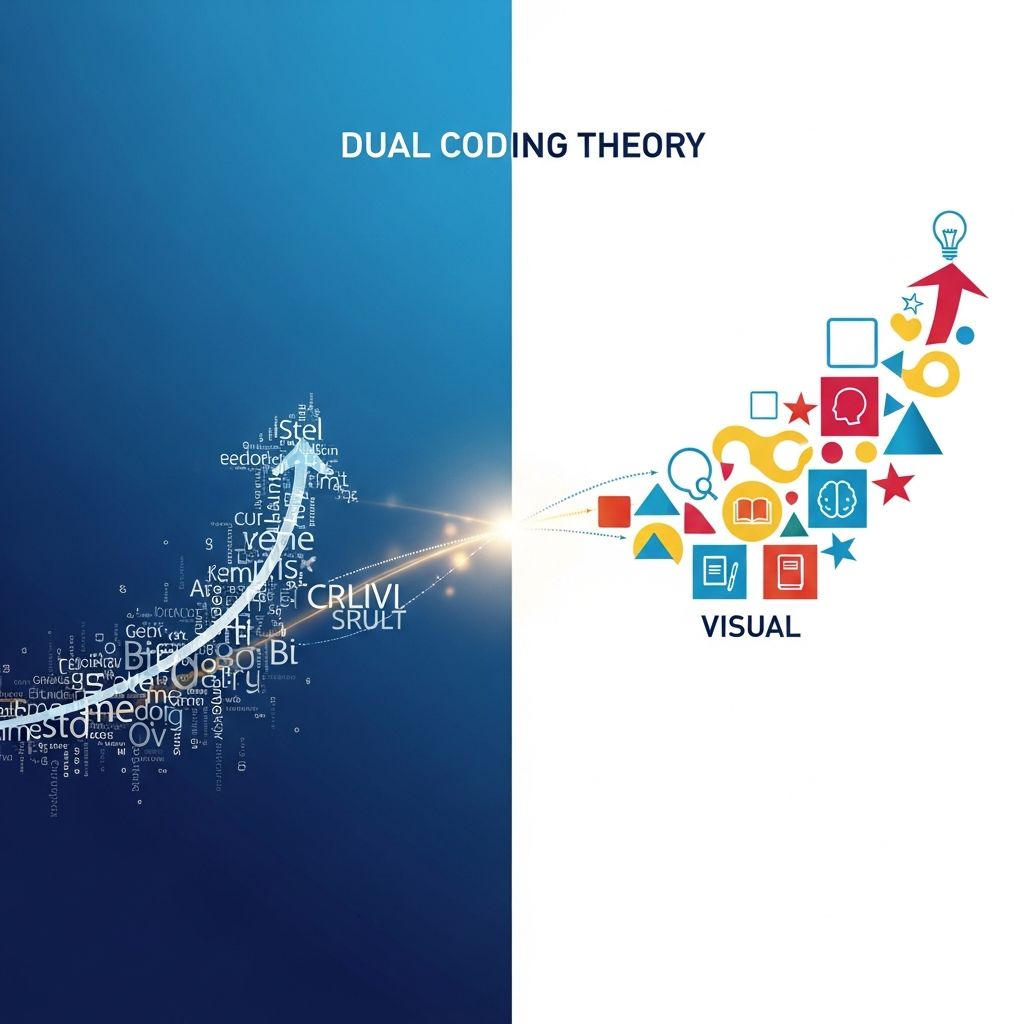
Dual coding theory posits that combining verbal and visual information creates stronger mental representations, leading to improved learning outcomes across educational settings. Developed by cognitive psychologist Allan Paivio, this approach leverages the brain’s separate but interconnected systems for processing words and images.
Foundations of Dual Coding in Cognitive Science
The human brain maintains distinct channels for handling linguistic input and pictorial data, allowing for richer encoding when both are engaged simultaneously. Verbal processing manages spoken or written language through sequential analysis, while the visual system interprets spatial relationships, shapes, and patterns in parallel. When educators pair explanations with diagrams or animations, learners form dual pathways that reinforce each other, creating more durable memories.
Research demonstrates that this integration not only boosts immediate comprehension but also enhances long-term retrieval. Unlike single-mode instruction, dual coding minimizes extraneous cognitive load, freeing mental resources for deeper understanding. For instance, studies show students recall facts 20-30% better when presented with text alongside relevant graphics compared to text alone.
Why Dual Coding Outperforms Traditional Methods
Many teaching practices rely heavily on verbal lectures, overlooking the brain’s natural affinity for multimodal input. Dual coding addresses this by aligning instruction with cognitive architecture, sidestepping myths like fixed learning styles. Evidence from cognitive load theory complements this: visuals offload working memory demands, enabling complex concept mastery.
- Enhanced Retention: Dual pathways create referential connections between systems.
- Reduced Overload: Visuals clarify abstract ideas without overwhelming verbal channels.
- Better Transfer: Learners apply knowledge across contexts more effectively.
In practice, this means transforming dry lectures into dynamic experiences. A history lesson on ancient Rome gains traction when timelines pair with illustrated maps, forging links that persist beyond the classroom.
Core Mechanisms: Verbal and Visual Systems at Work
Paivio’s model (1971, 1986) describes two subsystems: one for acoustic-phonetic codes (words) and another for imagistic representations (images). These systems connect via propositional links, forming a network where activation in one prompts the other. For example, hearing ‘photosynthesis’ triggers a mental image of chloroplasts, amplified by an actual diagram.
| System | Processing Style | Educational Benefit |
|---|---|---|
| Verbal | Sequential, linear | Builds logical arguments and narratives |
| Visual | Parallel, holistic | Captures relationships and structures |
| Integrated | Referential connections | Strengthens recall and comprehension |
This table illustrates how integration yields superior results, supported by empirical data from Mayer’s multimedia learning principles.
Practical Strategies for Classroom Implementation
Educators can embed dual coding seamlessly across subjects. Start with simple pairings: label diagrams while narrating their significance. In math, graph functions beside algebraic explanations; in literature, timelines accompany character arcs.
- Design Slides Thoughtfully: Place visuals prominently, with minimal text overlays to avoid split attention.
- Incorporate Student Creation: Have learners sketch concepts from verbal descriptions, reinforcing both systems.
- Use Animations Sparingly: Pair motion with narration to depict processes like cell division.
- Facilitate Discussions: Prompt verbal elaboration on visual aids during group work.
These techniques, drawn from field-tested applications, yield measurable gains in engagement and performance.
Dual Coding Across Disciplines: Real-World Examples
In science, a biology class on the circulatory system thrives with animated blood flow models synced to verbal step-by-step breakdowns. Students not only memorize pathways but visualize dynamic interactions, aiding problem-solving.
Language arts benefits too: vocabulary lessons pair word definitions with illustrative scenes, embedding meanings contextually. History teachers map battles with overlaid troop movements and narrated strategies, bringing events to life.
Even in professional training, like medical education, ultrasound images with voiceovers train diagnostic skills. Learners mentally rehearse procedures, bridging theory to practice effectively.
Evidence from Research: Proven Impact on Learning
Decades of studies validate dual coding’s efficacy. Paivio’s foundational work showed pictures recalled better than words, with combinations superior overall. Later research by Clark & Paivio (1991) confirmed processing differences enhance memory traces.
Mayer’s (2009) experiments revealed multimedia lessons outperform single-medium ones by 1.5 standard deviations in transfer tests. In healthcare training, video demos with narration improved procedural accuracy by 25%.
References
- Leveraging Dual Coding Theory in Teaching to Maximize Learning — TrueLearn. 2023. https://truelearn.com/resource-library/leveraging-dual-coding-theory-in-teaching-to-maximize-learning/
- Dual Coding: A Teacher’s Guide to Visual Learning — Structural Learning. 2023. https://www.structural-learning.com/post/dual-coding-a-teachers-guide
- Dual Coding and Learning Styles — The Learning Scientists. 2019-06-06. https://www.learningscientists.org/blog/2019/6/6-1
- Dual Coding: Exploring opportunities to deliver learning content — Nottingham Trent University. 2023. https://www.ntu.ac.uk/about-us/teaching/academic-development-and-quality/cadq-blogs/dual-coding-exploring-opportunities-to-deliver-learning-content-in-now
- Educational theories you should know: Dual-Coding — St.Emlyn’s Blog. 2023. https://www.stemlynsblog.org/educational-theories-you-should-know-dual-coding/
Common Pitfalls and How to Avoid Them
Not all multimodal content succeeds; poor design can fragment attention. Overloading slides with text and images creates ‘split attention effect,’ taxing working memory. Solution: Use concise labels on visuals, narrate expansions verbally.
Another error: decorative graphics unrelated to content, which distract without aiding encoding. Prioritize functional visuals that directly represent key ideas. Test materials by asking: Does this image clarify the verbal explanation?
Integrating Dual Coding with Other Evidence-Based Practices
Dual coding amplifies techniques like spaced retrieval and elaboration. Pair spaced reviews with evolving visuals to build schema depth. Combine with active recall: Students describe diagrams from memory, then verify.
Incorporate into retrieval practice by designing quizzes blending text prompts and image interpretation, mirroring real assessments.
Tools and Resources for Effective Dual Coding
Digital tools streamline implementation. Canva and PowerPoint enable custom infographics; BioRender suits science visuals. Free options like Google Drawings suffice for basics.
- Apps: Sketchpad for student drawing; PicLits for word-image pairing.
- Platforms: Khan Academy exemplifies narrated animations.
- Books: ‘Make It Stick’ and Mayer’s ‘Multimedia Learning’ for deeper dives.
Frequently Asked Questions (FAQs)
What is dual coding theory in simple terms?
Dual coding theory explains that people learn better when information is presented both visually (pictures, diagrams) and verbally (words, speech), as the brain processes these channels separately yet connects them for stronger memory.
Who developed dual coding theory?
Allan Paivio introduced the theory in 1971, expanding it in 1986 based on cognitive psychology research.
How does dual coding differ from learning styles?
Unlike learning styles, which lack empirical support, dual coding is evidence-based and benefits all learners by aligning with universal brain processes, not individual preferences.
Can dual coding help with exam preparation?
Yes, creating study aids with notes and mind maps enhances retention; practice explaining visuals aloud for optimal results.
Is dual coding suitable for young children?
Absolutely—simple picture books with stories introduce the concept early, building foundational skills.
This comprehensive guide equips educators with actionable insights from dual coding theory, fostering environments where students thrive through science-backed methods. (Word count: 1678)

- Integrated M.A. in Applied Linguistics, University of Hyderabad
- 5+ years in editorial, instructional, SEO, and research-based writing
Sneha is a relationships and lifestyle writer with a strong foundation in applied linguistics and certified training in relationship coaching. She brings over five years of writing experience to theskillvault, crafting thoughtful, research-driven content that empowers readers to build healthier relationships, boost emotional well-being, and embrace holistic living. Her writing and insights reflect the belief that beauty, happiness, and wellness…