
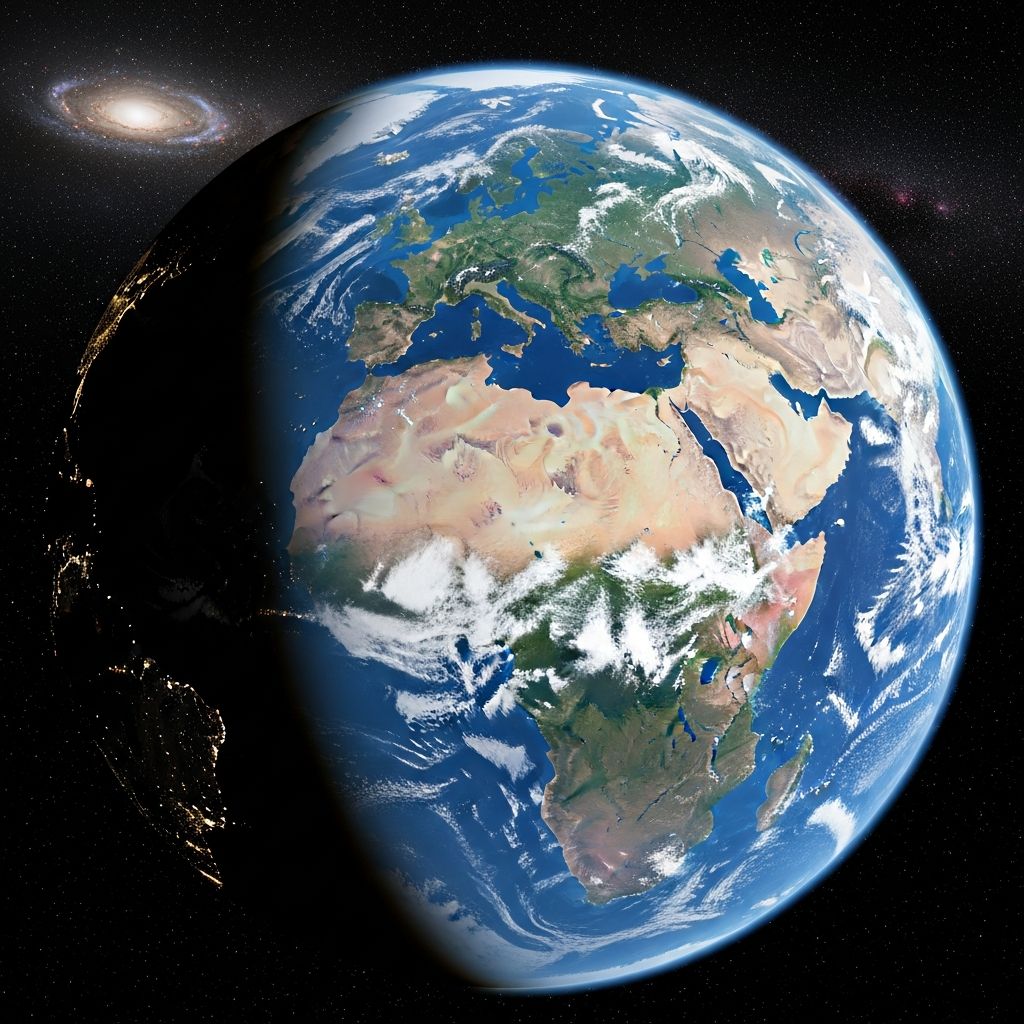
Earth stands out as the third planet from the Sun and the only known place in the universe teeming with life. Its unique combination of liquid water, breathable atmosphere, and active geology creates ideal conditions for countless species.
Earth’s Formation and Age
About 4.5 billion years ago, Earth coalesced from a swirling disk of gas and dust in the early Solar System. This process shaped it into the densest planet among the rocky worlds, with a mass and size surpassing Mercury, Venus, and Mars.
During its formative years, intense heat from collisions and radioactive decay melted the young planet, allowing heavier elements like iron to sink toward the center. This differentiation laid the foundation for Earth’s layered interior, setting the stage for oceans and life to emerge within the first billion years.
The Oblate Spheroid Shape
Contrary to popular depictions of a perfect sphere, Earth is an oblate spheroid, bulging at the equator due to its rotation. This equatorial bulge flattens the poles slightly, with the planet’s circumference measuring roughly 40,000 kilometers.
Rotational speed causes this distortion: Earth spins once every 24 hours, flinging mass outward at the equator. Variations in mass distribution, like dense ocean trenches or mountain ranges, further tweak local gravity, though these effects are imperceptible from space photos.
Oceans: The Dominant Feature
Water blankets 70.8% of Earth’s surface, making it an ocean world unlike any other in the Solar System. These vast seas hold nearly all the planet’s water, influencing climate, weather, and life.
- Global ocean covers 510 million square kilometers total surface area.
- Land comprises just 29.2%, mostly in continents within the land hemisphere.
- Polar ice sheets store more freshwater than all lakes, rivers, and groundwater combined.
Oceans moderate temperatures, drive currents like the Gulf Stream, and host hydrothermal vents—possible cradles of early life.
Dynamic Internal Layers
Earth’s interior comprises several distinct layers, each contributing to surface features and protection from space hazards.
| Layer | Composition | Key Role |
|---|---|---|
| Crust | Silicate rocks | Forms continents and ocean floors; 5-70 km thick |
| Mantle | Molten rock | Convection drives plate tectonics |
| Outer Core | Liquid iron-nickel | Generates magnetic field |
| Inner Core | Solid iron-nickel | 1,600 miles diameter; extreme pressure |
The core spans 4,400 miles wide, with its liquid outer portion swirling to produce a magnetic field that shields the surface from solar wind and cosmic rays.
Plate Tectonics: Engine of Change
Earth’s crust floats on the semi-fluid mantle in rigid plates that grind, collide, and separate. This activity births mountains like the Himalayas, fuels volcanoes, and triggers earthquakes.
Subduction zones recycle crust into the mantle, while mid-ocean ridges spew new material, keeping the surface dynamic. No other planet shows such vigorous tectonics, which likely aided life’s emergence by cycling nutrients.
Life-Sustaining Atmosphere
A thin gaseous envelope, primarily nitrogen (78%) and oxygen (21%), envelops Earth. Water vapor, carbon dioxide, and other gases trap solar heat via the greenhouse effect, maintaining liquid water.
This atmosphere deflects meteoroids (most burn up on entry) and blocks harmful UV radiation. Life, especially ancient cyanobacteria, transformed it through the Great Oxidation Event around 2 billion years ago, raising oxygen levels for complex organisms.
Rotation, Orbit, and Seasons
Earth orbits the Sun at 1 AU (about 93 million miles), completing a lap in 365.25 days—a solar year. Its 23.4-degree axial tilt causes seasons as hemispheres alternately lean toward or away from sunlight.
Daily rotation on its axis creates day and night, with the side facing the Sun illuminated. This rhythm, combined with orbit, dictates climate zones from tropical equators to frigid poles.
Extreme Landscapes and Biodiversity
Earth hosts staggering variety: the Atacama Desert, driest non-polar spot; Antarctica’s vast ice sheet; and Great Barrier Reef, the largest living structure built by coral polyps.
- Atacama: Some areas see no rain for centuries, yet life persists.
- Antarctica: Holds 70% of Earth’s freshwater as ice.
- Coral reefs: Shelter 25% of marine species despite covering <1% of ocean floor.
Microbes dominate biomass, with cyanobacteria pivotal in oxygenating the atmosphere billions of years ago.
Magnetic Field and Cosmic Defenses
The geodynamo in the liquid outer core generates a magnetic field, with poles that wander westward over time. This magnetosphere traps solar particles in radiation belts, protecting life.
Without it, solar wind would strip the atmosphere, as likely happened on Mars.
The Moon’s Influence
Earth’s satellite, formed from a colossal impact 4.5 billion years ago, stabilizes axial tilt for consistent seasons. Tides from lunar gravity mix oceans, fostering coastal ecosystems.
The Moon drifts away 3.8 cm yearly, but its pull remains vital for life’s rhythms.
Human Impact and Future
Life has reshaped Earth for billions of years; humans now accelerate change via emissions and land use. Rocks like Grand Canyon’s layers record eons of history, from anoxic seas to land colonization.
Preserving this ‘blue paradise’ requires understanding its delicate balance.
Frequently Asked Questions (FAQs)
Why is Earth the only planet with life?
Its liquid water, stable orbit, magnetic protection, and plate tectonics create habitable conditions unmatched elsewhere.
How old is Earth?
Radiometric dating of rocks pegs it at 4.54 billion years.
What causes earthquakes?
Movement along faults in tectonic plates releases built-up stress.
Is Earth perfectly round?
No, rotation flattens poles and bulges equator into an oblate spheroid.
How much water covers Earth?
About 71%, mostly in oceans; rest in ice, groundwater, and atmosphere.
References
- Earth – Wikipedia — Wikipedia contributors. 2023-10-01. https://en.wikipedia.org/wiki/Earth
- Planet Earth — Everything you need to know — Space.com. 2023-08-15. https://www.space.com/54-earth-history-composition-and-atmosphere.html
- 10 remarkable Earth facts — European Space Agency (ESA). 2022-04-22. https://www.esa.int/Applications/Observing_the_Earth/10_remarkable_Earth_facts
- Interesting facts about Earth from Harvard paleontologist — Harvard Gazette. 2022-04-20. https://news.harvard.edu/gazette/story/2022/04/interesting-facts-about-earth-from-harvard-paleontologist/
- Facts about the Earth! — National Geographic Kids. 2023-05-10. https://www.natgeokids.com/uk/discover/science/space/facts-about-the-earth/
- Earth – NASA Science — NASA. 2024-01-12. https://science.nasa.gov/kids/earth/

Medha Deb is an editor with a master's degree in Applied Linguistics from the University of Hyderabad. She believes that her qualification has helped her develop a deep understanding of language and its application in various contexts. Medha specializes in the areas of beauty, health, sports, and wellness and is committed to ensuring that the content on the website is…