
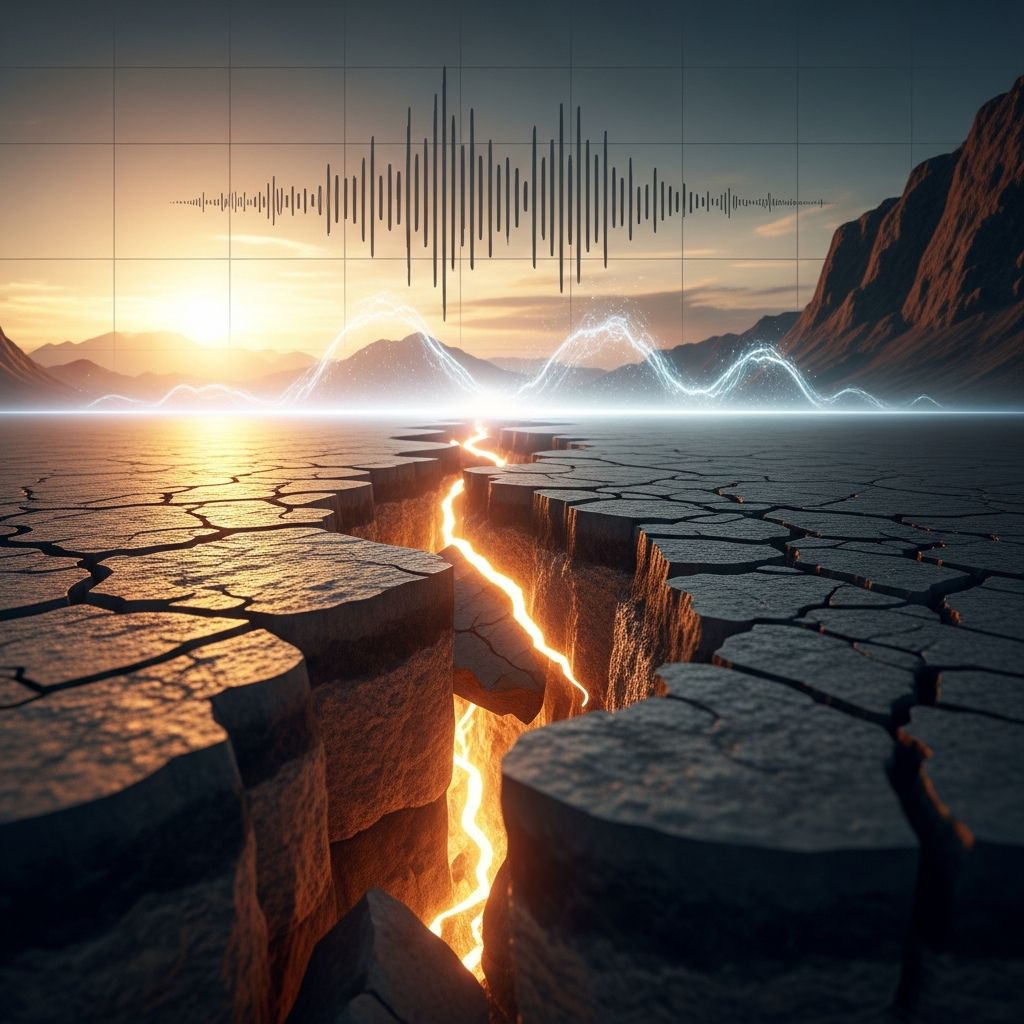
Earthquake magnitudes quantify the energy unleashed when tectonic plates shift, providing a standardized way to assess seismic events globally. This logarithmic measurement helps predict potential damage and guides preparedness efforts.
The Fundamentals of Seismic Energy Measurement
Seismologists measure earthquakes by analyzing seismic waves captured on seismographs, focusing on the total energy released at the fault’s hypocenter. Unlike intensity, which varies by location, magnitude remains constant for each event, offering a universal metric.
The scale’s logarithmic design means each whole number step represents a tenfold increase in wave amplitude and roughly 31 times more energy. For instance, a magnitude 6 quake shakes the ground 10 times harder than a magnitude 5 but liberates about 32 times the energy.
Evolution from Richter to Modern Scales
Developed in 1935 by Charles Richter and Beno Gutenberg, the original Richter scale targeted local Southern California quakes using maximum wave amplitudes on Wood-Anderson seismographs. It worked well for magnitudes below 7 but faltered for larger or distant events due to saturation and wave attenuation issues.
Today, the Moment Magnitude Scale (Mw) has superseded it, accounting for fault rupture area, slip distance, and rock rigidity. This makes Mw accurate for giant quakes up to 9.5, unlike Richter’s limitations.
| Magnitude Type | Key Features | Best For | Limitations |
|---|---|---|---|
| Richter (ML) | Measures max S-wave amplitude, logarithmic | Local, small quakes (<600km) | Underestimates large/deep/distant events |
| Moment (Mw) | Based on seismic moment (rigidity × area × slip) | All sizes, global use | More complex calculation |
| Body-Wave (Mb) | Uses P-wave amplitude | Deep earthquakes | Less precise for shallow quakes |
| Surface-Wave (Ms) | Long-period surface waves | Shallow quakes | Saturates above ~8 |
How Logarithmic Scaling Works in Practice
Logarithms compress vast energy ranges into manageable numbers. The energy E relates to magnitude M via log E = 11.8 + 1.5M (in ergs), so a magnitude 7 releases ~31.6 times more energy than a 6.
- Amplitude Multiplier: M+1 = 10× larger waves
- Energy Multiplier: M+1 ≈ 31-32× more energy
- Shaking Comparison: To compare quakes, use 10^(M1-M2) for relative shaking (e.g., M6 vs. M4 = 100× stronger).
This explains why magnitude 9 events, like the 1960 Chile quake, dwarf others in destructiveness despite similar-sounding numbers.
Effects Across the Magnitude Spectrum
Impacts escalate dramatically with magnitude, influenced by depth, geology, and infrastructure. Below 2.5, quakes are imperceptible; above 8, they devastate vast regions.
| Magnitude Range | Typical Effects | Annual Occurrences |
|---|---|---|
| <2.5 | Not felt; seismograph only | Millions |
| 2.5-5.4 | Felt; minor damage | ~500,000 |
| 5.5-6.0 | Slight building damage | ~350 |
| 6.1-6.9 | Significant damage in populated areas | ~100 |
| 7.0-7.9 | Major damage; widespread destruction | 10-15 |
| ≥8.0 | Catastrophic; tsunamis possible | 1 or fewer |
Magnitudes below 5 rarely damage sturdy structures, but poor building codes amplify risks.
Distinguishing Magnitude from Intensity
Magnitude gauges source energy; intensity measures local shaking severity via scales like Modified Mercalli (MMI). Intensity decreases with distance and depends on soil and structures.
- Magnitude: Single value per quake, energy-based.
- Intensity: Varies spatially; I (not felt) to XII (total destruction).
- Link: Higher magnitude generally means broader high-intensity zones.
Isoseismal maps plot intensity contours, aiding magnitude estimation from felt reports.
Record-Breaking Quakes and Physical Limits
The strongest recorded was the 1960 Valdivia, Chile quake at Mw 9.5, rupturing ~1,000 km of fault with massive slip. Tectonic limits cap magnitudes around 9.5-10, tied to plate sizes; subduction zones produce the giants.
Smallest quakes dip below 0, from minor fault slips. Fault area scales with size: M7 ~1,000 km² rupture.
Advanced Scales for Specialized Needs
Beyond Mw, scales like Mb (body waves) suit deep events, Ms (surface waves) shallow ones. Energy magnitude (Me) focuses on radiated waves for shaking potential, differing from Mw by up to 1.4 units based on focal mechanics.
Local magnitudes (ML) persist for routine monitoring but require corrections for strong quakes.
Global Monitoring and Reporting
Networks like USGS deliver rapid magnitudes using initial P-waves, refining with full data. Real-time info aids tsunami warnings and response.
Frequently Asked Questions (FAQs)
What does a magnitude 7 earthquake feel like?
It causes strong shaking, damaging well-built structures and destroying weak ones up to 100 km away. Annual occurrences: 10-15.
Is the Richter scale still used?
Rarely for official reports; Moment Magnitude is preferred for accuracy across all sizes.
Can earthquakes exceed magnitude 10?
No, plate dimensions limit max ~9.5-10; larger would require impossible fault scales.
How does distance affect felt magnitude?
Magnitude is fixed, but intensity drops with distance due to wave spreading and attenuation.
Why logarithmic instead of linear?
Earthquake energies span orders of magnitude; logs compress this into practical numbers.
Implications for Preparedness and Engineering
Understanding magnitudes informs building codes (e.g., seismic zones by expected max M), early warning systems, and insurance. Regions like Japan design for M8+ with base isolators and dampers.
Public education emphasizes that even M6+ can kill thousands if urban density is high and preparedness low, as in 2010 Haiti (M7.0).
References
- Richter Scale Explained: Earthquake Magnitude, Range & Meaning — SMS Tsunami Warning. Accessed 2026. https://www.sms-tsunami-warning.com/pages/richter-scale
- Earthquake Magnitude Scale — Michigan Technological University. Accessed 2026. https://www.mtu.edu/geo/community/seismology/learn/earthquake-measure/magnitude/
- How earthquakes are measured: Demonstrating magnitude — Britannica. Accessed 2026. https://www.britannica.com/video/how-do-earthquakes-work-and-how-are-the-effects-measured-video/-313422
- FACTSHEET: Magnitude Explained — BC Gov News. Accessed 2026. https://news.gov.bc.ca/factsheets/magnitude-explained
- Earthquake Magnitude, Energy Release, and Shaking Intensity — USGS. Accessed 2026. https://www.usgs.gov/programs/earthquake-hazards/earthquake-magnitude-energy-release-and-shaking-intensity
- Comparing Earthquakes, Explained — Science.org (AAAS). Accessed 2026. https://www.science.org/content/article/comparing-earthquakes-explained

Medha Deb is an editor with a master's degree in Applied Linguistics from the University of Hyderabad. She believes that her qualification has helped her develop a deep understanding of language and its application in various contexts. Medha specializes in the areas of beauty, health, sports, and wellness and is committed to ensuring that the content on the website is…