
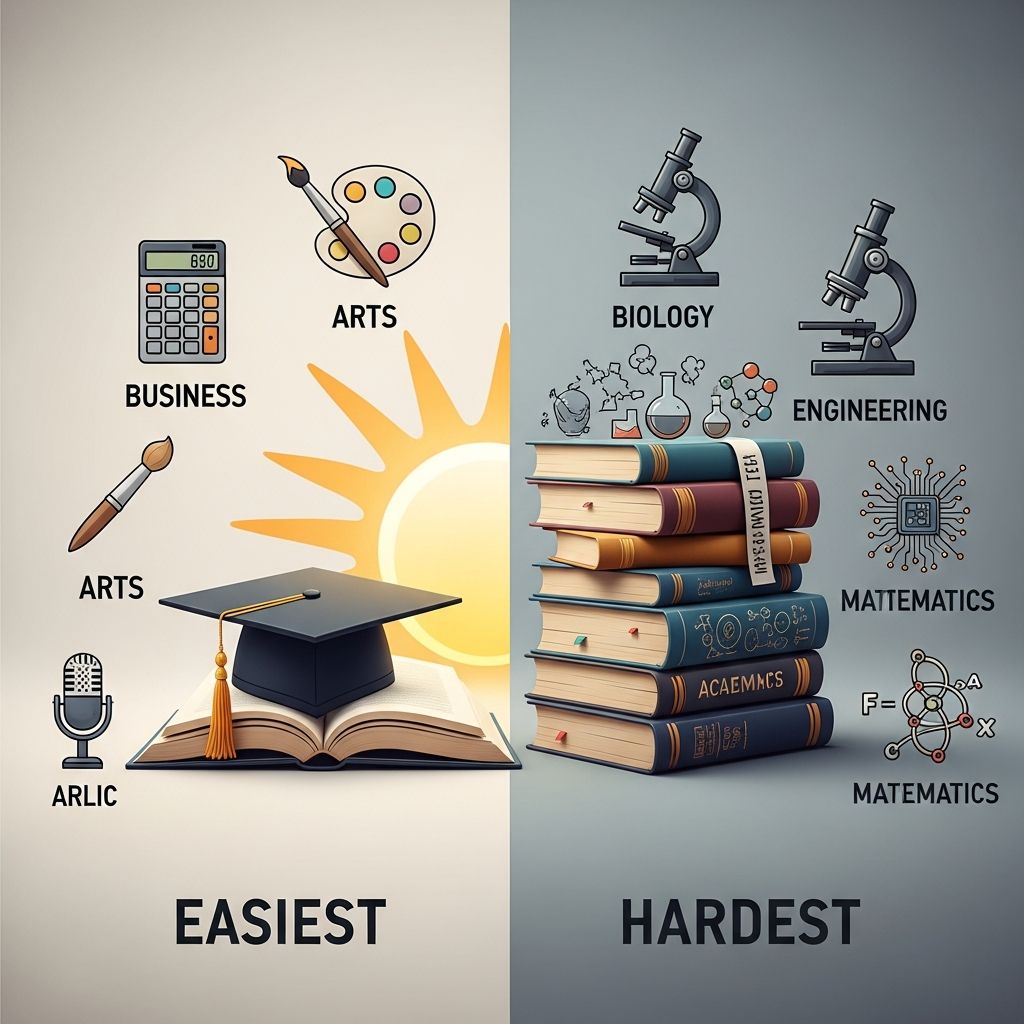
Choosing a college major involves balancing personal interests, academic strengths, and future career goals. While no degree is effortless, certain fields stand out for their lighter workloads or more intuitive coursework, whereas others demand rigorous math, lab hours, or abstract reasoning. This analysis draws from student performance data, including average GPAs, weekly study hours, and completion rates, to highlight top easiest and hardest majors. Understanding these can help prospective students make informed decisions without compromising on ambition.
Defining Major Difficulty: Key Metrics Explained
Difficulty varies by individual aptitude, but objective measures provide clarity. Average GPA reflects grading rigor and student success rates. Weekly study hours indicate time demands, with STEM fields often exceeding 18 hours per week. Completion time and dropout rates also factor in, as majors like engineering frequently extend beyond four years. Job market ROI adds perspective, showing long-term value despite short-term challenges. These metrics reveal patterns across disciplines.
| Metric | Easy Majors Average | Hard Majors Average |
|---|---|---|
| Average GPA | 3.2–3.5 | 2.8–3.1 |
| Weekly Study Hours | 12–15 | 18–22 |
| Typical Completion Time | 4 years | 4.5–5+ years |
| 20-Year ROI | $500K+ | $350K–$600K |
This table summarizes trends from aggregated data, emphasizing why some paths feel more manageable.
Top Easiest College Majors for Balanced Workloads
Majors deemed easiest often emphasize discussion, writing, or practical skills over heavy computation. They boast higher GPAs and shorter study sessions, allowing time for extracurriculars or part-time jobs.
Business Administration: Versatile and Practical
Business administration tops lists for its broad curriculum covering management, finance, and marketing. With an average GPA of 3.2 and just 13.5 weekly study hours, it suits organized thinkers. Courses build real-world skills like budgeting and team projects, leading to strong ROI of $563,000 over 20 years. Graduates enter diverse roles in corporate settings.
Communications and Public Relations: Skill-Focused Learning
Communications involves media strategies, writing, and interpersonal dynamics, often with GPAs around 3.3. Study time hovers at 14 hours weekly, focusing on presentations rather than equations. It’s ideal for outgoing students eyeing journalism or advertising careers.
Psychology and Sociology: Human Behavior Insights
Psychology ranks high for readability, with GPAs near 3.4. It explores motivations through experiments and theory, averaging 13 hours of study. Sociology complements this by examining societal patterns, offering flexibility for grad school or counseling paths.
English and Education: Creative and Structured Paths
English literature demands reading but rewards strong writers with high GPAs. Education majors focus on teaching methods, preparing for classrooms with manageable 14-hour weeks. Both foster critical thinking without intense labs.
- Business Administration: High ROI, people-oriented.
- Communications: Creative expression, media careers.
- Psychology: Behavioral science, counseling prep.
- Sociology: Social analysis, policy roles.
- English: Writing skills, versatile applications.
Challenging Majors: High Demands and Rewards
Harder majors cluster in STEM, requiring precision, endurance, and problem-solving. Low GPAs and long hours test resilience but yield specialized careers.
Chemistry and Biochemistry: Lab-Intensive Sciences
Chemistry leads as the toughest, with a 2.9 GPA and 18.5 study hours. It demands mastering reactions and equations through endless experiments. Biochemistry blends biology, intensifying lab demands. Both prep for medicine or research, with solid ROI despite rigor.
Engineering Disciplines: Building Complex Systems
Fields like chemical, electrical, and mechanical engineering average 19–22 hours weekly. GPAs dip to 3.0 amid math-heavy courses and projects. Architecture joins at 22 hours, factoring design studios. Persistence pays in high-demand jobs.
Physics and Mathematics: Abstract Mastery Required
Physics involves natural laws via advanced calculus, with 18.5 hours and low GPAs. Mathematics emphasizes proofs and modeling, suiting logical minds. Both demand abstract thinking, often extending graduation timelines.
Computer Science: Coding and Algorithms
Computer science requires programming proficiency and math, with GPAs around 3.1. Weekly hours hit 18+, including debugging marathons. It’s competitive, especially at top schools like Berkeley.
- Chemistry: Lowest GPA, lab overload.
- Engineering: Project-heavy, time sinks.
- Physics: Theoretical depth.
- Computer Science: Technical weeds.
- Biochemistry: Science fusion.
Factors Influencing Perceived Difficulty
Beyond rankings, personal fit matters. Strong math skills ease STEM; verbal aptitude aids humanities. Competition spikes in pre-med tracks like biology. Transfer-friendly majors like psychology have consistent requirements. Time management separates successes in demanding fields.
Career Outcomes and ROI Comparison
Harder majors often boast higher salaries offsetting effort. Engineering graduates earn premiums, with ROIs rivaling business. Easier ones like communications offer quicker entry but variable pay. Consider passions alongside data for fulfillment.
| Major Type | Avg Starting Salary | 20-Year ROI | Job Growth |
|---|---|---|---|
| Business Admin | $60K | $563K | High |
| Chemical Eng | $75K | $600K+ | Stable |
| Psychology | $50K | $450K | Growing |
| Computer Science | $80K | $700K | Very High |
Data highlights trade-offs.
Strategies for Thriving in Any Major
Regardless of choice, effective habits boost success. Office hours, study groups, and time-blocking counter heavy loads. Undeclared students can sample courses early. Advisors help navigate switches, especially from weed-out prereqs.
FAQs: College Major Difficulty
Are online majors easier?
Online programs match on-campus rigor but add flexibility, not reduced difficulty.
Can I switch from a hard major?
Yes, but low GPAs from weeder courses complicate transfers; aim early.
Do easiest majors limit careers?
No, business and psych lead to grad school or diverse roles.
What makes STEM hardest?
Math intensity, labs, and competition drive low GPAs.
Is major choice permanent?
Not at all; many pivot post-grad via certifications.
References
- What Are the Easiest and Hardest College Majors? — Road2College. 2023. https://www.road2college.com/easiest-hardest-college-majors/
- The 10 Hardest and Easiest College Majors — CollegeVine Blog. 2023. https://blog.collegevine.com/easiest-and-hardest-college-majors
- Easiest Major vs. Hardest Major — College Confidential (Berkeley data). 2023. https://talk.collegeconfidential.com/t/easiest-major-vs-hardest-major/475631?page=2
- Easiest College Majors and Degrees — BestColleges.com. 2024. https://www.bestcolleges.com/resources/easy-college-majors/
- The Easiest & Hardest College Majors — Poets&Quants for Undergrads. 2023. https://poetsandquantsforundergrads.com/news/the-easiest-hardest-college-majors/

Medha Deb is an editor with a master's degree in Applied Linguistics from the University of Hyderabad. She believes that her qualification has helped her develop a deep understanding of language and its application in various contexts. Medha specializes in the areas of beauty, health, sports, and wellness and is committed to ensuring that the content on the website is…