
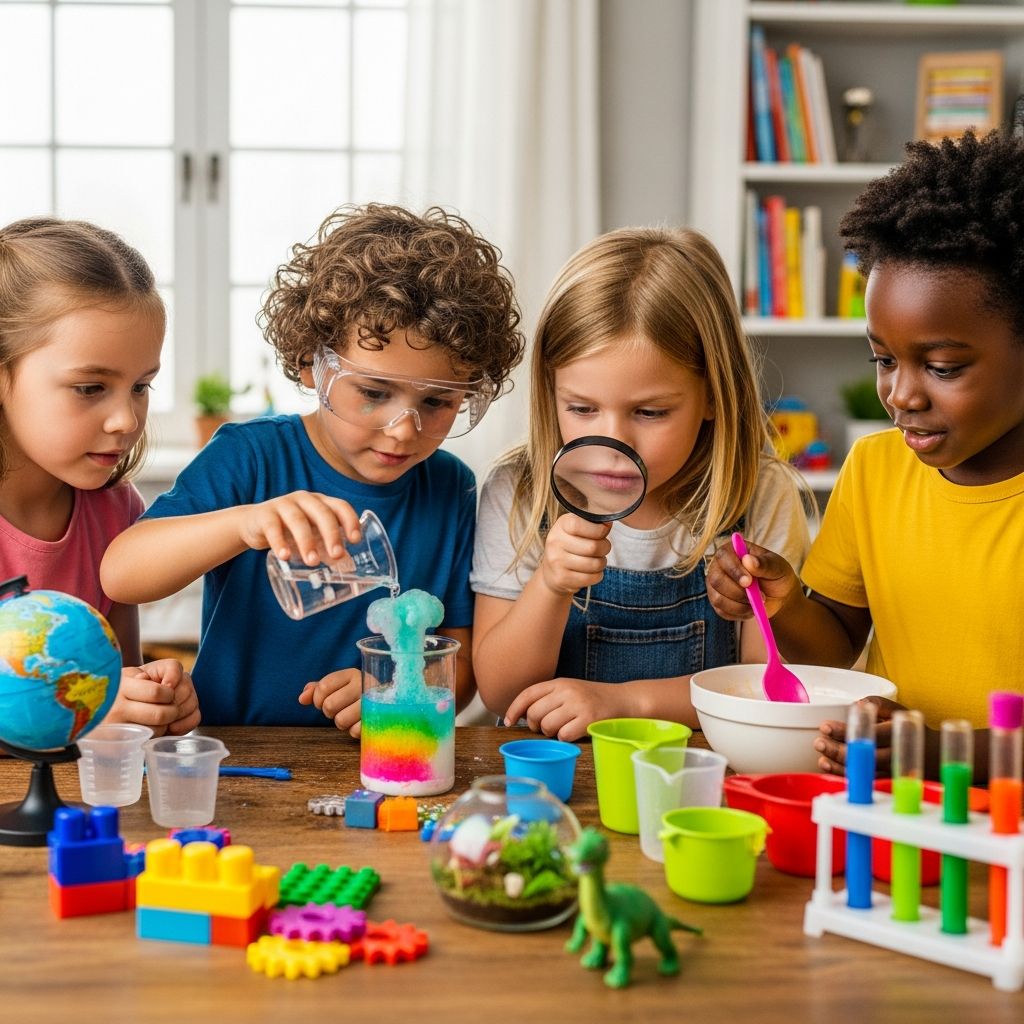
Science education extends far beyond the classroom. When children engage in practical experiments at home, they develop critical thinking skills, curiosity, and a deeper understanding of fundamental scientific principles. The beauty of home-based science activities lies in their accessibility—most require only common household items and adult supervision. This comprehensive guide explores how to create an enriching environment for scientific discovery while maintaining proper safety protocols.
Establishing a Foundation for Safe Scientific Exploration
Before initiating any home science project, it is essential to establish clear guidelines and safety practices. Young learners must understand that science experiments require responsible behavior and adherence to specific procedures. The foundation of safe science begins with two critical principles: experiments should never occur without adult supervision, and children should only perform activities that have been explicitly approved by parents or educators.
Creating a designated science space in your home sets the stage for organized learning. This area should be well-lit, free from distractions, and equipped with basic safety equipment such as goggles or aprons. When children see themselves prepared with protective gear, they internalize the importance of scientific responsibility and approach experiments with appropriate seriousness.
Parents and educators share responsibility for ensuring that home science remains both enjoyable and safe. Teachers should provide clear, written procedures for any school-assigned projects, allowing parents to review and understand exactly what their child will be doing. When uncertainty arises about an experiment’s safety, consulting with a science teacher at a local school is a prudent step. Additionally, schools bear responsibility for securing chemicals and equipment so that children cannot access potentially hazardous materials without supervision.
Foundational Chemistry Experiments Using Everyday Materials
Chemistry concepts become accessible and exciting when demonstrated through kitchen-based experiments. These activities allow children to observe chemical reactions firsthand while using ingredients commonly found in most homes.
Volcanic Reactions and Gas Production
One of the most popular introductory chemistry experiments involves combining baking soda and vinegar to simulate volcanic eruptions. This simple reaction demonstrates acid-base chemistry in a visually dramatic way. Children can construct a volcano model from clay or papier-mâché, fill it with baking soda, and add food coloring and dish soap to the vinegar solution before pouring it into the opening. The resulting foam eruption illustrates carbon dioxide gas production and makes abstract chemical concepts tangible.
Color Diffusion and Molecular Movement
The Skittles rainbow diffusion experiment introduces children to the concept of diffusion and molecular behavior. By arranging Skittles candies around the edge of a plate and pouring warm water into the center, children observe how sugar and food coloring disperse through water, creating a colorful gradient. This engaging activity demonstrates that molecules in liquids move and interact, providing visual evidence of concepts that might otherwise seem purely theoretical.
Fizzing Reactions and Foam Creation
Combining baking soda, vinegar, and dish soap produces a dramatic foaming reaction that captivates young scientists. The addition of food coloring adds visual interest, while the experiment effectively demonstrates exothermic reactions—processes that release energy, often in the form of heat or gas. This activity works particularly well for introducing the concept that chemical reactions create new substances with different properties than the original ingredients.
Physics Explorations Through Movement and Energy
Physics experiments help children understand how objects move, interact, and respond to forces. Many classic physics demonstrations require minimal equipment yet provide profound learning opportunities.
Energy Transformation Through Chain Reactions
Using craft sticks and pom-poms, children can construct chain reactions that dramatically illustrate the difference between potential and kinetic energy. When the tension holding the stacked sticks is released, stored energy converts to motion, sending pom-poms flying through the air. This hands-on demonstration helps children grasp abstract energy concepts through observable, exciting results.
Gravity and Motion Studies
Paper airplane variations, particularly those incorporating straws and paper hoops, provide opportunities to explore principles of flight and aerodynamics. By systematically changing variables such as straw length or hoop size, children engage in experimental design—testing hypotheses and analyzing how modifications affect flight distance and trajectory. This structured approach teaches the scientific method while producing fun, competitive results.
Projectile Motion and Propulsion
Film canister rockets powered by Alka-Seltzer tablets or baking soda reactions demonstrate Newton’s third law—for every action, there is an equal and opposite reaction. Children observe how chemical reactions create pressure that launches small objects into the air, making abstract physics principles immediately visible and exciting.
Engineering Challenges and Structural Design
Engineering activities encourage problem-solving and creative thinking while introducing children to concepts of structural integrity and material properties.
Bridge Construction and Load Bearing
The paper bridge challenge asks children to design and construct a bridge from paper that can support increasing weight, typically represented by stacked pennies. This activity introduces fundamental engineering principles: how folding paper increases its strength, how different structural designs affect load-bearing capacity, and how to test designs systematically. Children learn through trial and error which configurations work best, embodying the iterative nature of real engineering.
Catapult Design and Force Application
Building catapults from craft sticks teaches children about lever mechanics and force transfer. By experimenting with different fulcrum positions and launch angles, young engineers discover how mechanical advantage works and how to optimize their designs for specific objectives—launching projectiles accurately or achieving maximum distance.
Cardboard Construction Projects
Repurposing cardboard boxes into homemade rockets, mazes, or pinhole cameras encourages creative thinking and resourcefulness. Children learn that everyday materials can be transformed into functional scientific tools, developing appreciation for practical problem-solving and innovation.
Physics of Light and Optical Phenomena
Light-based experiments reveal fascinating principles about energy, waves, and perception.
Light Spectrum Separation
Using prisms to separate white light into its component colors demonstrates wave properties and the electromagnetic spectrum. Children observe how different wavelengths of light refract at slightly different angles, creating the visible rainbow. This experiment connects abstract concepts about light to observable, beautiful results.
Light Absorption and Reflection
Testing how different materials absorb or reflect light—using black paper, aluminum foil, and clear plastic—helps children understand material properties and energy interaction. They learn that surfaces interact differently with light, introducing concepts relevant to everything from clothing choices to solar technology.
Electrical Conductivity and Plasma Demonstrations
Plasma balls and static electricity experiments demonstrate how electrical energy behaves. Using a plasma ball to light an incandescent bulb through static electricity creates a tangible connection to abstract concepts about electrical conductivity and ionized gases.
Material Properties and Absorption Studies
Experiments focusing on material properties help children understand how different substances interact with water, heat, and other elements.
Absorption and Textile Properties
Observing how water-saturated T-shirts absorb and retain moisture introduces concepts of material porosity and absorption capacity. Children discuss which fabrics absorb more water and why, connecting everyday objects to scientific principles about material structure.
Creating Materials with New Properties
Mixing cornstarch, baking soda, and water to create bouncy balls demonstrates how combining different ingredients produces substances with entirely new properties. The resulting bouncy ball behaves differently from any single ingredient, illustrating that combinations can create emergent properties unexpected from individual components alone.
Hydrophobic Material Exploration
Hydrophobic sand that repels water provides visual evidence of how material properties determine behavior. Children observe sand remaining dry even when submerged, learning that materials can be engineered or naturally occurring with specific properties that defy initial expectations.
Capillarity and Water Transport
Water-based experiments reveal surprising properties of liquids and how they move through materials.
Paper Towel Capillary Action
The water-walking experiment uses folded paper towel bridges to transport colored water between containers arranged in circles. As water moves up and across the towels, colors mix and spread, demonstrating capillary action—how liquids move through porous materials against gravity. This accessible experiment produces beautiful visual results while teaching fundamental principles about liquid behavior.
Ice and Salt Interactions
Lifting ice cubes with string, made possible by salt lowering the freezing point and allowing water to refreeze around the string, demonstrates how temperature changes and salt interaction affect ice structure. Children see how understanding material properties enables accomplishing seemingly impossible tasks.
Organized Documentation and Scientific Record-Keeping
Supporting children in documenting their experiments develops scientific literacy and organizational skills. Providing a science journal or recording sheet encourages children to note observations, formulate hypotheses, record results, and draw conclusions. This practice embeds the scientific method into every experiment, transforming individual activities into a cohesive learning experience.
Documentation should include sketches, written observations, and numerical measurements when applicable. Over time, a collection of documented experiments creates a portfolio demonstrating the child’s growing scientific understanding and experimental technique.
Selecting Appropriate Experiments Based on Age and Development
Different age groups require different complexity levels and supervision intensity. Younger children benefit from experiments with immediate, dramatic results—colorful reactions and obvious transformations capture attention and maintain engagement. Older children can handle more complex procedures, multiple-step processes, and experiments requiring quantitative analysis and hypothesis testing.
Common Questions About Home Science Experiments
- What should I do if an experiment doesn’t work as expected?
- Unexpected results are valuable learning opportunities. Discuss with your child what happened differently and why the outcome might have varied from the expected result. This develops critical thinking about experimental variables and the scientific method.
- How can I make science experiments less messy?
- Conduct experiments over trays, use drop cloths, and select projects that aline with your family’s tolerance for mess. Many rewarding experiments produce minimal cleanup.
- Should I perform the experiment first before allowing my child to try it?
- Previewing experiments helps identify potential safety issues and ensures you understand the procedure. However, allowing your child to experience some discovery and surprise maintains enthusiasm and engagement.
- What if my child wants to modify an experiment?
- Controlled modification and hypothesis-testing about how changes affect outcomes represents excellent science practice. Guide your child in making one variable change at a time and predicting the result before experimenting.
Creating Long-Term Scientific Engagement
Regular science experiments at home build confidence and foster genuine curiosity about how the world works. By maintaining a consistent practice of hands-on learning, celebrating discoveries, and discussing observations together, parents create an environment where scientific thinking becomes natural and enjoyable. The experiments themselves matter less than the mindset they develop—one where questions are welcomed, investigation is valued, and the world is viewed as an endlessly fascinating collection of phenomena waiting to be understood.
References
- Safe Science at Home: Understanding Precautions for Home Science Experiments — Lab Safety Organization. https://www.labsafety.org/safe-science-at-home
- 75 Easy Science Experiments Using Materials You Already Have — We Are Teachers. https://www.weareteachers.com/easy-science-experiments/
- 45 Easy Science Experiments for Kids — Good Housekeeping. https://www.goodhousekeeping.com/life/parenting/g32176446/science-experiments-for-kids/
- Easy Science Experiments for Kids at Home or in the Classroom — Science Sparks. https://www.science-sparks.com
- Home Experiments — Children’s Science Center. https://www.childsci.org/home-experiments

- Integrated M.A. in Applied Linguistics, University of Hyderabad
- 5+ years in editorial, instructional, SEO, and research-based writing
Sneha is a relationships and lifestyle writer with a strong foundation in applied linguistics and certified training in relationship coaching. She brings over five years of writing experience to theskillvault, crafting thoughtful, research-driven content that empowers readers to build healthier relationships, boost emotional well-being, and embrace holistic living. Her writing and insights reflect the belief that beauty, happiness, and wellness…