
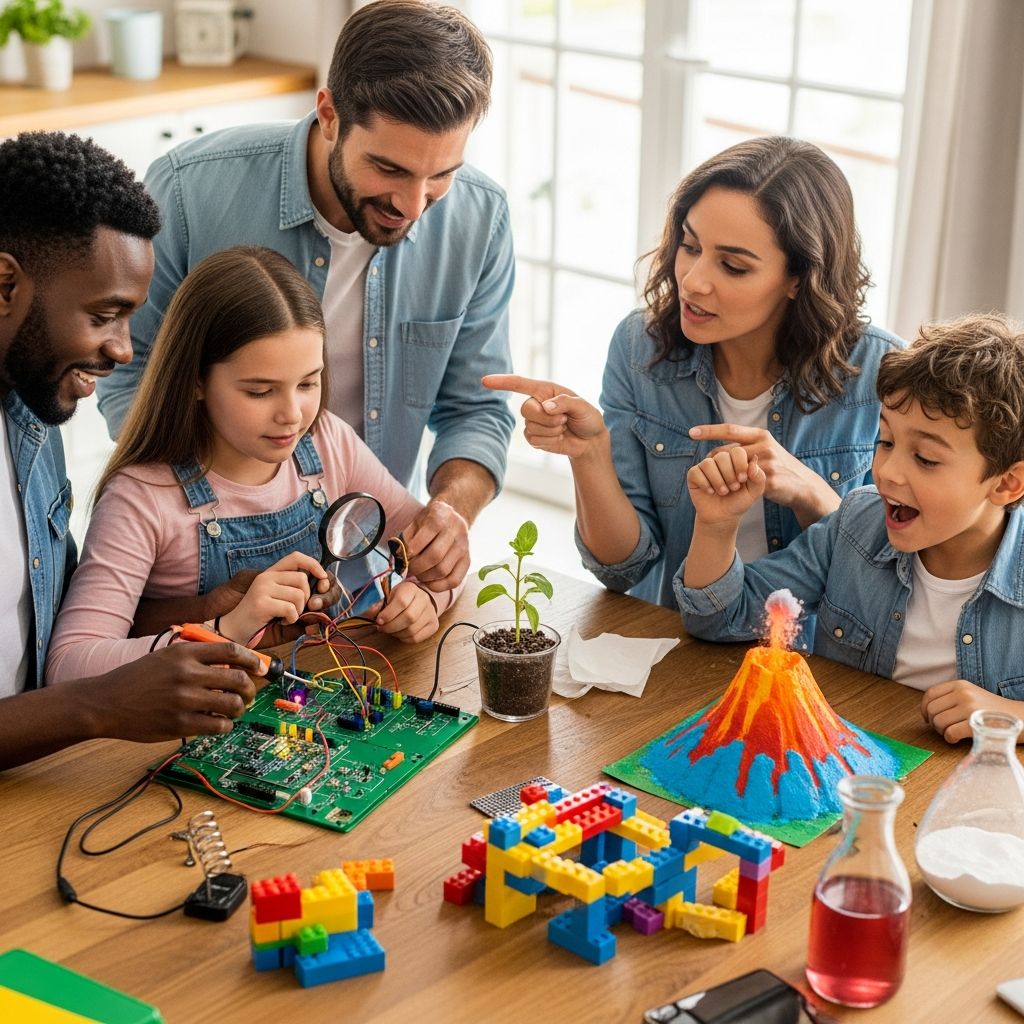
Bringing STEM (Science, Technology, Engineering, and Mathematics) education into the home environment offers families a unique opportunity to nurture curiosity and problem-solving skills. These activities transform everyday materials into gateways for discovery, allowing children to experiment, fail, iterate, and succeed in a low-pressure setting. Unlike traditional classroom lessons, home-based projects encourage collaboration between parents and kids, blending play with learning to make complex concepts accessible and memorable.
Why STEM Matters in Everyday Home Life
STEM fields drive innovation in our world, from smartphones to sustainable energy solutions. Introducing these disciplines early builds foundational skills like logical thinking, creativity, and resilience. According to educational research, hands-on activities significantly improve retention rates compared to passive learning methods. At home, parents can tailor projects to a child’s age and interests, fostering a lifelong love for learning without needing expensive kits.
Common household items—paper, tape, recyclables, and kitchen staples—become tools for exploration. These projects not only teach specific principles but also emphasize the engineering design process: ask, imagine, plan, create, and improve. This cycle mirrors real-world problem-solving used by professionals at organizations like NASA.
Engineering Marvels: Building Structures That Stand Tall
Structural engineering comes alive when families construct models that defy gravity. Start with a simple challenge using pasta and marshmallows to create freestanding towers. Kids learn about load-bearing, tension, and compression as they test designs against weights like coins or small toys.
- Gather materials: Dry spaghetti or pasta, mini marshmallows, ruler for measuring height.
- Steps: Brainstorm shapes (triangles for strength), assemble a base, build upward, and compete for the tallest stable tower.
- Science tie-in: Discuss why triangular trusses outperform squares in bridges and skyscrapers.
For younger builders, try popsicle stick bridges. Soak sticks in water for flexibility, then glue them into spans that hold heavy objects. This introduces concepts of span length and material strength. Extensions include varying water exposure times to test flexibility versus durability.
Physics in Motion: Roller Coasters and Launchers
Motion and energy transformation captivate with paper roller coasters. Roll paper into tubes, tape loops and hills, and send marbles racing to demonstrate potential to kinetic energy conversion.
| Project Element | Physics Concept | Age Range |
|---|---|---|
| Steep drops | Gravitational potential energy | 8+ |
| Loops | Centripetal force | 10+ |
| Marble speed measurement | Velocity and friction | 10+ |
Advance to paper airplane launchers or cotton ball catapults using rubber bands and spoons. These teach projectile motion and aerodynamics. Measure distances to graph improvements, introducing basic data analysis.
Environmental Science: Water and Air Purification
Address real-world issues like clean water with DIY filtration systems. Layer sand, gravel, charcoal, and cotton in a bottle to purify muddy water, revealing how treatment plants operate.
- Cut the bottom off a plastic bottle.
- Add layers from coarsest (gravel) to finest (cotton).
- Pour in contaminated water and observe clarity changes.
Pair with air quality experiments, like building wind-powered cars from recyclables to explore renewable energy. Kids predict which designs travel farthest, testing variables like sail size.
Chemistry Fun: Reactions and Color Explorations
Safe chemical reactions wow with elephant toothpaste: mix yeast, warm water, dish soap, and hydrogen peroxide for a foamy eruption demonstrating catalysis. Safety note: Adult supervision for hydrogen peroxide.
Create rainbows in a jar with density columns using sugar solutions dyed differently. Layers stay separated, teaching molecular packing. For biology ties, model DNA helices with twisted pipe cleaners and marshmallows, grasping double helix structure.
Technology and Coding: Unplugged Challenges
No screens needed for coding basics. Design chain reaction machines with dominoes, string, and toys to sequence events. Or build robot arms from cardboard and syringes for hydraulic movement, simulating automation.
Smartphone extensions measure acceleration in shakes or light levels, introducing sensors. These bridge to digital tech without devices.
Nature-Inspired Builds: From Forts to Feeders
Engineer blanket forts with geometry in mind, maximizing volume with triangles. Challenge: Build the strongest against ‘wind’ from a fan.
Recycled bird feeders teach ecosystems. Use milk cartons, seeds, and string; observe visitors to discuss biodiversity. Twig-based activities explore patterns and symmetry in nature art.
Advanced Challenges for Older Learners
Teens tackle seismographs from rubber bands and boxes to simulate earthquakes, or Archimedes screws from tubes to lift water, delving into ancient engineering. Puff cars powered by balloons quantify thrust.
Tips for Successful STEM Sessions at Home
- Set clear goals: Define success (e.g., height, distance) but embrace failures as learning.
- Document progress: Photos, journals track iterations.
- Connect to real world: Relate to NASA missions or environmental news.
- Scale by age: Simplify for preschoolers, add math for tweens.
- Safety first: Supervise sharps, chemicals.
These projects build confidence, with studies showing hands-on STEM boosts problem-solving by 25%. Rotate weekly for sustained engagement.
Frequently Asked Questions (FAQs)
What ages are these STEM projects suitable for?
Most suit ages 5-12, with adaptations: simple stacking for young kids, data analysis for teens.
Do I need special materials?
No—use recyclables, pantry items. Budget under $10 per project.
How long do projects take?
20-60 minutes setup and build, plus testing time.
Can these align with school curriculum?
Yes, cover NGSS standards in physics, engineering.
What if my child gets frustrated?
Encourage ‘version 2.0’—iteration is key to engineering.
Expanding Your STEM Adventures
Join virtual zoo cams for biology or design phone stands for tech. Track moon phases with playdough or sort objects by properties. These sustain momentum year-round.
Families report stronger bonds and kids’ enthusiasm for school STEM. Start small, celebrate efforts, and watch skills grow.
References
- 5 STEM Ideas for the Classroom or at Home — HR Green, Inc. Accessed 2026. https://www.hrgreen.com/5-stem-ideas-for-the-classroom-or-at-home/
- STEM Activities To Do At Home — WSU Extension Pierce County. Accessed 2026. https://extension.wsu.edu/pierce/4-h/stem-activities-to-do-at-home/
- STEM Activities for at Home Learning — Exploration Place. Accessed 2026. https://exploration.org/educational-resource/stem-activities-for-at-home-learning/
- 17 Creative STEM Activities Using Sticks for the Classroom — Project Learning Tree. Accessed 2026. https://www.plt.org/educator-tips/stem-activities-sticks-classroom/
- 250+ STEM Activities for Kids — KiwiCo. Accessed 2026. https://www.kiwico.com/diy/stem
- STEM Activities for Families — NASA Jet Propulsion Laboratory. Accessed 2026. https://www.jpl.nasa.gov/edu/resources/lesson-plan/stem-activities-for-families/

- Integrated M.A. in Applied Linguistics, University of Hyderabad
- 5+ years in editorial, instructional, SEO, and research-based writing
Sneha is a relationships and lifestyle writer with a strong foundation in applied linguistics and certified training in relationship coaching. She brings over five years of writing experience to theskillvault, crafting thoughtful, research-driven content that empowers readers to build healthier relationships, boost emotional well-being, and embrace holistic living. Her writing and insights reflect the belief that beauty, happiness, and wellness…