
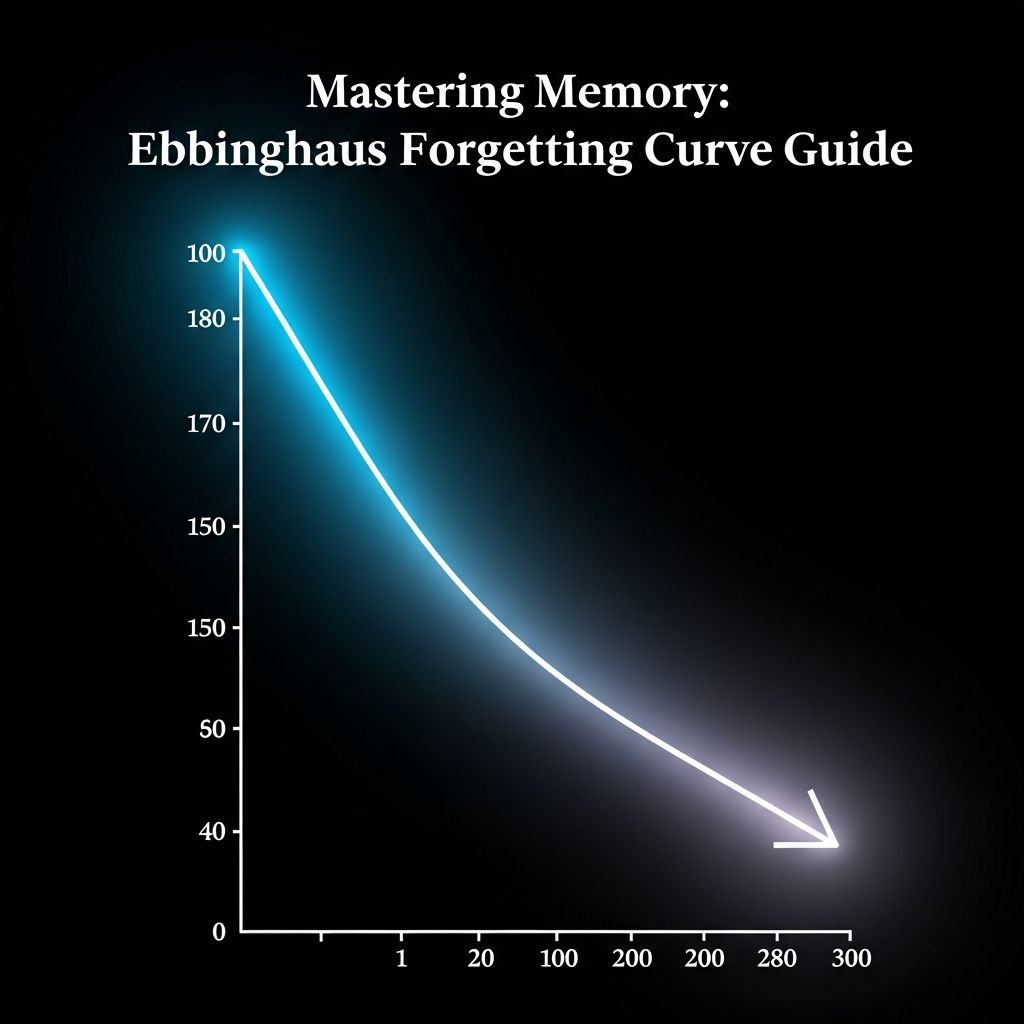
Hermann Ebbinghaus’s forgetting curve reveals how newly learned information decays rapidly without reinforcement, dropping to about 50% retention within the first hour and continuing exponentially. This 1885 discovery remains a cornerstone of cognitive psychology, guiding modern learning techniques to combat memory loss.
Discovering the Science of Forgetting
In the late 19th century, German psychologist Hermann Ebbinghaus pioneered experimental memory research by studying his own recall of nonsense syllables—meaningless letter combinations like ‘WIP’ or ‘ZOF’ to isolate pure memory processes without prior associations. Over thousands of trials, he measured retention across time intervals from 20 minutes to over a month, plotting the results into the iconic forgetting curve: a steep initial plunge followed by a gradual leveling.
Ebbinghaus quantified ‘savings,’ the reduced time needed to relearn material compared to initial learning. For instance, 100% savings meant perfect recall, while lower percentages indicated forgetting proportional to time elapsed. His formula, \( R = e^{-t/S} \) (where R is retention, t is time, and S is strength), approximates this decay, though modern fits refine it further.
The Steep Reality of Memory Decay
The curve’s shape is unmistakable: retention halves within 20-60 minutes, plummets to 20-30% after a day, and stabilizes around 10-20% after a week without review. A 2015 replication confirmed this pattern, with one subject mirroring Ebbinghaus’s data across 70 hours of testing—from 20 minutes (high retention) to 31 days (minimal recall).
This isn’t linear; exponential decay means most loss happens early. Factors like meaningfulness accelerate retention—real words or concepts stick better than nonsense—but the core curve persists for novel info. Surveys show learners underestimate this speed, assuming slower fade than reality.
| Time After Learning | Approx. Retention (%) | Key Insight |
|---|---|---|
| 20 minutes | 80-90% | Peak vulnerability begins |
| 1 hour | 50-60% | Half lost already |
| 1 day | 20-30% | Critical review window |
| 1 week | 10-20% | Long-term embedding needed |
| 1 month | 5-10% | Spaced practice essential |
This table summarizes averaged data from Ebbinghaus and replications, highlighting intervention points.
Why Does Forgetting Accelerate Initially?
Ebbinghaus attributed decay to trace weakening over time, but later theories emphasize interference: new info overwrites old, especially similar content. Storage strength (how well encoded) and retrieval strength (access ease) both matter—cramming boosts short-term storage but weak retrieval leads to fast loss.
Context changes, stress, or sleep deprivation exacerbate it. Yet, the curve isn’t inevitable; proactive strategies can ‘reset’ it, pulling retention back toward 100%.
Powerful Techniques to Defeat the Curve
To counteract decay, leverage these evidence-based methods:
- Spaced Repetition: Review at expanding intervals (e.g., 1 day, 3 days, 1 week). Ebbinghaus noted spaced practice triples retention over cramming.
- Active Recall: Test yourself instead of re-reading—retrieval strengthens pathways far more.
- Interleaving: Mix topics to reduce interference and boost discrimination.
- Elaboration: Connect new info to existing knowledge for deeper encoding.
- Dual Coding: Pair words with visuals; images flatten the curve significantly.
Optimal timing: Review within 24 hours, then 10-20% before need. Apps like Anki automate this via algorithms predicting your curve.
Applying the Curve in Real-World Learning
For students, replace all-nighters with daily 20-minute reviews. Professionals training skills (e.g., languages, coding) schedule micro-sessions. A study of workers revealed spaced microlearning cut forgetting by 80% vs. one-shot training.
In classrooms, teachers use ‘retrieval roulette’—random quizzes—to spike retrieval strength. Corporate onboarding benefits from drip-fed modules over marathons.
Modern Validations and Evolutions
While Ebbinghaus used simplistic stimuli, replications hold for complex material. Neuroscience links the curve to synaptic consolidation: short-term memories stabilize long-term during sleep, but without cues, they fade.
Critics note individual variance (prior knowledge slows forgetting) and interference’s role over pure decay. Still, the curve’s general form endures, informing AI tutors and adaptive platforms.
Common Myths About Memory and Forgetting
- Myth: Cramming works long-term. It spikes storage but crashes retrieval.
- Myth: Forgetting is total. Savings show latent traces remain, revivable by cues.
- Myth: Repetition alone suffices. Passive re-read is weak; active testing rules.
Tools and Apps for Curve Mastery
Harness tech:
- Anki/Quizlet: Spaced flashcards with AI scheduling.
- RemNote: Note-taking with built-in repetition.
- SuperMemo: Pioneered optimal intervals.
Track your curve manually: Log recall scores weekly to personalize spacing.
Frequently Asked Questions
How quickly do we forget new information?
Up to 50% within an hour, 70-80% in a day without review, per Ebbinghaus.
Can the forgetting curve be reversed?
Yes, through spaced repetition and active recall, resetting retention near 100%.
Does sleep affect the curve?
Yes, it consolidates memories, slowing decay if reviews precede it.
Is Ebbinghaus’s research still relevant?
Absolutely—2015 replications confirm it, powering modern edtech.
What’s better: massed or distributed practice?
Distributed (spaced) yields 200% better retention.
Building Habits for Lifelong Retention
Integrate curve-busting into routines: End study sessions with self-quizzing, schedule weekly reviews, vary contexts. Over time, this builds ‘super-memories’ resistant to decay. Ebbinghaus proved memory is trainable—start today for tomorrow’s recall.
References
- Forgetting Curve – The Decision Lab — The Decision Lab. 2023. https://thedecisionlab.com/reference-guide/psychology/forgetting-curve
- What is the Ebbinghaus forgetting curve? A Complete Guide — TalentCards. 2023. https://www.talentcards.com/blog/ebbinghaus-forgetting-curve/
- Replication and Analysis of Ebbinghaus’ Forgetting Curve — PMC – NIH (Peer-reviewed). 2015-07-08. https://pmc.ncbi.nlm.nih.gov/articles/PMC4492928/
- Forgetting curve — Wikipedia (references primary sources). 2023. https://en.wikipedia.org/wiki/Forgetting_curve
- Why The Forgetting Curve Is Not As Useful As You Think — Carl Hendrick Substack. 2023. https://carlhendrick.substack.com/p/why-the-forgetting-curve-is-not-as
- The Forgetting Curve [PDF] — Auburn University (.edu). 2023. https://www.eng.auburn.edu/current-students/documents/forgetting-curve.pdf

- Integrated M.A. in Applied Linguistics, University of Hyderabad
- 5+ years in editorial, instructional, SEO, and research-based writing
Sneha is a relationships and lifestyle writer with a strong foundation in applied linguistics and certified training in relationship coaching. She brings over five years of writing experience to theskillvault, crafting thoughtful, research-driven content that empowers readers to build healthier relationships, boost emotional well-being, and embrace holistic living. Her writing and insights reflect the belief that beauty, happiness, and wellness…