
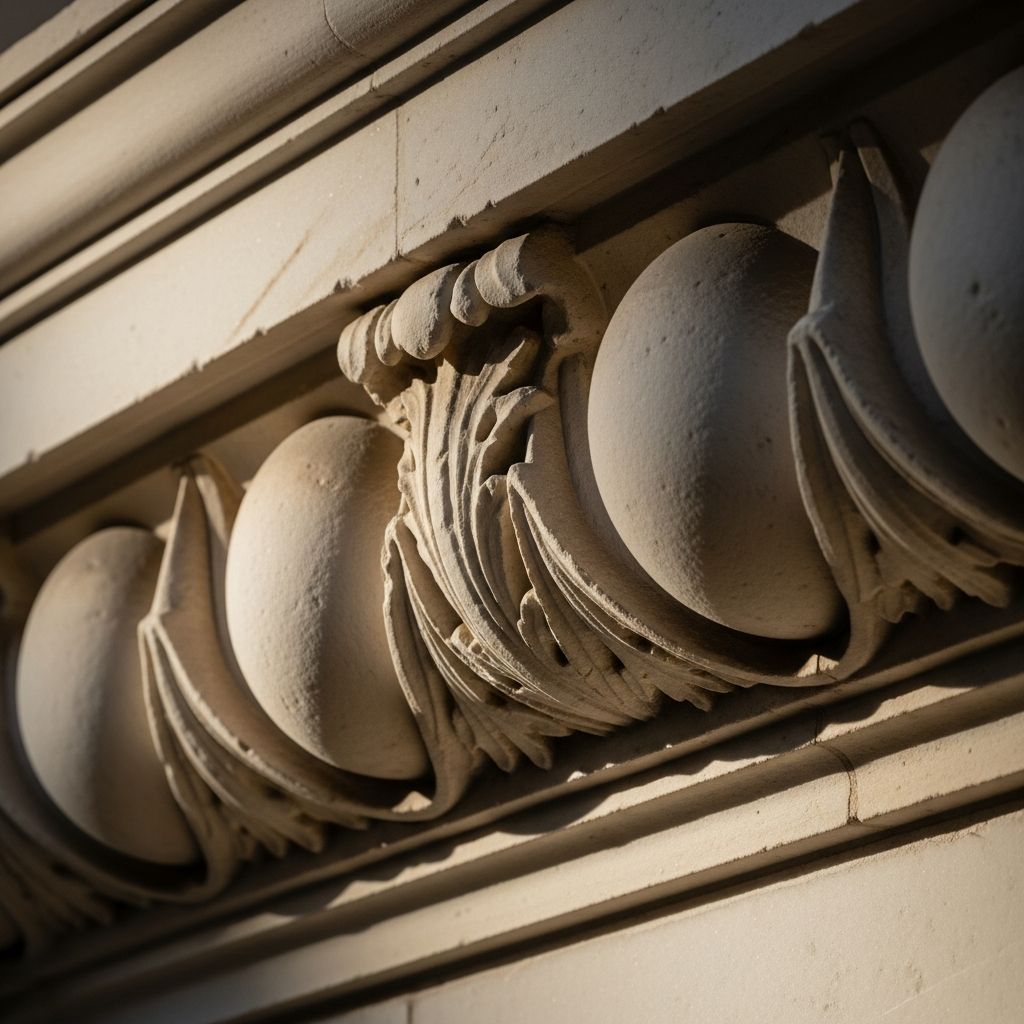
The **egg and dart motif** stands as one of the most iconic decorative elements in architectural history, featuring alternating oval “eggs” and pointed “darts” that evoke both beauty and deeper philosophical themes. Originating in ancient Greece and popularized by the Romans, this pattern adorns moldings, capitals, and friezes, symbolizing the eternal cycle of life and mortality.
Origins in Ancient Civilizations
The egg and dart design first emerged in classical antiquity, particularly within Greek architecture around the 5th century BCE. Builders incorporated it into the ovolo moldings of Ionic capitals, as seen in iconic structures like the Erechtheion on the Acropolis in Athens. This quarter-round, convex profile provided an ideal canvas for the alternating egg shapes and V-shaped darts, enhancing the visual rhythm of temples and public buildings.
Romans eagerly adopted and refined the motif, spreading it across their empire through grand constructions such as forums, basilicas, and triumphal arches. The pattern’s versatility allowed it to integrate seamlessly into stone carvings, enhancing structural elements like column capitals and entablatures. Its bas-relief execution—carved slightly raised from the surface—created subtle shadows and depth, contributing to the optical harmony of classical facades.
Symbolic Depth and Cultural Interpretations
Beyond aesthetics, the egg and dart carries profound symbolism. The egg represents fertility, birth, and the promise of new life, a universal emblem across cultures evoking creation and renewal. In contrast, the dart—often resembling an arrow, anchor, or tongue—symbolizes death, time’s passage, or directional force, embodying mortality and transience.
This duality mirrors philosophical concepts in ancient thought, such as the Greek interplay between genesis and decay. Some scholars link the forms to natural elements, like the opium poppy’s ovoid seed pod and serrated leaves, suggesting influences from botanical observation in early design. In Roman contexts, it reinforced themes of imperial eternity amid human fragility.
- Egg: Life, fertility, potential.
- Dart: Death, time, movement.
- Together: Cyclical balance of existence.
These interpretations persist, making the motif a meditative feature in sacred and civic architecture.
Variations Across Eras and Styles
While core to Greek and Roman work, the egg and dart evolved with variations like egg-and-anchor, egg-and-arrow, or egg-and-tongue, where the dart morphs into nautical anchors or leaf-like tongues. These adaptations suited diverse materials and regional tastes.
| Variation | Description | Common Use |
|---|---|---|
| Egg-and-Dart | Classic oval with pointed arrow | Ionic capitals, friezes |
| Egg-and-Anchor | Oval paired with anchor shape | Maritime or neoclassical interiors |
| Egg-and-Tongue | Oval alternating with tongue-like form | Plaster moldings, furniture |
| Egg-and-Star | Oval with starburst dart | Later Renaissance Revival |
In the Renaissance, architects like Andrea Palladio revived it for palazzos and villas, bridging antiquity and modernity. The 18th-19th centuries saw explosive popularity in Neoclassicism, Georgian Revival, Federal styles, and Beaux-Arts, appearing in American landmarks and European mansions.
Revival in Neoclassical and Modern Architecture
The 19th century marked a neoclassical renaissance, with egg and dart gracing public buildings worldwide. In the United States, it embellished door hardware from 1895-1920 and interiors like the Grace Millard Knox House in Buffalo. Modern examples include the Ionic capitals of the Jefferson Memorial in Washington, D.C., and the Romanian Athenaeum in Bucharest, where it maintains classical purity.
Today, the motif endures in traditionalist designs, high-end interiors, and restoration projects. Architects use it in plaster cornices, wood carvings (e.g., quarter-sawn white oak), and stone facades to evoke timeless sophistication. Its scalability—from grand exteriors to subtle furniture details—ensures relevance.
Craftsmanship Techniques and Materials
Creating egg and dart demands skilled artisanship. In antiquity, stone masons chiseled it freehand; Romans mass-produced plaster casts for efficiency. Woodcarvers today use gouges for precise curves, as in oak moldings showcased in carving tutorials.
- Design Phase: Sketch alternating ovals and darts on ovolo profile.
- Material Prep: Select stone, wood, or plaster; quarter-sawn woods prevent warping.
- Carving: Outline eggs with V-gouges for darts; refine with shallow chisels for bas-relief.
- Finishing: Sand, paint, or gild for depth and luster.
Modern tools like CNC machining replicate it accurately, but hand-carving preserves authenticity in heritage work.
Applications in Interiors and Furniture
Though architectural, egg and dart extends to interiors: ceiling medallions, wall panels, and door surrounds. In furniture, it adorns chair rails, cabinetry, and hardware, adding classical flair to contemporary spaces.
Restoration experts salvage plaster examples from historic homes, like Buffalo’s 32 Park St., highlighting its durability. Designers pair it with dentils for layered cornices, amplifying visual interest.
Frequently Asked Questions (FAQs)
What is the egg and dart motif?
It is a classical decorative pattern of alternating egg-shaped ovals and dart-like points, used on ovolo moldings in architecture.
Where did egg and dart originate?
Ancient Greece, notably in Ionic capitals like those of the Erechtheion, later spread by Romans.
What does egg and dart symbolize?
Typically, eggs represent life and fertility, darts death or time’s arrow, embodying life’s cycle.
Is egg and dart still used today?
Yes, in neoclassical buildings like the Jefferson Memorial and modern interiors, restorations.
What materials feature egg and dart?
Stone, wood (e.g., oak), plaster; from temples to furniture hardware.
Legacy and Future Influence
The egg and dart’s survival spans millennia, testifying to its universal appeal. It influences digital design software for parametric architecture and inspires minimalist echoes in contemporary motifs. As builders balance innovation with tradition, this pattern reminds us of design’s power to convey profound narratives through simple forms.
In educational contexts, like humanities studies, it exemplifies Neoclassical harmony and classical revival principles. Its adaptability—from micro-scale hardware to macro-scale entablatures—secures its place in design canons.
References
- Egg-and-dart — Wikipedia. 2023-10-15. https://en.wikipedia.org/wiki/Egg-and-dart
- Egg and dart — Encyclopædia Britannica. 2024-01-20. https://www.britannica.com/technology/egg-and-dart
- Egg and Dart Molding — Carving Magazine. 2022-05-10. http://www.carvingmagazine.com/wood-carving/projects/98-egg-and-dart-molding
- Egg-and-dart moldings — Fiveable (Intro to Humanities). 2023-08-05. https://fiveable.me/introduction-humanities/key-terms/egg-and-dart-moldings
- Egg-and-dart — Buffalo Architecture and History. 2021-11-12. https://buffaloah.com/a/DCTNRY/e/egg.html
- Exploring the Symbolism of the Egg & Dart Pattern — Antique Hardware Supply. 2023-03-22. https://antiquehardwaresupply.com/blogs/news/exploring-the-symbolism-of-the-egg-dart-pattern

- Integrated M.A. in Applied Linguistics, University of Hyderabad
- 5+ years in editorial, instructional, SEO, and research-based writing
Sneha is a relationships and lifestyle writer with a strong foundation in applied linguistics and certified training in relationship coaching. She brings over five years of writing experience to theskillvault, crafting thoughtful, research-driven content that empowers readers to build healthier relationships, boost emotional well-being, and embrace holistic living. Her writing and insights reflect the belief that beauty, happiness, and wellness…