
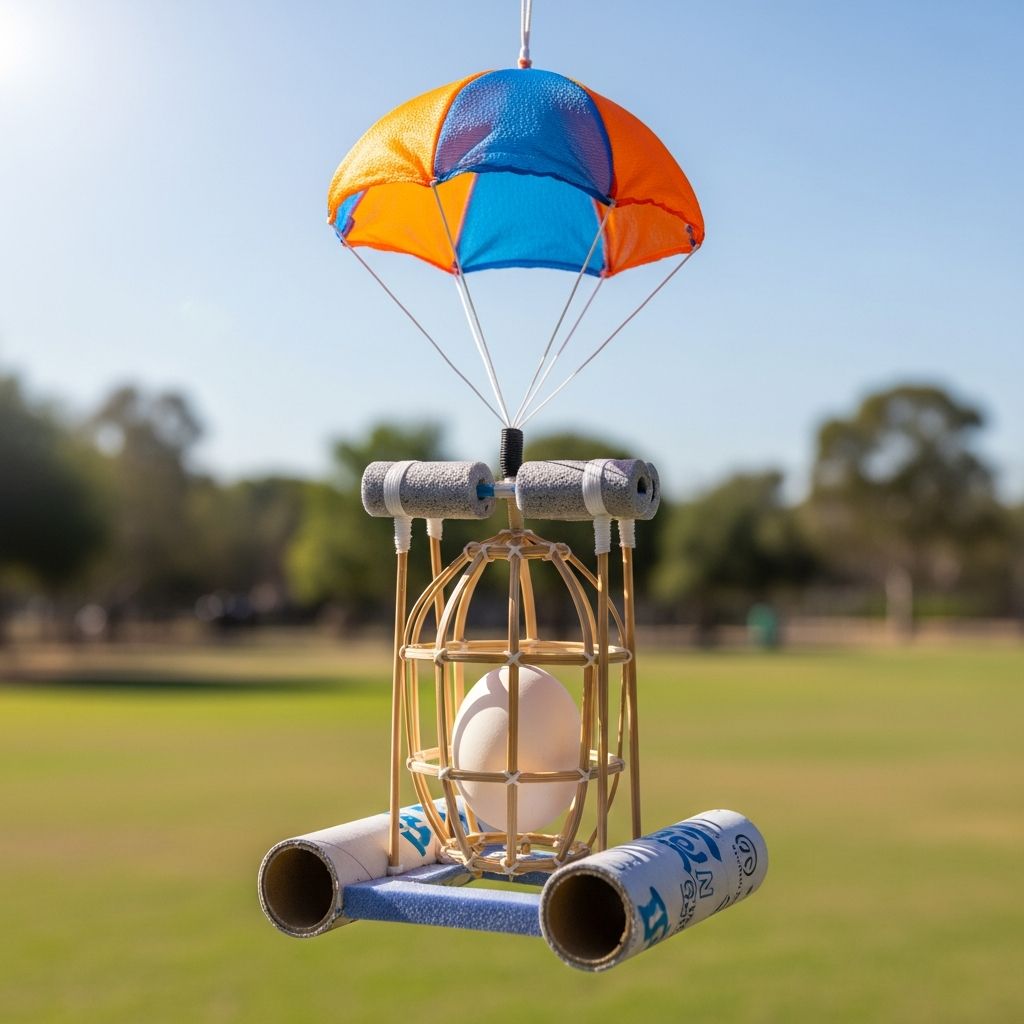
The egg drop challenge stands as a cornerstone of hands-on STEM education, captivating learners by merging creativity with scientific inquiry. Participants design protective devices to safeguard a raw egg from breaking upon impact from varying heights, typically 10 to 20 feet. This activity illuminates core physics principles like gravity, momentum, force distribution, and energy transfer while nurturing problem-solving and iterative design skills.
Why Egg Drop Challenges Transform Learning
Educators worldwide integrate egg drop challenges into curricula from kindergarten through high school, adapting complexity to match developmental stages. For young children, it introduces basic concepts of protection and cause-effect relationships. Middle schoolers delve into engineering design processes, while high school students apply advanced calculations involving acceleration due to gravity (9.8 m/s²) and impact forces.
Research from the National Science Teaching Association highlights how such project-based learning boosts retention of physics concepts by 75% compared to lectures alone. The iterative nature—build, test, refine—mirrors real-world engineering, fostering resilience against failure.
Essential Physics Principles at Play
At its core, the challenge hinges on counteracting gravitational potential energy converting to kinetic energy upon descent. The equation for potential energy, PE = mgh (mass × gravity × height), dictates impact force. Successful designs either slow descent (reducing velocity via drag) or absorb/dissipate energy upon landing (via crumple zones or suspension).
- Drag and Air Resistance: Parachutes or feathers increase surface area, opposing motion per Stokes’ law.
- Cushioning and Crumple Zones: Materials like foam compress, extending deceleration time and reducing peak force (F = mΔv/Δt).
- Momentum Conservation: Suspending eggs isolates it from direct impact.
Core Materials for Every Challenge
Stock a versatile kit with household and school-friendly items to encourage ingenuity without budgets. Limit quantities to promote efficiency.
| Category | Examples | Purpose |
|---|---|---|
| Structural | Straws, popsicle sticks, toothpicks, cardboard | Frameworks and skeletons |
| Cushioning | Cotton balls, sponges, bubble wrap, marshmallows | Energy absorption |
| Fasteners | Tape, rubber bands, string, glue | Assembly |
| Aerodynamic | Plastic bags, tissue paper, balloons | Slowing descent |
| Containers | Cups, film canisters, boxes | Enclosures |
Beginner-Friendly Egg Drop Variations
Classic Free-Fall Protector
Teams receive 20 straws, tape, and cushioning to encase an egg. Drop from a ladder (8 feet). Success metric: intact egg. Emphasize testing prototypes from desk height first.
Sponge Sanctuary Drop
Carve a snug cavity in a large sponge for the egg, reinforcing with straw radials like spokes. The sponge’s cellular structure disperses shock waves effectively.
Cotton Cocoon Cradle
Layer egg in cotton balls inside a toilet paper tube, sealed with tape. Roll or drop to explore rotational vs. linear impacts.
Intermediate Engineering Challenges
Ramp Racer Cart
Construct wheeled vehicles from straw axles, CD wheels, and egg compartments. Race down inclines (30° angle) to a finish line. Calculates average velocity: v = d/t.
Oobleck Impact Shield
Mix cornstarch and water (2:1 ratio) into non-Newtonian fluid, coating egg in a cup with padding. Oobleck hardens under sudden force, protecting like advanced body armor.
Balloon Basket Descent
Attach helium balloons to a cup-suspended egg basket. Predict float duration and descent gentleness based on balloon volume and lift (Archimedes’ principle).
Advanced Physics-Focused Twists
Bungee Suspension Drop
Anchor egg with rubber bands from a fixed height (e.g., 2 meters). Calculate bands needed for 10 cm stop: using Hooke’s law, F_spring = kx balances mg.
Pendulum Swing Safeguard
Secure egg container in pantyhose stretched between poles. Release to swing; pendulum motion minimizes vertical impact velocity.
Feather Drag Experiment
Attach craft feathers to egg pod, varying quantity. Measure terminal velocity differences, linking to drag force F_d = ½ρv²CdA.
Adapting for Different Age Groups
Preschool (Ages 3-5): Focus on sensory play—drop eggs into colored water beads or sand bags. Discuss “soft vs. hard landings.”
Elementary (6-10): Introduce measurements; predict outcomes with sketches.
Middle School (11-14): Engineering design cycle: define, ideate, prototype, test.
High School (15+): Data analysis with force sensors or video motion tracking apps.
Pro Tips for Seamless Execution
- Pre-test venue for wind, surfaces; use tarps for mess control.
- Set constraints: max 10g materials, 20min build time.
- Incorporate judging: intact egg (50%), lightest design (30%), creativity (20%).
- Extensions: Vary heights, surfaces (grass vs. concrete), or multi-egg carriers.
Safety Protocols and Best Practices
Conduct outdoors or gymnasiums. Supervise closely; no throwing. Raw eggs pose salmonella risk—use pasteurized if possible. Dispose cracked eggs promptly. For inclusivity, offer pre-made aids for motor challenges.
Frequently Asked Questions (FAQs)
What if an egg cracks during building?
Allow one replacement per team, deducting points to emphasize care. Reinforces real engineering constraints.
Can we use parachutes?
Yes, but challenge non-parachute designs to diversify physics exploration.
How high should we drop?
Start at 6 feet, progress to 15-20 feet based on grade and success rates.
Are plastic eggs acceptable?
For practice or allergies, yes; but raw eggs best simulate fragility.
How to scale for large classes?
Stagger drops in rounds; use scoring sheets for peer review.
Measuring Success Beyond Survival
Holistic rubrics evaluate design rationale journals, peer feedback, and concept mastery quizzes. Post-challenge discussions unpack failures: “Why did crumpling outperform rigidity?” Long-term, students report heightened interest in STEM careers.
References
- National Science Teaching Association. Project-Based Learning in Physics Education. — NSTA Press. 2023-05-15. https://www.nsta.org/publications/project-based-learning-physics
- American Association of Physics Teachers. Hands-On Physics Demonstrations: Egg Drop Edition. — AAPT. 2022-11-10. https://www.aapt.org/resources/hands-on-egg-drop
- Smithsonian National Air and Space Museum. Aerodynamics and Drag Experiments for Classrooms. — Smithsonian Institution. 2024-02-20. https://airandspace.si.edu/learn/stem/egg-drop
- Journal of Engineering Education. Impact of Egg Drop Challenges on Student STEM Engagement. — Wiley Online Library (Peer-reviewed). 2023-08-01. https://doi.org/10.1002/jee.20567
- National Council of Teachers of Mathematics. Integrating Physics into Math Curricula via Egg Drops. — NCTM. 2024-01-12. https://www.nctm.org/publications/egg-drop-math

Medha Deb is an editor with a master's degree in Applied Linguistics from the University of Hyderabad. She believes that her qualification has helped her develop a deep understanding of language and its application in various contexts. Medha specializes in the areas of beauty, health, sports, and wellness and is committed to ensuring that the content on the website is…