
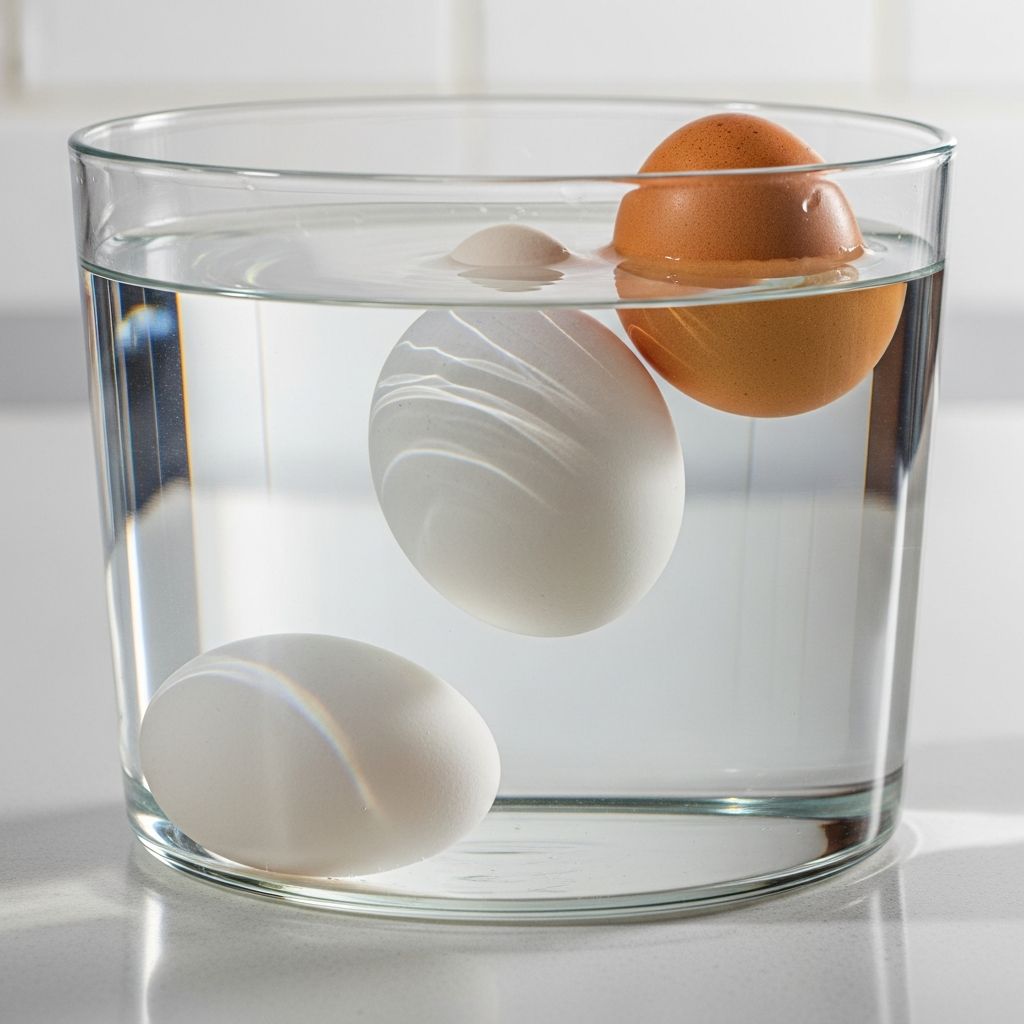
The humble egg float test has been a kitchen staple for generations, offering a quick way to gauge if your eggs are still safe to eat. By simply dropping an egg into a bowl of water, you can observe whether it sinks or floats, providing clues about its age and quality. This phenomenon hinges on basic principles of physics and biology, where changes inside the egg over time alter its buoyancy.
Understanding Buoyancy and Density Basics
At the heart of the egg float test lies **Archimedes’ principle**, which states that an object submerged in a fluid experiences an upward buoyant force equal to the weight of the fluid displaced. For an egg to float, it must be less dense than the surrounding water; if denser, it sinks.
- Fresh eggs typically have a density greater than water (around 1.03–1.08 g/cm³), causing them to sink.
- Aging eggs lose moisture and gain air, dropping their density below 1 g/cm³, making them buoyant.
Density is mass per unit volume. Water’s density is 1 g/cm³ at room temperature. Eggs start denser due to their high water content (about 75% in the albumen and yolk), but evaporation through the porous shell introduces air, reducing overall density.
Biological Changes Inside Aging Eggs
Eggshells are semi-permeable, allowing slow moisture loss and air entry. Initially, a small air cell forms at the blunt end from the egg separating from its membrane during laying. Over weeks:
- Water evaporates, shrinking the liquid contents.
- Carbon dioxide escapes, raising the egg white’s pH from 7.6 to 9.5, thinning it.
- Bacteria may enter if the shell is compromised, accelerating decomposition and gas production like hydrogen sulfide, infamous for the ‘rotten egg’ smell.
This air pocket enlarges, often reaching 1–2 cm by expiration, enough to make the egg float upright or bob. A USDA source notes that a floating egg signals an enlarged air cell indicative of poor quality, though not always unsafe.
How to Perform the Egg Float Test Step-by-Step
This test is simple, requiring no special tools. Follow these steps for accurate results:
- Fill a deep bowl or glass with cold tap water (at least 2–3 inches deep).
- Gently place the egg horizontally on the surface.
- Observe behavior:
- Sinks straight to bottom: Fresh and likely safe.
- Lies sideways or tilts: A few weeks old; use soon.
- Stands upright or floats: Old; inspect further before eating.
Always crack questionable eggs into a separate bowl to check for off odors or unusual appearance before cooking.
Limitations and Accuracy of the Float Test
While reliable, the test isn’t foolproof. Factors like egg size, storage temperature, and humidity affect results. Very fresh jumbo eggs might float slightly due to larger air cells naturally. Conversely, refrigerated eggs retain moisture longer, delaying floating.
| Result | Interpretation | Action |
|---|---|---|
| Sinks flat | Very fresh (<1 week) | Safe to store/use |
| Sinks tilted | Moderately fresh (1–3 weeks) | Use promptly |
| Floats upright | Old (>4 weeks) | Discard or test further |
Studies from academic sources confirm stale eggs float due to lower density from air replacement. For precision, combine with the shake test (listen for sloshing) or smell test.
Fun Kitchen Experiments with Eggs and Density
Extend the float test into educational play. Demonstrate density variations safely at home.
Making Fresh Eggs Float: Salt Solution Demo
Dissolve salt in water to increase density beyond the egg’s. Start with 1 cup water:
- Add 1 tbsp salt; stir and test egg.
- Continue adding until it floats (typically 5–8 tbsp).
This mirrors why swimming feels easier in the Dead Sea, with salinity over 34%. Measure precisely to quantify: each tbsp raises density by ~0.01 g/cm³.
Vinegar Egg Dissolution: Shell Science
Submerge a raw egg in white vinegar for 24–48 hours. The shell dissolves due to acetic acid reacting with calcium carbonate:
CaCO₃ (shell) + 2CH₃COOH (vinegar) → Ca(CH₃COO)₂ + H₂O + CO₂ (gas)
Bubbles confirm the reaction. The resulting ‘naked egg’ is rubbery, bouncy, and reveals membrane properties. Use citric acid for faster results.
Health and Safety: When to Trust or Toss Eggs
Floating doesn’t always mean spoiled; enlarged air cells occur naturally after 3–5 weeks. USDA advises: floating eggs may be safe if no bad smell upon cracking. Key risks:
- Salmonella: Rare in intact shells but grows in warm storage.
- Off flavors: From pH changes, even without bacteria.
Store eggs at 40°F (4°C), pointy end down, for up to 4–5 weeks. Pasteurized eggs extend usability. In 2023 USDA data, proper refrigeration prevents most issues.
Advanced Egg Freshness Indicators
Beyond floating:
- Yolk float: Separate white; fresh yolks sink in water.
- Candling: Shine light through shell to view air cell size (commercial standard).
- Sniff test: Crack and smell; sulfur indicates spoilage.
For farms or labs, ovoscopes measure air cell precisely (<1/8 inch fresh).
Egg Storage Tips for Maximum Freshness
Prevent air pocket growth:
- Refrigerate immediately at 35–40°F.
- Avoid door storage (temperature fluctuations).
- Wash only before use; natural bloom protects.
- Buy local or farm-fresh for less transit time.
In hot climates, test weekly. Globally, eggs last longer unwashed (Europe) vs. washed (US).
Frequently Asked Questions (FAQs)
Does a floating egg mean it’s rotten?
Not necessarily. It indicates age and low density from air, but check smell and appearance. Safe if no spoilage signs.
Why do some fresh eggs float slightly?
Large eggs or warm storage enlarge air cells early. Cold water test minimizes this.
Can I eat eggs that stand upright in water?
Use caution: cook thoroughly. Discard if sloshy or smelly.
How long do eggs last after best-by date?
3–5 weeks refrigerated. Float test helps post-date.
Is the float test reliable for hard-boiled eggs?
Less so; shells thicken air cell effects. Use smell instead.
Conclusion: Empower Your Kitchen with Science
The egg float test blends everyday physics with food biology, turning a simple bowl of water into a freshness detector. Master it alongside storage best practices for waste-free cooking.
References
- Why Do Fresh Eggs Sink and Expired Ones Float? — Taste Cooking. Accessed 2026. https://tastecooking.com/fresh-eggs-sink-expired-ones-float/
- Science on the Shelves – Eggsperiments — University of York (.ac.uk). Accessed 2026. https://www.york.ac.uk/res/sots/activities/eggs.htm
- What does it mean when an egg floats in water? — Ask USDA (.gov). Accessed 2026. https://ask.usda.gov/s/article/What-does-it-mean-when-an-egg-floats-in-water

Medha Deb is an editor with a master's degree in Applied Linguistics from the University of Hyderabad. She believes that her qualification has helped her develop a deep understanding of language and its application in various contexts. Medha specializes in the areas of beauty, health, sports, and wellness and is committed to ensuring that the content on the website is…