
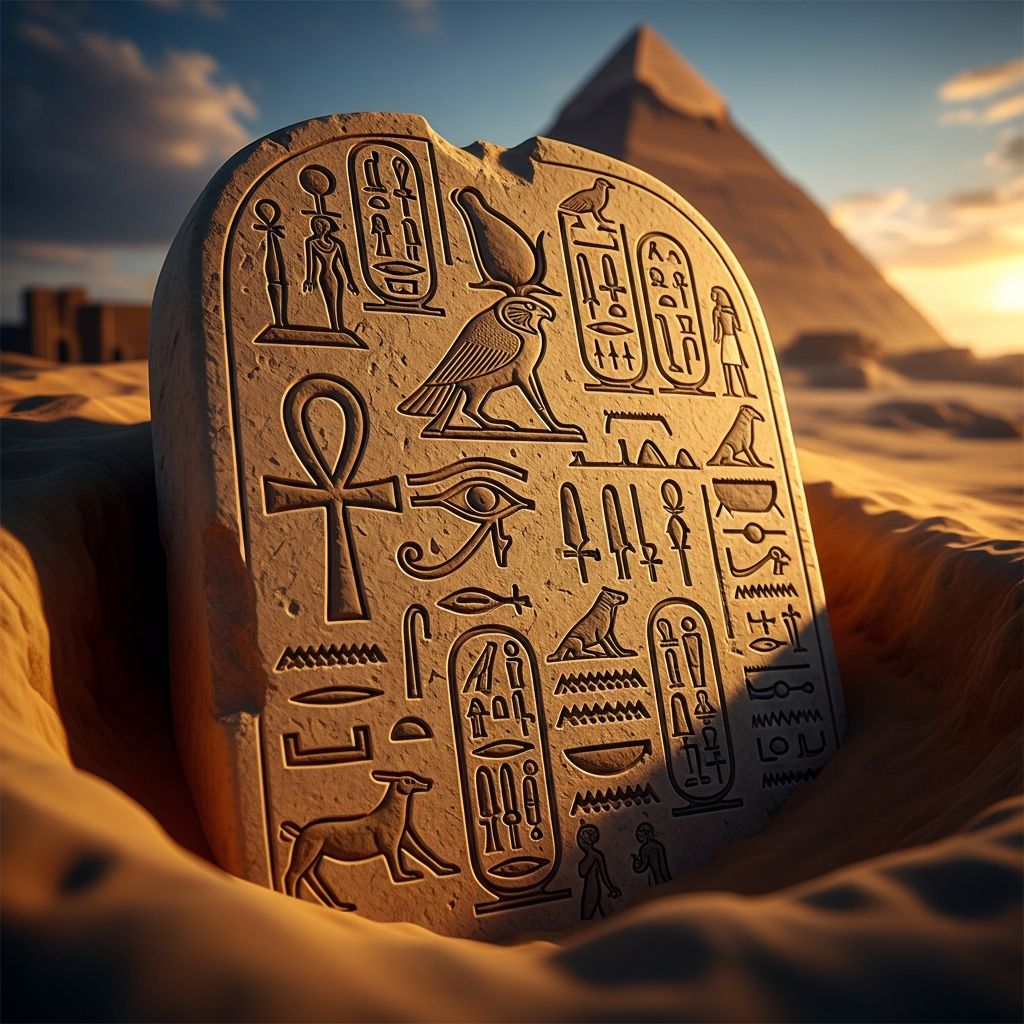
Egyptian hieroglyphs represent one of humanity’s earliest and most intricate writing systems, blending art, language, and spirituality into a visual code that defined ancient Egyptian civilization for over 3,000 years. Derived from Greek terms meaning ‘sacred carvings,’ these symbols adorned temples, tombs, and monuments, preserving the deeds of pharaohs, religious rituals, and everyday accounts.
Origins and Evolution of the Hieroglyphic System
The birth of hieroglyphs traces back to around 3100 BCE during Egypt’s Predynastic period, coinciding with the unification of Upper and Lower Egypt under early rulers. Initially, these symbols likely evolved from rudimentary pictographs used in trade and record-keeping, gradually developing phonetic values to express the Egyptian language.
Unlike purely pictorial systems, hieroglyphs incorporated multiple layers of meaning. Scholars believe the script matured by the Early Dynastic Period, with the earliest readable inscriptions appearing on artifacts like the Narmer Palette, showcasing phonetic usage rather than simple rebus-like representations.
- Predynastic roots: Simple icons for goods and quantities on pottery and ivory tags.
- Old Kingdom advancement: Formalization for royal decrees and tomb inscriptions.
- Middle Kingdom peak: Over 1,000 distinct signs in monumental use.
This evolution reflects Egypt’s centralized society, where writing served administrative, religious, and propagandistic functions. Hieroglyphs remained the prestige script for eternity-bound monuments, even as cursive variants emerged for practicality.
Decoding the Components: Phonetics, Ideograms, and Determinatives
At its core, the hieroglyphic system combines ideographic, logographic, syllabic, and alphabetic elements, making it far more sophisticated than initial appearances suggest. Over 700 commonly used signs (from a total exceeding 1,000) fall into three primary categories.
| Sign Type | Description | Example | Function |
|---|---|---|---|
| Phonograms | Represent sounds, often consonants | Owl for ‘m’ | Spell words phonetically |
| Logograms/Ideograms | Depict words or concepts directly | Eye for ‘see’ | Standalone meaning |
| Determinatives | Non-phonetic classifiers | Water ripples after ‘water’ | Clarify ambiguous words |
Phonetic signs dominate, functioning uniliterally (single consonant), biliterally (two), or triliterally (three). Notably, vowels are omitted, relying on context for interpretation—a trait shared with Semitic scripts. Determinatives, silent but crucial, resolve homophones; for instance, a man figure specifies a human-related term.
Words form through sequences of these elements, often ending with determinatives. The reed leaf (i) or quail chick (w) frequently conclude names, aiding pronunciation guesses.
Directionality and Aesthetic Principles in Inscriptions
Hieroglyphs arrange in horizontal lines or vertical columns, read right-to-left in traditional Egyptian style—facing the way human or animal figures orient. Modern publications often reverse this for left-to-right familiarity.
Artists oriented signs meticulously: birds face the reading direction, symmetry governs compositions, and signs rotate (never flip) to fit spaces. This artistic rigor underscores hieroglyphs’ dual role as script and decoration.
- Horizontal lines: Preferred for papyrus or long temple walls.
- Vertical columns: Common on obelisks and stelae.
- Cartouches: Oval rings enclosing royal names for protection.
Practical Adaptations: From Hieroglyphs to Cursive Scripts
While hieroglyphs suited eternal monuments, their carving was labor-intensive. Egyptians developed hieratic—a cursive, right-to-left script on papyrus—for administration and literature during the Old Kingdom.
By the Late Period, demotic emerged as an even faster cursive for daily use, while hieroglyphs persisted in sacred contexts. Coptic, the final stage, incorporated Greek letters and survives in Christian liturgy.
These scripts coexisted: hieroglyphs for gods and kings, hieratic for priests, demotic for merchants—mirroring societal layers.
Monuments, Tombs, and the Power of Eternal Names
Hieroglyphs immortalized pharaohs’ legacies on obelisks, pyramids, and valley tombs. Inscriptions detailed victories, offerings, and divine mandates, believed to sustain ka (spirit) in the afterlife.
The Egyptians held names sacred; erasing them (damnatio memoriae) doomed foes to oblivion. Temples like Karnak feature vast hieroglyphic narratives, blending text with reliefs.
The Enigma and Breakthrough: Deciphering the Unknown
For centuries post-antiquity, hieroglyphs baffled scholars, dismissed as symbolic esoterica. The 1799 Rosetta Stone discovery—bearing Greek, demotic, and hieroglyphs—provided the key.
Jean-François Champollion cracked it in 1822 by matching royal names (cartouches) across scripts, revealing phonetic principles. His work unlocked thousands of texts, revolutionizing Egyptology.
Modern Legacy: Hieroglyphs in Scholarship and Culture
Today, Unicode enables digital hieroglyphs, powering databases like the Thesaurus Linguae Aegyptiae. Museums worldwide display artifacts, and AI aids pattern recognition in undeciphered inscriptions.
Hieroglyphs influence logos, tattoos, and fiction, symbolizing mystery. Educational tools demystify them, proving accessibility beyond ancient scribes.
Frequently Asked Questions (FAQs)
What is the origin of the word ‘hieroglyph’?
The term derives from Greek ‘hieros’ (sacred) and ‘glyphē’ (carving), coined by early observers to distinguish formal Egyptian script from cursive forms.
Do hieroglyphs include vowels?
No, they primarily record consonants; vowels are inferred from context or bilingual texts like the Rosetta Stone.
How many hieroglyphic signs exist?
Over 1,000 distinct characters, though daily use involved about 700.
Who deciphered hieroglyphs?
Jean-François Champollion in 1822, building on Thomas Young’s phonetic insights.
Were hieroglyphs used only by priests?
No, trained scribes across society used them, though priests dominated religious texts.
Preserving Hieroglyphs for Future Generations
Conservation efforts by organizations like the Egypt Exploration Society digitize inscriptions, combating erosion and looting. Virtual reality reconstructions bring temples alive, ensuring hieroglyphs’ wisdom endures.
From phonetic ingenuity to artistic splendor, hieroglyphs encapsulate ancient Egypt’s genius—a testament to human creativity in encoding thought.
References
- Hieroglyph | Definition, History, & Facts — Encyclopædia Britannica. 2023-10-26. https://www.britannica.com/topic/hieroglyph
- Hieroglyphs — Egypt Exploration Society. 2024-01-15. https://www.ees.ac.uk/resource/hieroglyphs.html
- Egyptian hieroglyphs — Wikipedia (citing primary Egyptological sources). 2026-04-01. https://en.wikipedia.org/wiki/Egyptian_hieroglyphs
- Fascinating facts about hieroglyphics! — National Geographic Kids. 2023-05-12. https://www.natgeokids.com/uk/discover/history/egypt/hieroglyphics-uncovered/
- Hieroglyphs are easier than they look — YouTube (Babbel collaboration). 2022-11-10. https://www.youtube.com/watch?v=90An1dnvwyc
- Ancient Egypt: Hieroglyphs and writing systems — YouTube (British Museum). 2021-06-20. https://www.youtube.com/watch?v=I0C4BYy_EWQ

- Integrated M.A. in Applied Linguistics, University of Hyderabad
- 5+ years in editorial, instructional, SEO, and research-based writing
Sneha is a relationships and lifestyle writer with a strong foundation in applied linguistics and certified training in relationship coaching. She brings over five years of writing experience to theskillvault, crafting thoughtful, research-driven content that empowers readers to build healthier relationships, boost emotional well-being, and embrace holistic living. Her writing and insights reflect the belief that beauty, happiness, and wellness…