
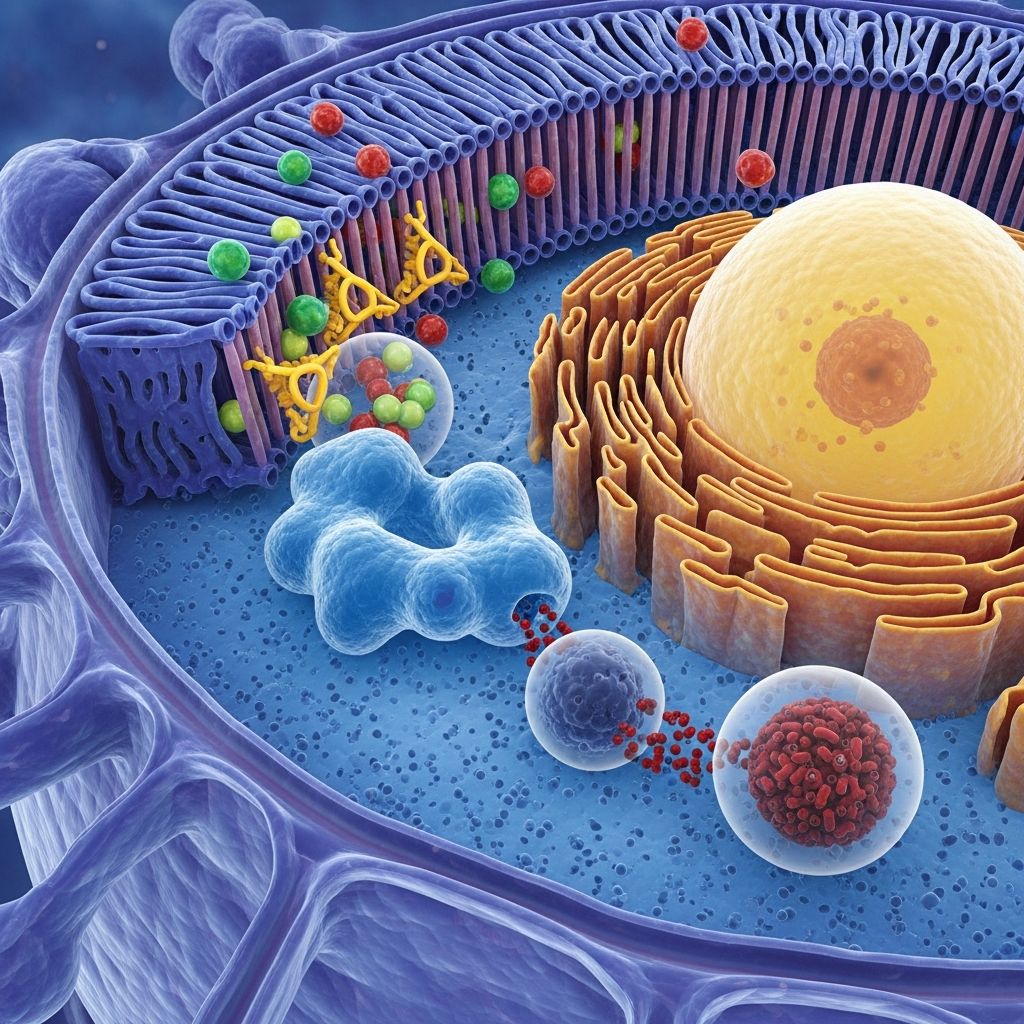
Cells maintain their internal environment by selectively importing substances from the outside world. **Endocytosis** represents a fundamental active transport mechanism that allows cells to engulf large molecules, particles, or even other cells that cannot cross the plasma membrane through passive diffusion. Unlike simple diffusion or carrier-mediated transport, endocytosis involves the dynamic remodeling of the cell membrane to form intracellular vesicles containing the imported material.
The Biological Imperative of Endocytosis
Every eukaryotic cell relies on endocytosis to acquire nutrients, recycle membrane components, and respond to environmental signals. This process consumes a significant portion of the cell’s energy, primarily in the form of ATP, to drive membrane curvature and vesicle formation. Estimates suggest that in many cell types, the equivalent of the entire plasma membrane surface is internalized and recycled every 30-120 minutes through endocytic pathways.
Endocytosis plays critical roles in immune surveillance, where phagocytes engulf pathogens; nutrient uptake, such as cholesterol via low-density lipoprotein (LDL); and signal transduction, where growth factors are internalized after binding their receptors. Disruptions in endocytic pathways are linked to diseases like cancer, Alzheimer’s, and infectious diseases caused by pathogens that exploit these mechanisms.
Core Mechanisms Driving Vesicle Formation
The universal feature of endocytosis is the invagination of the plasma membrane, which creates a pocket that engulfs extracellular material. This pocket then pinches off to form a vesicle—a membrane-bound compartment that shuttles cargo into the cell’s interior. Key molecular players include coat proteins like clathrin, which stabilize membrane curvature; GTPases such as dynamin, which mediate vesicle scission; and actin-myosin machinery for force generation.
Once formed, vesicles uncoat and fuse with early endosomes, sorting stations that acidify their lumen (pH ~5.5-6.0) using V-ATPase proton pumps. This acidification often dissociates ligands from receptors, directing them to lysosomes for degradation or recycling them back to the plasma membrane.
Major Pathways of Endocytosis
Endocytosis manifests in distinct forms tailored to specific cargo sizes and types. The three primary categories are phagocytosis, pinocytosis, and receptor-mediated endocytosis, each optimized for particular biological functions.
Phagocytosis: Engulfing the Large and Threatening
**Phagocytosis**, often called “cellular eating,” enables cells like macrophages, neutrophils, and amoebae to ingest particles larger than 0.5 μm, such as bacteria, apoptotic cells, or debris. The process begins when cargo binds to surface receptors, triggering actin polymerization that extends pseudopodia—finger-like projections—around the target.
These pseudopodia fuse, forming a spacious phagosome (>0.25 μm diameter) that matures by fusing with lysosomes into a phagolysosome. Lysosomal hydrolases degrade the contents, releasing nutrients like amino acids into the cytosol. Phagocytosis is indispensable for innate immunity; defects lead to immunodeficiencies like chronic granulomatous disease.
- Key Steps: Receptor binding → Pseudopod extension → Phagosome formation → Lysosomal fusion → Digestion and recycling.
- Energies Required: ATP for actin dynamics and vesicle trafficking.
- Typical Cargo: Pathogens, dead cells, large debris.
Pinocytosis: Sampling the Fluid Environment
**Pinocytosis**, or “cellular drinking,” involves the non-specific uptake of extracellular fluid and dissolved solutes into small vesicles (~0.1 μm). This constitutive process occurs continuously in most cells, sampling the environment for nutrients like sugars or ions without requiring specific ligands.
Membrane ruffles or invaginations form vesicles that deliver fluid-phase contents to endosomes. While less selective than other forms, pinocytosis is crucial for maintaining membrane turnover and capturing soluble factors. In nutrient-poor conditions, it facilitates bulk uptake of growth-promoting molecules.
- Characteristics: Continuous, non-selective, forms small vesicles.
- Role in Cells: Fluid and small solute uptake, membrane recycling.
- Examples: Occurs in endothelial cells lining blood vessels.
Receptor-Mediated Endocytosis: Precision Targeting
The most selective pathway, **receptor-mediated endocytosis (RME)**, concentrates specific ligands using clathrin-coated pits. Receptors cluster in these pits (occupying 1-2% of membrane area), where adaptor proteins recruit clathrin to form a polyhedral lattice that drives invagination.
Dynamin collars the pit neck, GTP hydrolysis pinches off a coated vesicle (~50-100 nm). After uncoating, vesicles fuse with early endosomes. Ligands like LDL dissociate in the acidic environment and traffic to lysosomes, while receptors recycle via tubular extensions.
| Pathway | Cargo Size | Specificity | Coat Protein |
|---|---|---|---|
| Phagocytosis | >0.5 μm | Receptor-triggered | None (actin-based) |
| Pinocytosis | <0.2 μm | Non-specific | Variable |
| RME | ~50 nm | High (receptor-ligand) | Clathrin |
From Vesicle to Lysosome: Intracellular Trafficking
Post-endocytosis, vesicles navigate a sophisticated sorting network. Early endosomes act as hubs, sorting cargo via pH gradients and Rab GTPases. Receptors return to the surface via recycling endosomes, conserving energy and maintaining receptor density.
Late endosomes, more acidic (pH ~5), mature into lysosomes equipped with 40+ hydrolases for macromolecule breakdown. Digested products—sugars, amino acids, lipids—re-enter metabolism, while indigestible remnants form residual bodies.
This recycling ensures membrane homeostasis; without it, cells would deplete their surface area.
Energy Dynamics and Regulation
Endocytosis is unequivocally active transport, demanding ATP for coat assembly, membrane deformation, and motor-driven trafficking. Clathrin lattice formation and dynamin function are ATP/GTP-dependent, while actin remodeling consumes additional energy.
Regulation occurs via signaling cascades: phosphorylation modulates adaptor recruitment, and GTPases like Arf1 control coat dynamics. Pathogens like HIV exploit RME for entry, highlighting its vulnerability.
Endocytosis in Health and Disease
Beyond nutrition, endocytosis mediates signaling by internalizing activated receptors, attenuating responses (e.g., EGF receptor downregulation). In neurons, it recycles synaptic vesicles; in epithelia, it maintains polarity.
Dysfunctions contribute to pathology: Hyperactive RME in cancer promotes growth factor uptake; impaired phagocytosis fails to clear amyloid-beta in Alzheimer’s. Viruses (e.g., Ebola) and toxins (cholera toxin) hijack pathways for invasion.
Therapeutically, targeting endocytosis offers promise: Drugs like statins influence LDL uptake, and nanoparticles exploit RME for targeted delivery.
Frequently Asked Questions (FAQs)
What is the main difference between endocytosis and exocytosis?
Endocytosis imports materials into the cell, while exocytosis exports them. Both use vesicles but in opposite directions.
Is endocytosis active or passive transport?
Endocytosis is active, requiring ATP for membrane invagination and vesicle formation.
How does clathrin contribute to endocytosis?
Clathrin forms a scaffold in coated pits, driving membrane curvature and vesicle budding in receptor-mediated endocytosis.
Can all cells perform phagocytosis?
No, only specialized phagocytes like macrophages and neutrophils; most cells use pinocytosis or RME.
What happens to endocytic vesicles after formation?
They fuse with endosomes for sorting: cargo to lysosomes, receptors recycled to the membrane.
Comparative Overview of Endocytic Pathways
- Phagocytosis: Large particles, immune cells, actin-driven.
- Pinocytosis: Fluids/solutes, all cells, constitutive.
- RME: Specific ligands, clathrin-coated, selective uptake.
These pathways ensure cellular adaptability, underscoring endocytosis’s centrality to life.
References
- Bulk Transport – Endocytosis — Biology LibreTexts. 2023-10-15. https://bio.libretexts.org/Bookshelves/Introductory_and_General_Biology/General_Biology_(Boundless)/05:_Structure_and_Function_of_Plasma_Membranes/5.13:_Bulk_Transport_-_Endocytosis
- Endocytosis Definition, Purpose & Process — Study.com. 2023-05-20. https://study.com/academy/lesson/endocytosis-definition-types-examples.html
- Endocytosis — NCBI Bookshelf (NIH). 2022-01-12. https://www.ncbi.nlm.nih.gov/books/NBK9831/
- An Overview of Endocytosis — News-Medical.net. 2024-03-10. https://www.news-medical.net/life-sciences/An-Overview-of-Endocytosis.aspx
- Endocytosis and Exocytosis: AP Biology Review — Albert.io. 2023-08-05. https://www.albert.io/blog/endocytosis-and-exocytosis-ap-biology-review/

Medha Deb is an editor with a master's degree in Applied Linguistics from the University of Hyderabad. She believes that her qualification has helped her develop a deep understanding of language and its application in various contexts. Medha specializes in the areas of beauty, health, sports, and wellness and is committed to ensuring that the content on the website is…