
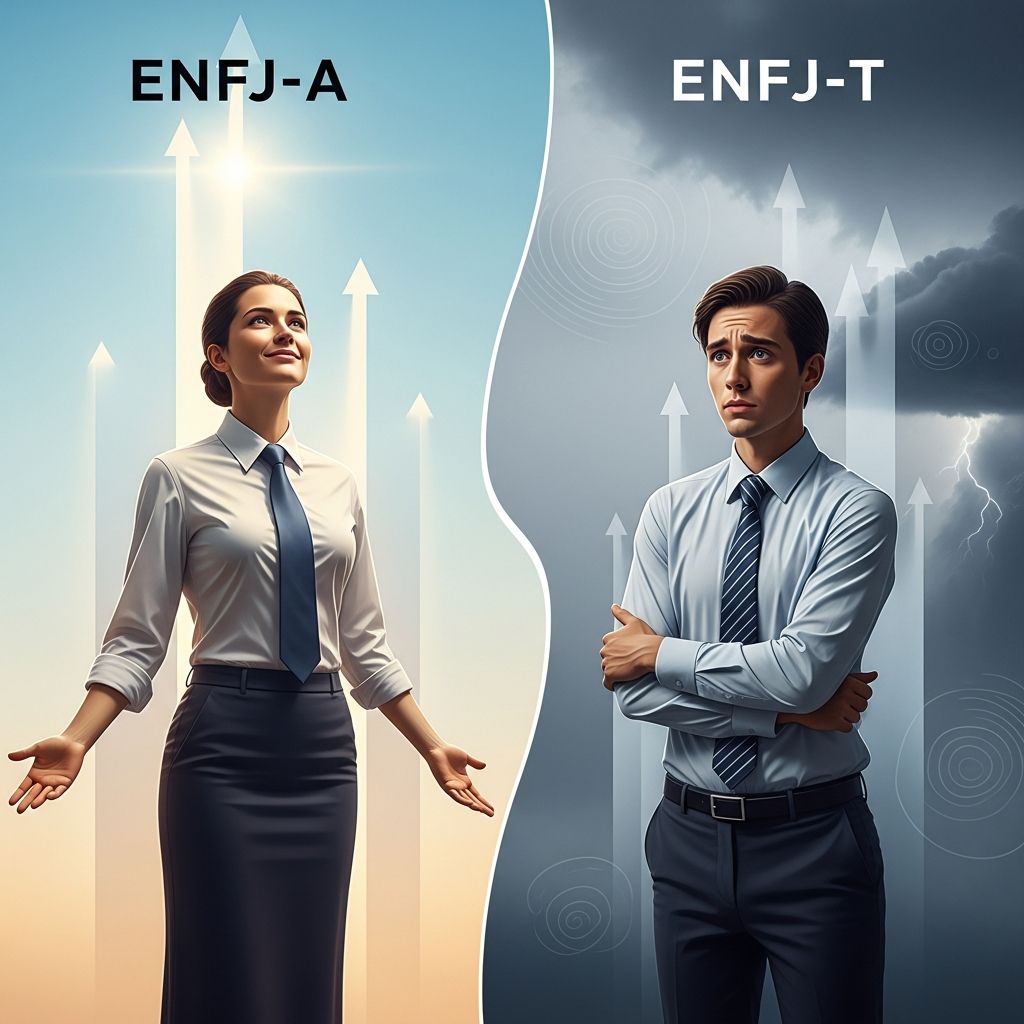
ENFJs are often described as warm, future-oriented leaders who care deeply about people and social harmony. Within this personality, the Assertive (ENFJ-A) and Turbulent (ENFJ-T) identities add another layer, shaping how Protagonists handle confidence, stress, and growth.
This article explores how these two variants differ while sharing the same ENFJ core, helping you recognize your own style and use it more effectively.
Understanding ENFJ Protagonists
The ENFJ profile combines four preferences:
- Extraverted – Energized by interaction, conversation, and collaboration.
- Intuitive – Oriented toward patterns, meanings, and future possibilities rather than concrete details.
- Feeling – Guided by values, empathy, and the impact on people.
- Judging – Prefers structure, plans, and closure over spontaneity.
Research and expert descriptions consistently portray ENFJs as socially skilled, persuasive, and emotionally attuned, often drawn to roles where they can support, guide, or inspire others.
What the A/T Identity Adds
The letters A (Assertive) and T (Turbulent) describe a broad style of emotional regulation and self-evaluation. They do not change the core ENFJ preferences, but they strongly influence how that personality shows up in daily life.
| Aspect | ENFJ-A (Assertive Protagonist) | ENFJ-T (Turbulent Protagonist) |
|---|---|---|
| Baseline mood | More even-tempered; emotional swings are less intense. | More emotionally reactive; mood shifts more quickly. |
| Self-confidence | Higher self-assurance; less self-doubt after decisions. | More self-questioning; frequently revisits choices. |
| Stress response | Tends to detach, reframe, and move on faster. | More likely to ruminate and feel pressure. |
| Motivation style | Goals driven by vision and values. | Goals fueled by concern about performance and impact. |
| Self-criticism | Gentler with self; may overlook flaws. | More critical; highly aware of weaknesses. |
Core Similarities: What All ENFJs Share
Before focusing on differences, it helps to highlight what both identities have in common.
- People-centered focus – Both ENFJ-A and ENFJ-T care about others’ well-being and are sensitive to interpersonal dynamics.
- Leadership potential – They often step into leadership or mentorship, formally or informally, because they notice needs and feel responsible to help.
- Vision for growth – Both are inclined toward personal and collective improvement; they usually have a sense of mission about making life better for others.
- Conflict sensitivity – ENFJs of both identities dislike prolonged tension and often act as mediators or facilitators.
The A/T identity does not remove these qualities; it changes the tone with which they are expressed.
ENFJ-A: The Steady, Self-Assured Protagonist
Assertive Protagonists tend to project calm confidence. Their ENFJ empathy and idealism are present, but moderated by a belief that things will work out and that they can handle whatever arises.
Typical Strengths of ENFJ-A
- Resilient optimism – They bounce back from setbacks quickly and are less likely to feel defined by short-term failures.
- Decisive leadership – When others hesitate, ENFJ-A types often step forward, make a call, and stick to it.
- Lower social anxiety – Their extraversion is reinforced by self-assurance, making it easier to start conversations and take social risks.
- Emotional grounding – They still feel deeply, but they usually keep perspective and avoid getting swallowed by others’ distress.
Typical Challenges for ENFJ-A
- Blind spots about impact – Confidence can make them underestimate how strongly their opinions influence others.
- Overlooking unresolved issues – In their eagerness to “move on,” they may gloss over hurt feelings, their own or others’.
- Underestimating stress load – They may say “yes” too often, assuming they can handle everything, until exhaustion surfaces unexpectedly.
- Resistance to feedback – Some ENFJ-A individuals can appear less open to criticism, interpreting it as unnecessary negativity.
ENFJ-T: The Sensitive, Self-Questioning Protagonist
Turbulent Protagonists often experience the ENFJ profile with more emotional intensity. They still lead and support, but they carry a heightened awareness of how things could go wrong and how they might be falling short.
Typical Strengths of ENFJ-T
- High empathy bandwidth – Emotional fluctuations can make them extremely responsive to subtle changes in others’ moods.
- Motivated by improvement – Self-criticism, while painful, often drives serious growth efforts and learning.
- Preparedness – Worry about outcomes can lead them to plan thoroughly, anticipate problems, and build safeguards.
- Authentic vulnerability – They may be more comfortable acknowledging insecurity, which can deepen trust in close relationships.
Typical Challenges for ENFJ-T
- Rumination – They can replay conversations and decisions, searching for mistakes or signs of rejection.
- Sensitivity to criticism – Feedback may feel personal, even when delivered gently or constructively.
- Decision paralysis – Fear of making the wrong choice can slow them down and create stress around relatively minor decisions.
- Over-identification with emotions – Difficult feelings may be interpreted as proof that they are failing, rather than temporary signals.
How ENFJ-A and ENFJ-T Handle Stress
Stress is one of the clearest areas where Assertive and Turbulent Protagonists diverge.
Stress Patterns in ENFJ-A
- Quick reframing – They often look for a positive interpretation or a solution right away.
- External focus – They may shift attention to helping others or taking action instead of dwelling on distress.
- Risk of emotional bypassing – Because they move on quickly, unresolved stress may accumulate in the background.
Stress Patterns in ENFJ-T
- Intense emotional response – Stressful events may feel more personally threatening.
- Internal focus – They closely examine their own role, asking what they did wrong or could have done better.
- Risk of burnout – Constant internal pressure combined with ENFJ responsibility for others can lead to exhaustion if not managed.
Decision-Making: Confidence vs Second-Guessing
Both identities tend to decide based on long-term impact on people and values, but the emotional tone of the decision process differs.
- ENFJ-A
- Moves from insight to action quickly.
- Trusts their read of people and situations.
- Less likely to revisit the decision unless feedback is strong.
- ENFJ-T
- Spends more time gathering reassurance and input.
- Replays scenarios to predict possible negative outcomes.
- More likely to revise decisions when doubts arise.
Neither style is inherently better: fast conviction can be efficient but error-prone, while careful reconsideration reduces mistakes but can create delays.
Relationships and Communication
ENFJs are often described as supportive partners and friends who value emotional connection and shared growth. Identity influences how they communicate needs and manage relationship stress.
ENFJ-A in Relationships
- Reassuring presence – They frequently play the stabilizing role during conflict or crisis.
- Initiating contact – They may more readily reach out first, make plans, and set a relational direction.
- Under-sharing of vulnerability – Confidence can mask deeper insecurities or fatigue, leaving partners unaware of their real strain.
ENFJ-T in Relationships
- Attentive listening – Their heightened sensitivity makes them excellent at noticing small shifts in tone or mood.
- Frequent reassurance needs – They may ask more often if things are “okay,” especially after misunderstandings.
- Risk of self-silencing – Fear of being a burden can lead them to hide worries, then overthink privately.
Work, Leadership, and Career Expression
At work, ENFJs are often seen in roles that blend people skills with a sense of mission: teaching, counseling, management, social services, advocacy, or community leadership. Both identities share this inclination but experience it differently.
ENFJ-A at Work
- Visible leadership – They may gravitate toward high-visibility roles, presentations, or public-facing responsibilities.
- Comfort with delegation – Belief in their own competence can make it easier to trust others and distribute tasks.
- Risk of overextension – They may take on ambitious workloads, assuming they can maintain performance indefinitely.
ENFJ-T at Work
- Detail-aware leadership – Concern about what could go wrong often translates into careful follow-through.
- High preparation – They tend to over-prepare for meetings, presentations, and difficult conversations.
- Performance anxiety – They may undervalue their abilities, seeking constant validation even when they are performing strongly.
Growth Strategies for Each Identity
Both ENFJ variants benefit from learning to care for themselves as well as others. The route, however, looks somewhat different for Assertive and Turbulent Protagonists.
Development for ENFJ-A
- Practice slow reflection – Create regular moments to sit with discomfort instead of immediately reframing it.
- Invite honest feedback – Ask trusted people to share how your decisions and style affect them and listen without defending.
- Set realistic limits – Recognize that energy is finite and that modeling rest can be as inspiring as modeling productivity.
- Stay curious about doubt – When you feel completely certain, briefly explore what you might be overlooking.
Development for ENFJ-T
- Differentiate feelings from facts – Anxious emotions are valuable signals, but they are not always accurate descriptions of reality.
- Use structured reassurance – Instead of repeatedly seeking others’ approval, create measurable criteria for “good enough.”
- Build self-compassion habits – Speak to yourself as you would to a friend you admire who made a mistake.
- Limit rumination time – Set a time box for reviewing an event, then deliberately shift to action or rest.
Embracing Your Variant Without Comparison
It is tempting to view one identity as superior—usually whichever seems calmer or more productive. Yet psychological research suggests that both higher emotional stability and higher sensitivity come with trade-offs: stability aids resilience, while sensitivity supports depth of processing and empathy. For ENFJs, this means:
- Assertive ENFJs offer steadiness, confidence, and forward momentum.
- Turbulent ENFJs offer nuance, vigilance, and emotional granularity.
Both are valuable to groups, families, and organizations. The goal is not to switch from one identity to the other, but to round out your edges so that strengths are maximized and weaknesses are managed.
Frequently Asked Questions (FAQs)
Q: Can an ENFJ change from Turbulent to Assertive, or vice versa?
A: Your underlying temperament tends to be relatively stable over time, but self-awareness and skill building can make a Turbulent ENFJ feel more grounded and an Assertive ENFJ more reflective. The goal is flexibility, not forcing a new label.
Q: Is one variant more “real” or accurate as an ENFJ?
A: No. Both ENFJ-A and ENFJ-T share the same core personality structure. The A/T identity simply describes how that structure expresses itself in terms of confidence, stress, and self-evaluation.
Q: Which variant is better suited for leadership roles?
A: Both can be effective leaders. ENFJ-A may feel more comfortable in visible, fast-paced leadership, while ENFJ-T may excel where careful listening, risk awareness, and continuous improvement are crucial.
Q: Are ENFJ-T individuals always anxious or insecure?
A: Not necessarily. Turbulence describes a tendency toward stronger emotional reactions and self-monitoring, not constant anxiety. Many ENFJ-T individuals learn to channel this trait into empathy, conscientiousness, and depth.
Q: How can I support an ENFJ partner, friend, or colleague of each type?
A: With ENFJ-A, honest feedback and gentle reminders to rest are helpful. With ENFJ-T, consistent reassurance, clear appreciation, and space to express doubts without judgment can make a big difference for their sense of security.
References
- ENFJ Personality (Protagonist) — 16Personalities. 2023-06-01. https://www.16personalities.com/enfj-personality
- Strengths & Weaknesses — ENFJ Personality (Protagonist) — 16Personalities. 2023-06-01. https://www.16personalities.com/enfj-strengths-and-weaknesses
- ENFJ Personality Type: In-Depth Profile & Analysis — Personality Junkie. 2022-03-15. https://personalityjunkie.com/enfj-type-profile/
- The ENFJ Personality Type Explained — Psychology Junkie (YouTube transcript). 2021-08-30. https://www.youtube.com/watch?v=C8YHeBg6MWY

Medha Deb is an editor with a master's degree in Applied Linguistics from the University of Hyderabad. She believes that her qualification has helped her develop a deep understanding of language and its application in various contexts. Medha specializes in the areas of beauty, health, sports, and wellness and is committed to ensuring that the content on the website is…