
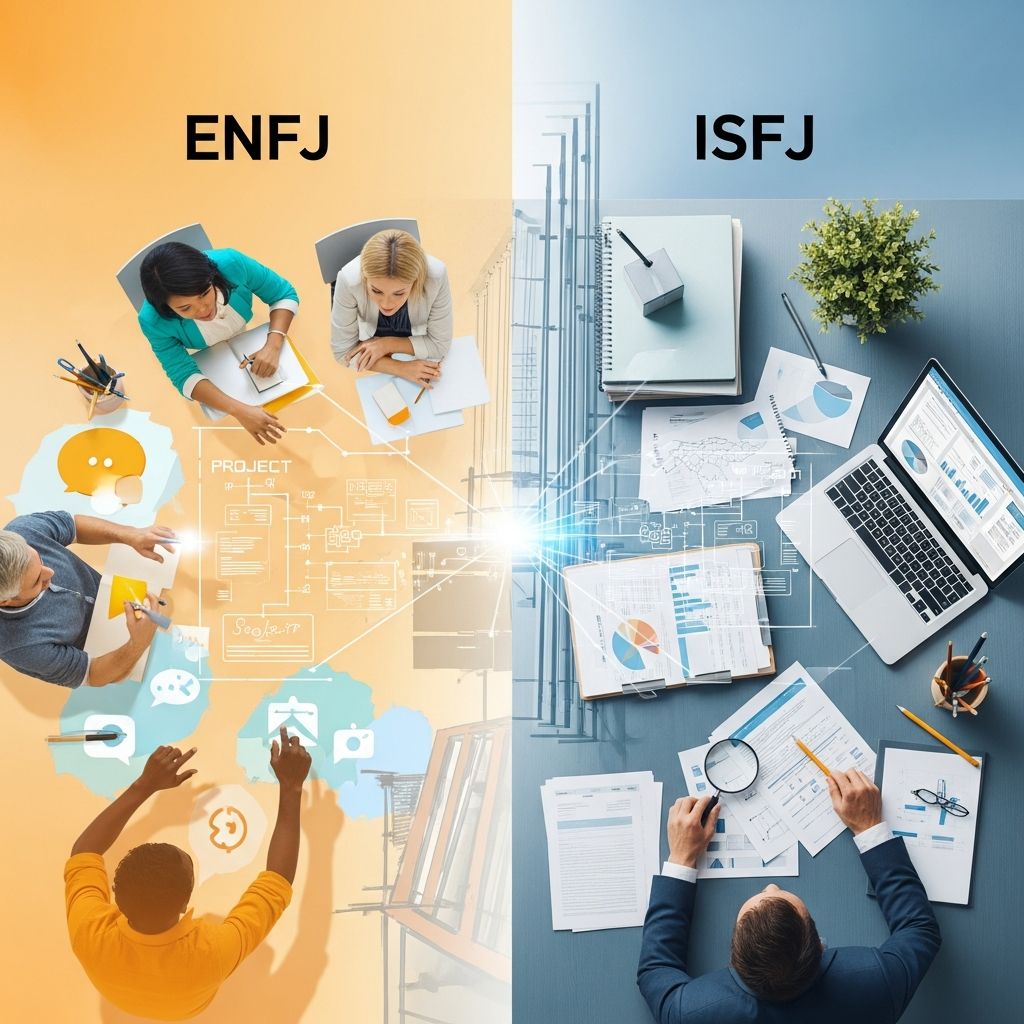
Among all personality pairings at work, the collaboration between ENFJ “Protagonists” and ISFJ “Defenders” can be especially effective. Both are warm, conscientious, and people-focused, yet they express these qualities in different ways that can complement each other when managed thoughtfully.
This guide explores how ENFJ and ISFJ colleagues can become reliable partners, what strengths they bring to a team, where they might clash, and how they can intentionally grow together.
Understanding ENFJs and ISFJs at Work
| Aspect | ENFJ – Protagonist | ISFJ – Defender |
|---|---|---|
| Energy | Extraverted, energized by interaction | Introverted, energized by quieter settings |
| Information focus | Intuitive, big-picture and future-oriented | Observant/Sensing, detail- and present-focused |
| Decision style | Feeling, values-driven and people-conscious | Feeling, considerate and harmony-seeking |
| Organization | Judging, structured, goal-driven | Judging, orderly, reliable and consistent |
Both types tend to value cooperation, clear expectations, and supportive workplaces where people are treated fairly and respectfully.
Shared Foundations That Make Collaboration Easier
ENFJs and ISFJs start with several important similarities that make it easier for them to trust each other and get work done.
1. A Common Focus on People and Harmony
Both ENFJs and ISFJs tend to:
- Notice the emotional tone of a room and adjust their behavior to maintain or restore harmony.
- Weigh the impact of decisions on people, not just systems or numbers.
- Offer help before being asked, often stepping in to support colleagues who are overwhelmed.
This shared concern for others can turn an ENFJ–ISFJ pair into the emotional backbone of a team, ensuring that people feel seen and supported while work moves forward.
2. A Preference for Structure and Follow-Through
Because both types share the Judging trait, they often prefer:
- Clear plans and timelines.
- Defined responsibilities and expectations.
- Closure on tasks rather than open-ended ambiguity.
Research on personality in the workplace shows that people who value structure tend to set goals, create routines, and stick with them, which supports consistent performance and reliability. ENFJs and ISFJs can therefore build strong project systems together – ENFJs driving alignment and motivation, ISFJs maintaining order and continuity.
3. Deep Commitment to Duty and Quality
ISFJs are often described as conscientious, dependable workers who take pride in doing tasks thoroughly and correctly. ENFJs similarly feel responsible for delivering outcomes that live up to their values and the trust others place in them.
When these two types collaborate, they are likely to:
- Hold themselves and each other to high standards.
- Follow up on loose ends others might ignore.
- Take ownership of group results, not just their personal piece.
Complementary Strengths: Why They Balance Each Other
Beyond similarities, ENFJs and ISFJs bring different strengths that can cover each other’s blind spots when they work together intentionally.
4. Visionary Leadership Meets Grounded Execution
ENFJs typically look far ahead, imagining what a team, program, or organization could become. They are often drawn to:
- Long-term strategy and vision.
- Change initiatives and new projects.
- Motivating others toward shared goals.
ISFJs, by contrast, usually anchor that vision in practical reality. They often excel at:
- Defining detailed steps and routines.
- Tracking what has already been promised or tried.
- Protecting continuity so important details are not lost.
When they collaborate well, ENFJs can set direction and build buy-in, while ISFJs ensure that the plan is realistic, sustainable, and well-documented.
5. Social Reach vs. Deep Individual Attention
ENFJs tend to move easily through broader networks: they speak up in meetings, coordinate across departments, and draw people into conversations. ISFJs are more likely to invest in a smaller circle, offering steady, one-on-one support that keeps a core group functioning smoothly.
Combined, this often looks like:
- ENFJ opening doors, gathering stakeholders, and representing the team.
- ISFJ nurturing the close working relationships that keep everyday operations healthy.
6. Innovation Tempered by Tradition
ENFJs usually embrace new ideas, tools, and methods if they believe these changes will benefit people and results. ISFJs, while not inherently resistant to change, tend to take a more cautious stance, assessing how changes will affect established routines and standards.
This pairing can be powerful when both perspectives are heard:
- The ENFJ pushes the team to grow, improve, and adopt better ways of working.
- The ISFJ tests whether the change respects existing knowledge, workflows, and risks.
In well-functioning ENFJ–ISFJ partnerships, new initiatives are thoughtfully integrated rather than rushed or blocked.
Common Friction Points (and How to Prevent Them)
Despite their many strengths, ENFJs and ISFJs can misunderstand one another, especially when under pressure. Recognizing potential friction points early allows both types to address them calmly and constructively.
7. Extraversion vs. Introversion: Different Ways of Participating
An ENFJ may interpret an ISFJ’s quietness as disengagement, while the ISFJ may feel overwhelmed by the ENFJ’s energy or pace of interaction. Research on extraversion and introversion suggests that introverts often need more time to reflect before speaking, and may prefer smaller group settings for meaningful contribution.
To reduce tension:
- ENFJs can build in reflection time, send agendas in advance, and not pressure ISFJs for immediate responses.
- ISFJs can signal when they need processing time and share that their quieter style does not mean lack of interest.
8. Abstract Ideas vs. Concrete Details
ENFJs often enjoy conceptual discussions about possibilities and long-term impact, while ISFJs may quickly ask, “How would this work in practice?” or “What does this mean for us today?”
Misunderstandings can look like:
- ENFJ feeling that the ISFJ is being “too cautious” or “negative.”
- ISFJ feeling that the ENFJ is being “unrealistic” or “vague.”
A helpful compromise is to explicitly separate discussions into two phases:
- First explore possibilities (ENFJ’s strength).
- Then examine feasibility, resources, and procedures (ISFJ’s strength).
9. Emotional Overload and Unspoken Resentment
Both types care deeply about others, which can make them reluctant to express frustration. Over time, unmet expectations or unequal workloads can quietly build resentment.
Healthy habits include:
- Scheduling regular check-ins focused specifically on workload, boundaries, and expectations.
- Using “I” statements to raise concerns in a non-accusatory way.
- Agreeing that honest feedback is an expression of respect, not a threat to the relationship.
Strategies to Strengthen ENFJ–ISFJ Partnerships
With some intentional practices, ENFJ–ISFJ work relationships can move from “pleasant” to genuinely high-performing and resilient.
10. Clarify Roles Around Vision and Detail
Rather than competing for the same tasks, ENFJs and ISFJs can define complementary responsibilities:
- Assign ENFJs more ownership over communication, alignment, and change advocacy.
- Assign ISFJs more ownership over documentation, process integrity, and quality control.
- Pair up on planning: ENFJ proposes direction, ISFJ tests and refines the plan.
11. Design Communication Routines That Suit Both Styles
Helpful structures include:
- Weekly planning conversations to review priorities and adjust plans.
- Written summaries after key discussions so ISFJs have records and ENFJs confirm shared understanding.
- Agreed communication channels (e.g., chat for quick questions, email for details, meetings for decisions).
12. Protect Each Other from Burnout
Both ENFJs and ISFJs can overextend themselves in service of others, sometimes neglecting their own limits. Organizational psychology research notes that highly conscientious, service-oriented workers are at increased risk of stress and burnout when they consistently prioritize others’ needs over their own.
In a healthy partnership, they can support each other by:
- Checking whether they are taking on too many “invisible” tasks like emotional support, onboarding, or extra coordination.
- Normalizing boundaries (for example, “Let’s agree that it’s okay to say no when our plates are full”).
- Encouraging time off and modeling breaks instead of glorifying overwork.
Practical Scenarios: How ENFJ–ISFJ Teams Can Shine
The ENFJ–ISFJ pairing is especially effective in certain types of work environments and projects.
13. Ideal Contexts for ENFJ–ISFJ Collaboration
- People-centric fields such as education, healthcare, community services, and HR, where empathy and structure are both crucial.
- Change initiatives that require both employee buy-in (ENFJ strength) and careful implementation planning (ISFJ strength).
- Customer-facing roles where ENFJs can manage relationships broadly while ISFJs ensure consistent quality and follow-up.
14. Sample Division of Labor on a Project
| Project Phase | ENFJ Natural Contributions | ISFJ Natural Contributions |
|---|---|---|
| Initiation | Articulate purpose, rally stakeholders, frame benefits. | Gather background information, document requirements. |
| Planning | Set goals, define success measures, align team roles. | Create timelines, check resource needs, refine procedures. |
| Execution | Motivate team, resolve conflicts, manage communication. | Track progress, maintain records, uphold standards. |
| Review | Facilitate debrief, identify lessons, propose improvements. | Compile results, compare to expectations, note best practices. |
Frequently Asked Questions (FAQs)
Q: Can ENFJs and ISFJs work well together if they are peers rather than manager–employee?
Yes. Because both types value cooperation and responsibility, they can function as highly effective peers. ENFJs often take informal leadership in communication and coordination, while ISFJs provide stability and detail management. The key is to avoid unspoken hierarchies: both contributions should be acknowledged as equally important.
Q: What should an ENFJ avoid doing when collaborating with an ISFJ?
ENFJs should avoid pressuring ISFJs to respond immediately, dismissing concerns about practical details, or making last-minute changes without consultation. Taking time to listen, providing advance notice when possible, and following through on agreed plans all build trust.
Q: What should an ISFJ avoid doing when collaborating with an ENFJ?
ISFJs should avoid assuming that enthusiasm automatically means recklessness or that abstract discussion lacks substance. Instead of quietly doubting, they can ask clarifying questions, share specific concerns, and suggest alternative approaches. This allows their realism to sharpen the ENFJ’s vision rather than block it.
Q: How can managers support an ENFJ–ISFJ pair on their team?
Managers can give this pair shared projects that require both stakeholder engagement and careful execution. It helps to explicitly recognize their complementary strengths, ensure that planning time is built into deadlines, and check that neither partner is carrying an unfair share of emotional labor or routine administrative work.
Q: Are ENFJ and ISFJ combinations always productive?
No personality pairing is automatically successful. If expectations are unclear, communication is indirect, or stress levels are high, ENFJ–ISFJ partnerships can suffer from misunderstandings and unspoken frustration. However, with clear roles, open dialogue, and mutual respect, their natural alignment around care, structure, and responsibility gives them a strong foundation for productivity.
References
- The 16 Personalities at Work: HR Guide to Team Management — Effy AI. 2023-06-01. https://www.effy.ai/blog/16-personalities
- Burnout and health — World Health Organization. 2019-05-28. https://www.who.int/news/item/28-05-2019-burn-out-an-occupational-phenomenon-in-the-icd-11
- ENFJ and ISFJ Compatibility: Relationships, Friendships, and More — TraitLab. 2022-08-15. https://blog.traitlab.com/enfj/isfj
- Maximizing Team Collaboration: The Role of Personality in Working Well Together — 16Personalities. 2022-04-10. https://www.16personalities.com/articles/maximizing-team-collaboration-the-role-of-personality-in-working-well-together
- 16 Types in the Workplace – ENFJ — The Myers-Briggs Company. 2020-01-01. https://www.themyersbriggs.com/en-US/Access-Resources/Articles/16-types-in-the-workplaceenfj
- 16 Personality Types in the Workplace — WeCP. 2021-03-12. https://www.wecreateproblems.com/blog/personality-types-in-the-workplace
- Myers-Briggs Team Management: Effective Strategies for All Personality Types — Atarim. 2023-02-20. https://atarim.io/blog/myers-briggs/

Medha Deb is an editor with a master's degree in Applied Linguistics from the University of Hyderabad. She believes that her qualification has helped her develop a deep understanding of language and its application in various contexts. Medha specializes in the areas of beauty, health, sports, and wellness and is committed to ensuring that the content on the website is…