
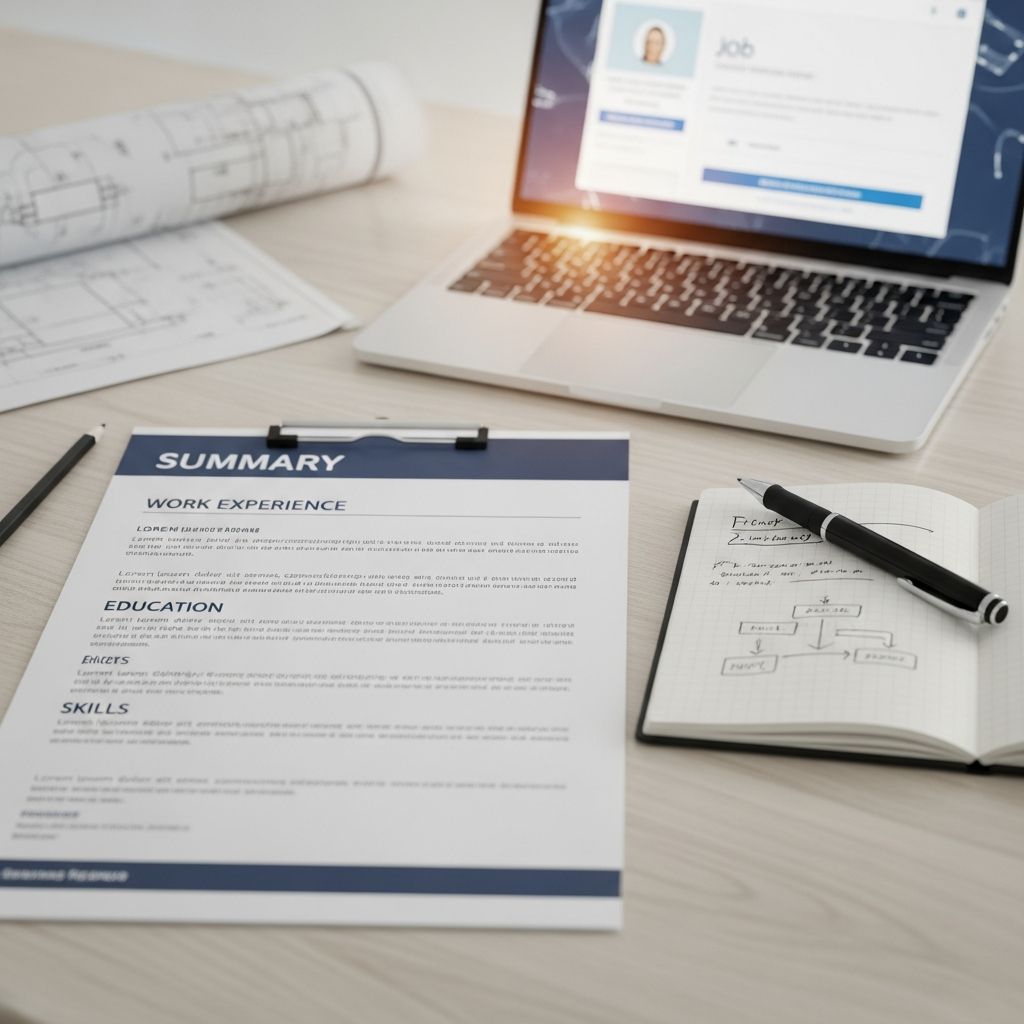
An effective engineering resume does two difficult jobs at once: it must satisfy applicant tracking systems (ATS) that search for specific keywords, and it must convince technical reviewers that you can solve real problems and deliver measurable results.
This guide walks you through every part of a modern engineering resume, from layout and sections to quantified bullet points and portfolio links, so you can present your skills with clarity and impact.
Core Principles of a Strong Engineering Resume
Before you start writing, align your resume with a few non-negotiable principles used by leading engineering schools and career centers.
- Clarity first: Use a clean, scannable layout, consistent formatting, and standard section titles so both humans and ATS can quickly parse your information.
- Evidence over claims: Focus on measurable achievements instead of generic responsibilities or buzzwords.
- Relevance: Tailor skills and experience to the specific role and industry (e.g., civil, mechanical, software, electrical).
- Conciseness: Keep most engineering resumes to one page, especially for early- and mid-career roles, unless you have extensive experience.
- Consistency: Use one professional font, uniform date formats, and aligned bullet styles so the document looks polished.
Ideal Resume Structure for Engineers
Most engineers are evaluated quickly, often from a screen or mobile device. A logical and expected order helps recruiters find what they need without effort.
| Section | Recommended Order | Who Should Prioritize It |
|---|---|---|
| Contact & Headline | Top of page | All engineers |
| Professional Summary or Objective | Below contact | Mid-career engineers; career changers |
| Technical Skills | High on page | All, especially ATS-heavy roles |
| Experience | Core middle | Anyone with internships or work history |
| Education | Above experience if student/new grad | Students and recent graduates |
| Projects, Certifications, Awards | Bottom third | Technical roles, skill-heavy jobs |
Crafting a Professional Summary or Objective
A well-written top section provides a quick snapshot of your expertise, especially useful for experienced engineers.
When to Use a Summary vs. Objective
- Professional summary: Ideal if you have several years of experience; focuses on your discipline, strengths, and impact.
- Career objective: Better for students, new graduates, or career changers; emphasizes your direction and what you aim to contribute.
Checklist for an Effective Summary
- Names your engineering discipline (e.g., mechanical, civil, software).
- Indicates level (e.g., entry-level, senior, principal).
- Highlights 3–5 core technical strengths aligned with target roles.
- Includes at least one quantified outcome (cost savings, throughput, uptime, efficiency, defect rate, etc.).
Showcasing Technical Skills Strategically
Engineering recruiters often scan for a specific list of tools, programming languages, and methods before reading anything else. Place your skills near the top of the resume in a clearly labeled section such as Technical Skills.
Organizing Your Skills
Group related tools to make your capabilities easier to understand at a glance.
- Design & Modeling: CAD, CAE, FEA tools, PCB layout software.
- Programming: Languages, frameworks, embedded systems, scripting.
- Analysis & Simulation: Statistical tools, simulation packages, numerical methods.
- Manufacturing & Hardware: CNC, CAM, test equipment, lab instruments.
- Project & Quality: Lean, Six Sigma, Agile, standards (e.g., ISO, ASME).
For each skill group, include the exact terminology that appears in the job description when relevant; this helps with ATS keyword matching.
Writing Experience Bullets That Prove Your Impact
In engineering resumes, the experience section is where you show that you can apply theory to real-world constraints. Strong bullets combine an action, a technical context, and a result.
A Reliable Formula for Bullet Points
Use this pattern to keep your bullets focused and impressive:
- Action verb + technical task + tools or methods + quantified outcome.
For example, instead of saying you were “responsible for testing,” specify what you tested, how you tested it, and what changed because of your work. Whenever possible, quantify:
- Percent improvements (e.g., 18% cost reduction, 30% faster cycle time).
- Financial impact (e.g., saved $250K annually, delivered project under budget).
- Reliability, uptime, or defect rates (e.g., reduced failures per million, increased availability).
- Scale (e.g., size of system, number of users, power level, production volume).
Tailoring Experience to the Job
For each application, emphasize experience that mirrors the job description. Career centers consistently recommend customization over generic resumes, even if that means maintaining multiple versions.
- Reorder bullets so the most relevant achievements appear first.
- Use the employer’s terminology when it accurately reflects your work.
- Reduce space on older or less relevant roles to prioritize recent impact.
Highlighting Education for Engineers
Engineering roles typically require formal education in a technical field. Universities advise that students and new graduates feature education near the top, while experienced professionals can move it below work history.
What to Include Under Education
- Degree(s), major(s), and minor(s).
- Institution name and location.
- Graduation date or expected graduation date.
- GPA, if it is a strong asset (often 3.5 or above).
- Relevant coursework, design clinics, or capstone projects, especially for early-career candidates.
- Honors, scholarships, or academic awards that signal high performance.
Projects, Research, and Design Work
Engineering employers value demonstrated problem-solving. A dedicated projects section is particularly powerful when you lack extensive full-time experience.
Choosing Projects to Feature
- Capstone or senior design projects.
- Independent or open-source engineering work.
- Hackathons, design competitions, or build challenges.
- Research projects with a clear engineering component.
For each project, include a brief description that highlights:
- Your role and teammates (if applicable).
- Key technologies, tools, or methods used.
- Engineering constraints (cost, weight, safety, power, standards).
- Outcomes, tests passed, or performance metrics.
Certifications, Licenses, and Professional Development
Formal credentials are often critical in engineering. A short section for certifications signals both compliance with industry requirements and a commitment to continued learning.
- Professional Engineer (PE) or equivalent licensure.
- Engineer in Training (EIT) or Fundamentals of Engineering (FE).
- Specialized standards or safety certifications (e.g., welding codes, power systems, safety clearances).
- Methodology credentials such as Lean Six Sigma or Agile project management.
- Vendor or technology certifications relevant to your field (cloud, networking, CAD platforms, PLCs).
Formatting for Readability and ATS Compatibility
Engineering schools emphasize that resumes should be accurate, concise, and easy to read, which also aligns with ATS best practices.
Formatting Guidelines
- Use a standard, professional font (e.g., Arial, Calibri, Times New Roman) at 10–12 pt size.
- Stick to one column; complex layouts can confuse parsing software.
- Use clear headings like Experience, Education, Skills, and Projects instead of creative titles that might not be recognized by ATS.
- Save and submit as PDF or Word according to the employer’s instructions.
- Maintain consistent bullet styles, date formats, and spacing.
Keyword Strategy for Engineers
Because many organizations rely on ATS for first-round screening, thoughtful keyword placement is essential.
- Mirror the terminology used in the job posting for tools, frameworks, and standards.
- Include both acronyms and full names for critical technologies (e.g., FEA (Finite Element Analysis)).
- Weave keywords throughout the summary, skills, and experience sections instead of concentrating them in a single list.
Adapting Your Resume to Different Engineering Disciplines
Although the structure of an engineering resume is broadly similar across fields, the emphasis within sections should reflect your specialty.
| Discipline | Key Emphasis Areas |
|---|---|
| Civil & Structural | Codes and standards, design software, permitting, infrastructure projects, safety and compliance metrics. |
| Mechanical | CAD/CAE tools, thermal/fluid analysis, manufacturing methods, tolerance and GD&T, performance testing. |
| Electrical & Electronics | Circuit design, power systems, embedded systems, PCB layout, testing and measurement tools. |
| Chemical & Process | Process design, safety and environmental regulations, simulation tools, scale-up and optimization. |
| Software & Computer | Programming languages, frameworks, system design, performance optimization, code quality and testing. |
Common Mistakes on Engineering Resumes
Avoiding a few frequent errors can significantly increase your chances of reaching the interview stage.
- Overloaded jargon: Using technical terms without context makes impact hard to evaluate; explain how tools were applied.
- No metrics: Listing duties instead of outcomes hides your contribution; quantify whenever feasible.
- Irrelevant details: Including unrelated jobs or outdated technologies dilutes your engineering narrative.
- Visual complexity: Heavy graphics, multiple columns, and decorative fonts may break ATS parsing.
- Typos and inconsistencies: Small errors undermine trust in your attention to detail—crucial for engineers.
Frequently Asked Questions (FAQs)
How long should an engineering resume be?
Most early- and mid-career engineers should keep their resume to one page, focusing on the most relevant and recent experience. A second page may be acceptable for senior professionals with extensive project and leadership histories, but only if every entry adds value.
Do I need a different resume for every job?
You do not need to rewrite your resume from scratch, but you should adjust it for each application—reordering bullets, highlighting different projects, and aligning terminology with the job posting. Career centers consistently find that targeted resumes perform better than generic ones.
Should I include soft skills like communication and teamwork?
Yes, but they should be demonstrated, not simply listed. Describe how you led cross-functional teams, presented results to non-technical stakeholders, or mentored junior engineers; this shows communication and collaboration in action.
Where should I put my GPA on an engineering resume?
If your GPA is strong and you are early in your career, list it in the education section near your degree. If you have several years of experience, you can omit GPA unless specifically requested or especially impressive.
Is it acceptable to include personal projects and open-source work?
Yes. Personal and open-source projects can be powerful evidence of initiative and technical depth, particularly in software and computer engineering. Treat them like professional experience: describe the problem, tools, and measurable outcomes.
References
- Resume Writing – A. James Clark School of Engineering — University of Maryland, A. James Clark School of Engineering. 2023-01-01. https://eng.umd.edu/sites/clark.umd.edu/files/Resume%20Handout%20with%20Samples.pdf
- CREATE A STRONG RESUME — Harvard University, Mignone Center for Career Success. 2023-08-15. https://careerservices.fas.harvard.edu/resources/create-a-strong-resume/
- Resumes, CVs and Cover Letters — University of Michigan Engineering Career Resource Center. 2023-05-10. https://career.engin.umich.edu/resumes-cvs-cover-letters/
- RESUMES/COVER LETTERS — Stanford Career Education. 2022-09-01. https://careered.stanford.edu/sites/g/files/sbiybj22801/files/media/file/resume-and-cover-letter-examples.pdf
- 4 Resume Writing Tips to Engineer Career Success — Rise Technical Recruitment. 2025-01-05. https://www.risetechnical.com/blog/2025/01/4-resume-writing-tips-2025
- 16 Engineering Resume Examples & Writing Guide for 2025 — ResumeGenius. 2025-02-01. https://resumegenius.com/resume-examples/engineering-resume-examples
- Practical guide to writing FAANG-ready software engineer resumes — Tech Interview Handbook. 2024-06-10. https://www.techinterviewhandbook.org/resume/

- Integrated M.A. in Applied Linguistics, University of Hyderabad
- 5+ years in editorial, instructional, SEO, and research-based writing
Sneha is a relationships and lifestyle writer with a strong foundation in applied linguistics and certified training in relationship coaching. She brings over five years of writing experience to theskillvault, crafting thoughtful, research-driven content that empowers readers to build healthier relationships, boost emotional well-being, and embrace holistic living. Her writing and insights reflect the belief that beauty, happiness, and wellness…