
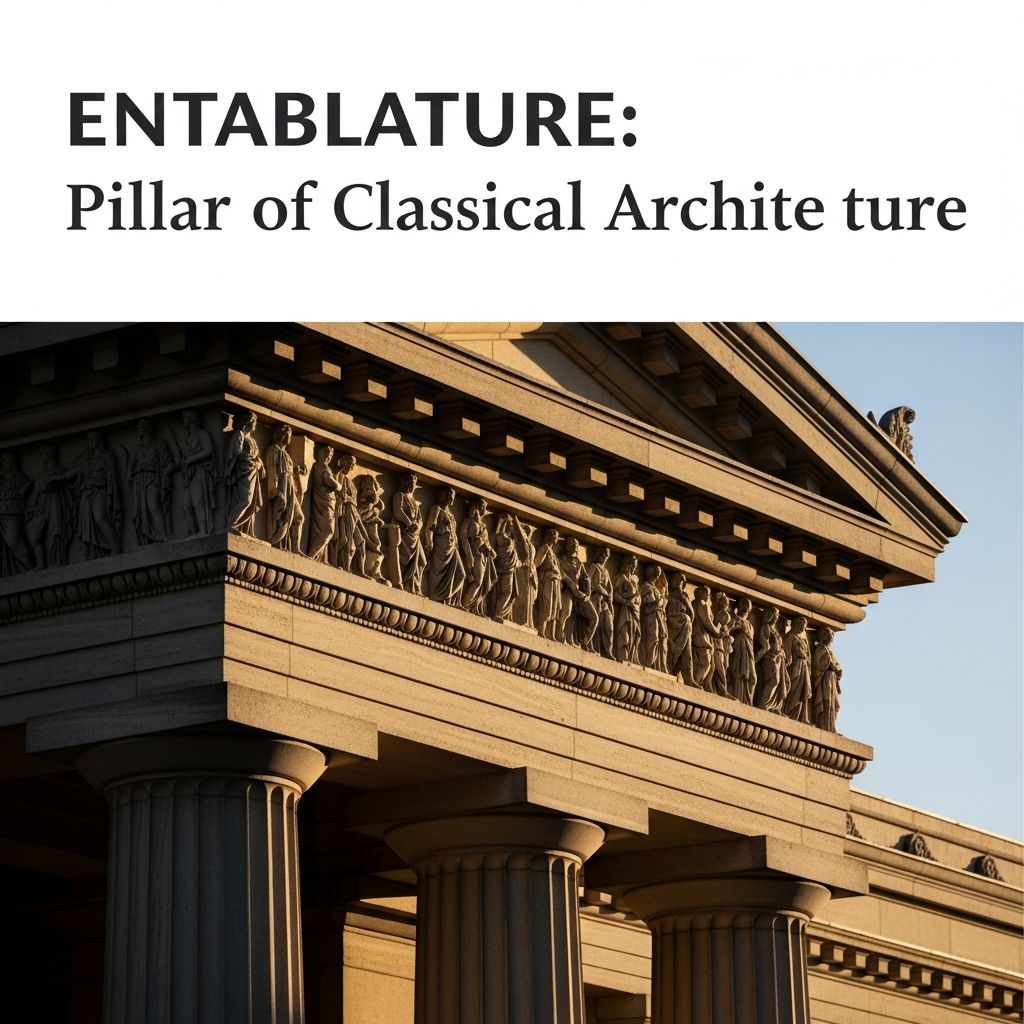
The entablature stands as a fundamental element in classical architecture, serving as the horizontal superstructure that crowns columns and unites structural integrity with artistic expression. This layered assembly, resting directly atop column capitals, transforms simple supports into grand architectural statements, embodying principles of proportion, balance, and decoration that have endured for millennia.
Defining the Entablature: Structure and Purpose
An entablature is a continuous horizontal band composed of moldings and decorative elements positioned immediately above columns or pilasters. It typically divides into three primary sections: the architrave at the base, the frieze in the middle, and the cornice at the top. This configuration not only provides structural support for roofs or ceilings but also offers a canvas for intricate carvings, sculptures, and motifs that convey cultural narratives.
Originating from ancient post-and-lintel construction, the entablature evolved from practical timber beams into sophisticated stone features. In essence, it bridges the vertical thrust of columns with the horizontal expanse above, creating visual rhythm and hierarchy in building facades. Its presence defines classical temples, porticos, and public structures, where it often supports a pediment—a triangular gable end—for added drama.
Breaking Down the Components: Architrave, Frieze, and Cornice
Understanding the entablature requires dissecting its core parts, each with distinct functions rooted in ancient building techniques.
- Architrave: The lowest layer, akin to a chief beam or lintel, spans between columns. Often plain or subtly banded into steps, it symbolizes raw structural power. A thin molding called the taenia may cap it, evoking a historical board atop timber supports.
- Frieze: Positioned centrally, this band serves as the decorative heart. It can be smooth or richly adorned with relief sculptures, metopes (carved panels), or triglyphs (vertical grooves). The frieze narrates myths, victories, or rituals, making it a storytelling medium in Greek and Roman works.
- Cornice: The uppermost section projects outward, shielding walls from weather. Comprising bedmolds, corona (a drip edge), and cymatium (a curved top molding), it mimics roof overhangs from primitive wooden structures. Its shadows accentuate depth and movement.
These elements interlock seamlessly, with proportions varying by architectural order to evoke different moods—from sturdy restraint to ornate elegance.
Classical Orders and Their Unique Entablatures
Classical architecture organizes entablatures within five canonical orders: Doric, Ionic, Corinthian, Tuscan, and Composite. Each order pairs specific column designs with tailored entablatures, ensuring stylistic cohesion.
| Order | Architrave Style | Frieze Features | Cornice Details | Overall Character |
|---|---|---|---|---|
| Doric | Three flat bands | Alternating triglyphs and metopes | Simple mutules and guttae | Masculine, robust |
| Ionic | Three stepped fascias | Continuous or lightly sculpted | Dentils and elaborate egg-and-dart | Graceful, refined |
| Corinthian | Layered with moldings | Richly carved foliage | Modillions and brackets | Opulent, decorative |
| Tuscan | Plain and bold | Unadorned | Straightforward projection | Simplified, sturdy |
| Composite | Mixed Ionic-Corinthian | Elaborate scrolls and leaves | Highly projecting | Eclectic, grand |
The Doric entablature, the earliest and plainest, reflects Mycenaean influences with its triglyph-frieze system mimicking wooden end-beams. Ionic introduces delicacy via dentils (small blocks) under the cornice, while Corinthian dazzles with acanthus-leaf motifs, as seen in the Pantheon.
Historical Origins: From Timber to Timeless Stone
The entablature’s story begins in prehistoric wood construction, where beams (architrave), rafter ends (frieze), and eaves (cornice) formed natural divisions. Ancient Greeks petrified these in marble around 600 BCE, starting with Doric temples like the Parthenon, where Phidias’ friezes depict the Panathenaic procession.
Roman architects adapted and innovated, blending orders and scaling entablatures for colossal basilicas and arches. The Renaissance revived them via Vitruvius’ De Architectura, inspiring Brunelleschi’s Pazzi Chapel and Palladio’s villas. This classical revival permeated Neoclassicism, evident in the U.S. Capitol and Napoleonic Paris.
Beyond Greco-Roman spheres, entablature-like features appear in Egyptian hypostyle halls, Persian palaces, and Mayan pyramids, underscoring universal post-lintel logic.
Entablatures in Modern and Interior Applications
Though modernism favored steel and glass, entablatures persist in traditionalist and postmodern designs. Frank Lloyd Wright sparingly used simplified versions, while contemporary firms like Robert A.M. Stern revive full orders for luxury residences and civic buildings.
Indoors, entablatures frame rooms, crown doors, and mantelpieces, imposing order on spaces. In traditional American interiors, as studied at Winterthur Museum, they delineate hierarchies—grand in salons, modest in passages. Furniture echoes this: cabinets with entablature crowns mimic temples in miniature.
Iconic Examples Across Eras
- Parthenon, Athens (447-432 BCE): Doric entablature with Phidias’ masterful frieze, symbolizing Athenian supremacy.
- Pantheon, Rome (126 CE): Corinthian entablature supporting the world’s largest unreinforced dome.
- St. Paul’s Cathedral, London (1710): Wren’s Baroque adaptation with rhythmic modillions.
- White House, Washington D.C. (1800): Neoclassical portico entablature evoking Roman dignity.
These landmarks illustrate the entablature’s adaptability, from sacred to secular contexts.
Constructing an Entablature: Materials and Techniques
Historically carved from limestone, marble, or sandstone, modern replicas use concrete, fiberglass, or plaster. Stone entablatures demand precise quarrying and jointing; friezes require skilled sculptors for reliefs. Proportions follow strict modules based on column diameter—e.g., Doric entablature height is roughly 1/4 the column’s.
Digital tools now aid design, with CNC milling replicating classical profiles accurately, blending craft with technology.
The Symbolic Power of the Entablature
Beyond structure, entablatures encode symbolism: triglyphs as ax ends invoke warrior ethos; volutes suggest scrolls of wisdom. They demarcate sacred from profane, public from private, eternalizing human aspirations in stone.
Frequently Asked Questions
What is the main function of an entablature?
It supports the roof while providing decorative and proportional balance above columns.
How does a Doric entablature differ from Corinthian?
Doric is austere with triglyphs; Corinthian is florid with acanthus carvings.
Can entablatures be used without columns?
Yes, as isolated beams or wall crowning in non-classical styles.
Why is the frieze often decorated?
It offers a flat, prominent surface ideal for narrative sculptures.
Are entablatures relevant today?
Absolutely, in neoclassical revivals, interiors, and sustainable stone architecture.
References
- Entablature Definition — Cambridge University Press. 2023. https://dictionary.cambridge.org/us/dictionary/english/entablature
- Entablature — Encyclopædia Britannica. 2024-01-15. https://www.britannica.com/technology/entablature
- Entablature — Merriam-Webster. 2024. https://www.merriam-webster.com/dictionary/entablature
- Design Dictionary: Entablature — Lynn Byrne Architecture. 2022-05-10. https://www.lynn-byrne.com/posts/design-dictionary-entablature
- The Magical Entablature — This is Carpentry. 2012-11-23. https://www.thisiscarpentry.com/2012/11/23/the-magical-entablature/

- Integrated M.A. in Applied Linguistics, University of Hyderabad
- 5+ years in editorial, instructional, SEO, and research-based writing
Sneha is a relationships and lifestyle writer with a strong foundation in applied linguistics and certified training in relationship coaching. She brings over five years of writing experience to theskillvault, crafting thoughtful, research-driven content that empowers readers to build healthier relationships, boost emotional well-being, and embrace holistic living. Her writing and insights reflect the belief that beauty, happiness, and wellness…