
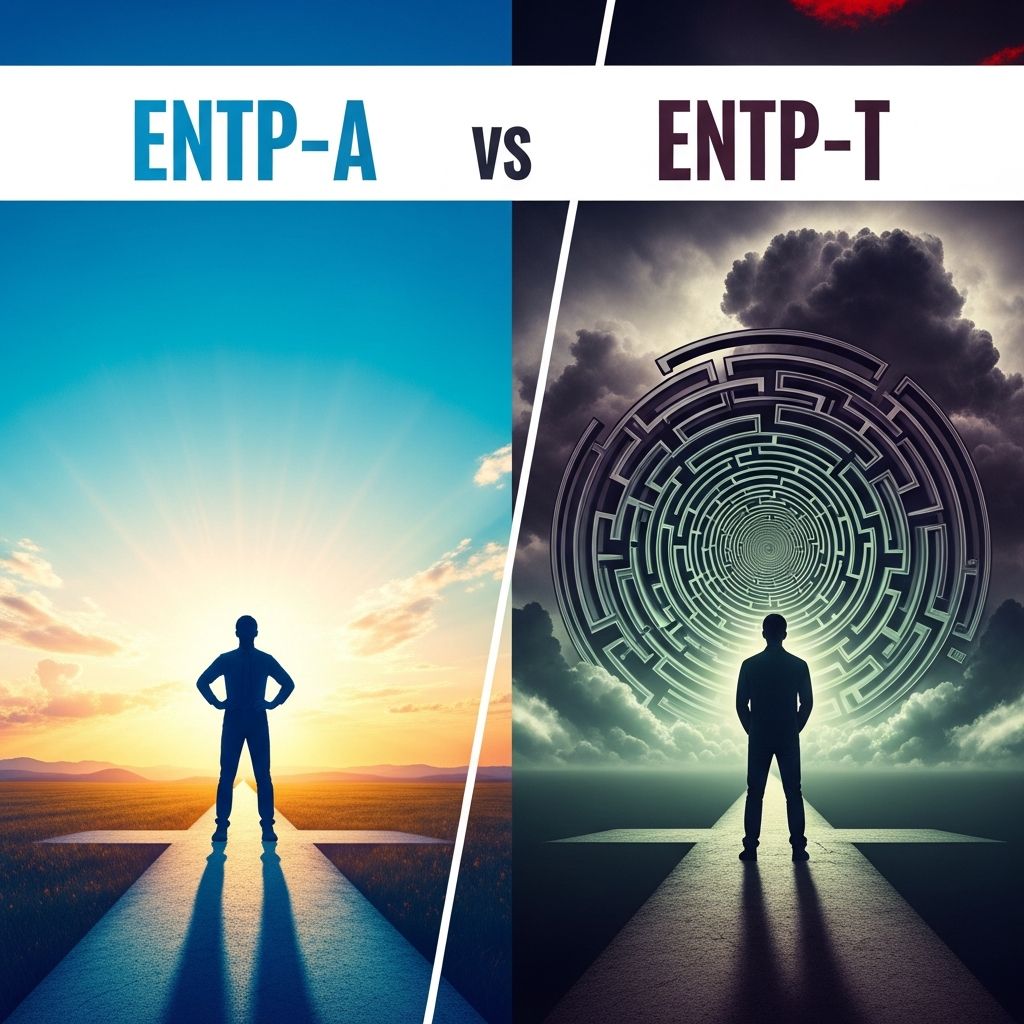
The ENTP personality type, often called the Debater, is known for lively curiosity, love of ideas, and a talent for challenging assumptions. Yet within this type, the Assertive (A) and Turbulent (T) variants can look and feel quite different day to day. This article explores how ENTP-A and ENTP-T diverge in confidence, emotional intensity, stress, work style, and relationships – while sharing the same energetic, idea-driven core.
1. A Quick Refresher: What Makes Someone an ENTP?
ENTP stands for Extraverted, Intuitive, Thinking, Perceiving, a pattern first systematized in the Myers–Briggs tradition and related to Jungian psychological types. Research and practitioner descriptions consistently highlight several core ENTP themes:
- Extraverted (E): Gain energy from interaction, conversation, and social engagement.
- Intuitive (N): Focus on concepts, patterns, and possibilities more than concrete details.
- Thinking (T): Prefer logical analysis and objective criteria in decision-making.
- Perceiving (P): Value flexibility, spontaneity, and keeping options open.
Across sources, ENTPs are described as innovative, quick-witted, and debate-loving, often thriving in fast-paced, idea-rich environments such as entrepreneurship, problem-solving roles, or creative industries.
| Area | Typical ENTP Pattern |
|---|---|
| Communication | Verbal, fast-paced, enjoys argument and playful banter. |
| Thinking style | Big-picture, pattern-seeking, experimental, solution-focused. |
| Motivation | Curiosity, novelty, intellectual challenge, autonomy. |
| Common strengths | Creativity, adaptability, persuasive communication, strategic thinking. |
| Common struggles | Follow-through, routine tasks, sensitivity to emotional cues, impatience with slower thinkers. |
2. What Do the “A” and “T” Variants Mean?
Beyond the four letters of type, many modern personality questionnaires introduce additional traits such as Assertiveness and Neuroticism/Emotional Stability, which have strong support in broader personality research like the Big Five model. Assertive vs. Turbulent ENTPs are often understood as differing along a similar emotional-stability dimension.
- ENTP-A (Assertive Debater): Typically more self-assured, resistant to stress, and less prone to self-doubt.
- ENTP-T (Turbulent Debater): Typically more self-critical, emotionally reactive, and sensitive to external feedback.
Both are still clearly ENTPs – they share the same enthusiasm for ideas and argument – but their inner emotional climate and coping patterns can diverge quite markedly.
3. Inner Confidence and Self-Perception
One of the most noticeable contrasts between ENTP-A and ENTP-T is how they see themselves and interpret their own performance.
3.1 ENTP-A: Confident Experimenters
Assertive ENTPs often move through life with a sense of “I’ll figure it out as I go.” They tend to:
- Trust their ability to improvise solutions on the spot.
- Recover quickly from social missteps or failed ideas.
- Adopt a pragmatic, even humorous, attitude toward mistakes.
- Show less visible anxiety before presentations, risks, or major decisions.
This doesn’t mean they never doubt themselves, but those doubts rarely dominate their choices. Their natural confidence mirrors broader findings that some people have more stable self-esteem and lower trait anxiety, which can buffer stress in demanding situations.
3.2 ENTP-T: Self-Critical Strategists
Turbulent ENTPs often describe an inner commentary that replays what they said, how they came across, and what they might do better next time. They are more likely to:
- Second-guess social interactions or decisions after the fact.
- Hold themselves to high internal standards and feel frustrated when they fall short.
- Experience performance anxiety before high-stakes events.
- Use comparison with others as a motivator – or as a source of stress.
In personality research, higher emotional sensitivity and self-criticism can correlate with greater responsiveness to feedback, which sometimes supports improvement but can also increase stress and rumination if unchecked.
4. Stress, Pressure, and Emotional Reactivity
Because ENTPs already enjoy challenge and novelty, how they respond under pressure is especially important. Their Assertive vs. Turbulent style can shape whether they treat stress as a game or a threat.
4.1 Typical ENTP Stressors
Regardless of variant, ENTPs often feel stressed by:
- Rigid rules, bureaucracy, and micro-management.
- Long stretches of repetitive work with little room for ideas or experimentation.
- Being forced into premature decisions without time to explore options.
- Interpersonal environments where open debate is discouraged.
4.2 ENTP-A Under Stress
Assertive ENTPs tend to:
- Minimize or downplay stress, sometimes to the point of ignoring legitimate warning signs.
- Lean harder on humor, intellectualization, and reframing.
- Take bold, sometimes risky, shortcuts to escape stifling situations.
- Appear outwardly calm even when circumstances are objectively challenging.
This resilience can be a strength in crises, but it may delay them from recognizing when they need rest, support, or more thorough preparation.
4.3 ENTP-T Under Stress
Turbulent ENTPs are more likely to:
- Experience visible tension, overthinking, and emotional swings.
- Replay conflicts or mistakes long after the event.
- Seek reassurance or detailed information before acting.
- Use stress as a cue to refine their ideas, upgrade their skills, or plan more carefully.
While their emotional reactivity can feel overwhelming, it can also push them to take feedback seriously and implement concrete improvements.
5. Work, Learning, and Productivity Styles
ENTPs often gravitate toward dynamic environments where they can generate ideas, solve problems, and interact with a range of people. Yet ENTP-A and ENTP-T often organize work very differently.
5.1 ENTP-A at Work and School
Assertive ENTPs typically:
- Jump into new projects quickly, sometimes before all the details are clear.
- Negotiate for autonomy and flexible structures rather than strict supervision.
- Feel comfortable speaking up in meetings, even with limited preparation.
- Prefer broad strategic tasks over meticulous follow-through.
Their challenge is often depth and consistency: they may move on from projects as soon as the intellectual puzzle feels solved, leaving maintenance and implementation to others.
5.2 ENTP-T at Work and School
Turbulent ENTPs tend to:
- Do extensive research before committing to an idea or proposal.
- Organize backup plans to manage their worry about things going wrong.
- Take criticism to heart and adjust strategies accordingly.
- Set ambitious goals and push themselves hard to meet them.
They may be more likely to experience burnout if they overwork to quiet inner doubts, but they can also be the ENTPs who turn brilliant ideas into solid, real-world results through persistence.
6. Social Life and Relationships
ENTPs in general are often energetic conversationalists who enjoy exploring others’ viewpoints and challenging assumptions in playful or provocative ways. The A/T difference shapes how they handle emotional nuance and interpersonal tensions.
6.1 Shared ENTP Relationship Themes
- High value on mental connection: They are drawn to partners and friends who can spar with them intellectually.
- Playful teasing: Banter and debate can be expressions of affection, not hostility.
- Independence: They often need freedom to pursue interests and ideas without feeling constrained.
- Potential blind spot: They may underestimate the emotional impact of their words or debates on more sensitive people.
6.2 ENTP-A in Relationships
Assertive Debaters may:
- Appear emotionally steady and unshakeable, which can feel reassuring or distant depending on the partner.
- Move on quickly after arguments, expecting others to “reset” just as fast.
- Be less likely to seek reassurance or share vulnerabilities unprompted.
- Take relational conflict as a problem to solve rather than a threat to the bond.
They benefit from consciously slowing down to acknowledge others’ feelings, especially when their confidence comes across as dismissive.
6.3 ENTP-T in Relationships
Turbulent Debaters are often:
- More emotionally expressive and transparent about their worries.
- Quick to notice subtle shifts in tone, mood, or wording.
- Prone to replaying conflicts, sometimes asking for additional conversations to feel secure.
- Motivated to “do better next time,” especially when they know they’ve hurt someone.
This sensitivity can support strong empathy once they deliberately practice reading and responding to others’ emotional needs rather than only tracking their own performance.
7. Growth Paths for ENTP-A and ENTP-T
Personality research emphasizes that types are tendencies, not destinies; development is possible for everyone over time. Both ENTP-A and ENTP-T can leverage their subtype strengths while addressing predictable blind spots.
7.1 Growth Tips for ENTP-A
- Invite honest feedback: Regularly ask trusted people what you might be overlooking, especially in emotional or practical areas.
- Practice depth: Choose a few projects or relationships and commit to sustained effort, even after the novelty fades.
- Monitor stress realistically: Notice when dismissing stress becomes avoiding real problems.
- Slow your responses: In conflict, pause before replying so your confidence does not steamroll others’ experiences.
7.2 Growth Tips for ENTP-T
- Challenge catastrophic thinking: When you imagine worst-case scenarios, deliberately list realistic alternatives.
- Set boundaries with self-criticism: Allow a defined “review period” after events, then consciously shift attention to the next step.
- Celebrate progress: Track concrete improvements you have made, not just what remains undone.
- Use sensitivity as data: Your awareness of nuance can help you read people and contexts more accurately – when it’s balanced with evidence.
8. ENTP-A vs ENTP-T: Side-by-Side Comparison
| Dimension | ENTP-A (Assertive) | ENTP-T (Turbulent) |
|---|---|---|
| Self-confidence | Generally high; trusts ability to adapt. | Fluctuating; often questions own performance. |
| Response to stress | Downplays problems; appears steady. | Feels pressure strongly; more visible anxiety. |
| Motivation style | Driven by curiosity and challenge. | Driven by goals and desire to improve or avoid failure. |
| Handling criticism | Takes it as data or shrugs it off. | Takes it personally, but often uses it to grow. |
| Relationships | Acts as stable, problem-solving partner; may under-share worries. | Open about insecurities; seeks reassurance and detailed talks. |
| Risk-taking | Ready to experiment; may underestimate downsides. | More cautious; runs scenarios before acting. |
9. Practical Tips for Working With Either Variant
Whether you are an ENTP yourself or collaborate with one, tailoring your approach to their A/T style can improve communication and outcomes.
9.1 Partnering With an ENTP-A
- Offer autonomy and trust, but agree on clear checkpoints for follow-through.
- Share direct, concrete feedback – they may not notice subtle concerns.
- Encourage them to document plans so others can execute their ideas.
- Balance their risk-taking with reality checks, framed as interesting strategic puzzles rather than restrictions.
9.2 Partnering With an ENTP-T
- Provide constructive feedback that includes what is working, not only what needs to change.
- Clarify expectations so they don’t burn out trying to exceed invisible standards.
- Recognize and appreciate their preparation and improvements over time.
- Invite them into planning roles where their scenario-thinking shines.
Frequently Asked Questions (FAQs)
Q1: Is one variant – ENTP-A or ENTP-T – better than the other?
Neither is inherently better. ENTP-A often brings steadiness, boldness, and quick recovery from setbacks, while ENTP-T offers depth, responsiveness to feedback, and a strong drive for improvement. Both can be highly effective when they understand and manage their natural tendencies.
Q2: Can an ENTP-T become more Assertive, or vice versa?
Trait levels like assertiveness and emotional sensitivity are partly stable over time, but habits and skills can significantly change how they show up in daily life. ENTP-T individuals can learn tools that reduce anxiety and self-criticism, appearing more like ENTP-A in practice, while ENTP-A individuals can cultivate deeper reflection and emotional awareness.
Q3: Do ENTP-A and ENTP-T use different cognitive functions?
No. Both variants share the same underlying type structure often described for ENTPs – a preference for Extraverted Intuition, supported by Introverted Thinking, along with Feeling and Sensing in less conscious roles. The A/T distinction primarily reflects how confidently and emotionally they express those preferences.
Q4: How can I tell whether I am ENTP-A or ENTP-T?
Look at your typical emotional patterns: if you usually feel internally steady, brush off stress quickly, and seldom replay mistakes, you likely lean Assertive. If you feel experiences intensely, are frequently self-critical, and use pressure to push yourself harder, you likely lean Turbulent. Formal questionnaires that measure traits like assertiveness and emotional stability can provide additional clarity.
Q5: Does knowing my variant really matter for personal growth?
It can. Understanding whether your main challenges cluster around overconfidence and under-reflection (more common for ENTP-A) or overthinking and self-doubt (more common for ENTP-T) helps you choose more targeted strategies, such as seeking feedback, building routines, or practicing self-compassion.
References
- This Is the ENTP Personality Type: The Flexible, Formidable Socialite — PsychCentral. 2022-03-24. https://psychcentral.com/health/entp-persontality-type
- Strengths & Weaknesses | ENTP Personality (Debater) — 16Personalities. 2023-05-10 (last updated, approximate). https://www.16personalities.com/entp-strengths-and-weaknesses
- ENTP Personality Type: Debater — Simply Psychology. 2023-08-15. https://www.simplypsychology.org/entp-personality.html
- 10 characteristics of the debater personality type (ENTP) — Calm Blog. 2022-11-30. https://www.calm.com/blog/entp
- ENTP Personality (Debater) — 16Personalities. 2023-05-10 (last updated, approximate). https://www.16personalities.com/entp-personality
- ENTP: MBTI® personality profile — The Myers-Briggs Company. 2021-09-01. https://eu.themyersbriggs.com/en/tools/MBTI/MBTI-personality-Types/ENTP
- Personality and Individual Differences (various articles on extraversion, neuroticism, and assertiveness) — Elsevier (journal). 2019-2024. https://www.sciencedirect.com/journal/personality-and-individual-differences

Medha Deb is an editor with a master's degree in Applied Linguistics from the University of Hyderabad. She believes that her qualification has helped her develop a deep understanding of language and its application in various contexts. Medha specializes in the areas of beauty, health, sports, and wellness and is committed to ensuring that the content on the website is…