
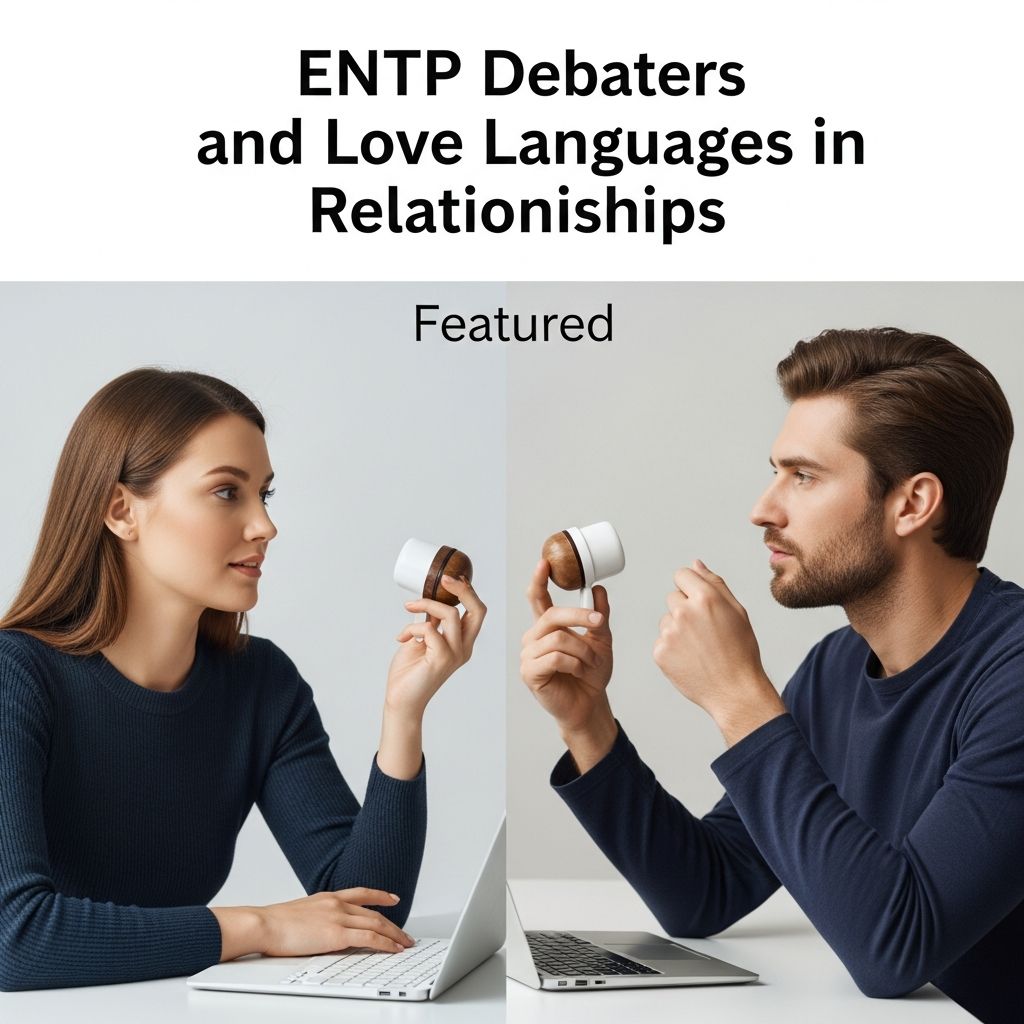
Debater personalities (often described as ENTP in the Myers-Briggs framework) are known for their quick minds, playful arguments, and love of exploring possibilities. When it comes to romance, these same traits shape how they give and receive love – and how their love language tends to show up in daily life.
This article explores how ENTP Debaters typically relate to love languages, why understanding this can help both partners, and practical strategies for creating a relationship that feels stimulating and emotionally secure.
Understanding ENTP Debaters in Love
The ENTP pattern is often described as extraverted, intuitive, thinking, and prospecting. In close relationships, this can translate into certain consistent preferences and challenges.
- Extraversion: ENTPs gain energy from interaction and often seek dynamic, two-way engagement with a partner.
- Intuition: They focus on possibilities, patterns, and future potential rather than routine details.
- Thinking: They typically prioritize logic and consistency when making decisions, even in emotional situations.
- Prospecting: They value flexibility, spontaneity, and open-ended plans over strict structure.
These tendencies do not prevent deep emotional bonds, but they often mean that ENTPs show love through mental engagement, shared adventures, and creative problem-solving rather than primarily through sentimental displays.
Love Languages in a Personality Context
The most widely known model of love languages describes five main ways people tend to give and receive affection: words of affirmation, quality time, acts of service, receiving gifts, and physical touch. Research suggests there are some modest links between general personality traits and preferred love languages, though the correlations are not strong.
According to a study using the Big Five personality model, extraversion was moderately associated with valuing words of affirmation and physical touch, while conscientiousness related more to quality time. Although this research did not directly use MBTI types, ENTP Debaters are usually high in extraversion and openness to experience, which can partially explain their preference for dynamic interaction and expressive communication in relationships.
How ENTP Debaters Commonly Express Love
Individual ENTPs differ, but certain patterns often emerge in how Debaters naturally show affection. Rather than fitting neatly into a single love language, they tend to blend several in a distinct style.
1. Intellectual Connection as a Core “Meta-Language”
ENTP Debaters frequently experience intellectual engagement as a central form of intimacy. This is similar to what some researchers and practitioners describe as an “intellectual” love style for analytical personality types.
- They often flirt by debating, questioning assumptions, and testing ideas.
- They may see long, winding conversations as one of the most romantic parts of a relationship.
- They feel loved when a partner engages with their theories, creative projects, and thought experiments.
This intellectual bond does not replace emotional warmth; instead, it becomes the gateway through which ENTPs feel safe enough to be emotionally vulnerable.
2. Words of Affirmation: Playful, Witty, and Rapid-Fire
Because of their extraverted and verbally agile nature, many ENTPs lean toward words of affirmation, though often in a playful or teasing form rather than overt sentimentality.
- Compliments may come wrapped in humor or light mockery.
- They often enjoy exchanging inside jokes and clever banter.
- They appreciate when partners acknowledge their ideas and creative risk-taking.
Partners sometimes miss the affectionate intent behind this style because it can sound casual or ironic. Learning to recognize appreciative humor as a form of affirmation can help avoid misunderstandings.
3. Quality Time: Shared Experiences and Mental Adventures
ENTP Debaters typically value quality time when it feels immersive and mentally engaging rather than purely routine. Research on highly extraverted people notes that they often seek stimulating, interactive activities in close relationships.
- They enjoy brainstorming future plans, business ideas, or creative projects together.
- They may prefer experiences that feel novel – new restaurants, travel, events, or learning something together.
- Unstructured time that allows conversations to wander is especially meaningful.
If a relationship becomes highly predictable, an ENTP may appear restless or detached, not because they care less, but because they crave fresh input and shared exploration.
4. Acts of Service: Problem-Solving Over Chores
Some Debaters show love through acts of service, though the form often reflects their analytical strengths. Instead of consistently handling routine tasks, they may step in when there is a complex problem to solve.
- Helping a partner reframe a career decision or navigate bureaucracy.
- Designing an efficient solution to an ongoing household challenge.
- Offering strategic advice and troubleshooting when crises arise.
This style can feel very supportive in high-stress moments, but partners who value daily, predictable acts of service might need to communicate those needs explicitly.
5. Physical Touch and Gifts: Context-Dependent Signals
ENTPs vary widely in how much they value physical touch and receiving gifts, but for many Debaters, these languages gain importance when tied to shared memories or playful spontaneity.
- Physical affection may grow as the intellectual and emotional bond deepens.
- Gifts that reference an ongoing joke, a niche interest, or a shared experience tend to feel more meaningful than generic presents.
- Overly formal or obligatory displays often feel less authentic to them.
Common Relationship Strengths of ENTP Debaters
When their natural traits are understood and appreciated, ENTPs can be invigorating and loyal partners. A number of counseling resources highlight personality-linked relational strengths such as flexibility, creativity, and willingness to experiment with new solutions.
| Strength | How It Shows Up in Love Languages |
|---|---|
| Mental stimulation | Transforms conversations into a primary form of intimacy; affirmations often arrive through ideas and jokes. |
| Adaptability | Can adjust how they show love as they learn what a partner needs, especially when expectations are clearly stated. |
| Optimism | Uses humor and reframing to encourage partners, aligning with verbal affirmation and supportive acts of service. |
| Inventiveness | Creates unique dates, spontaneous trips, or unconventional gifts that reinforce shared memories. |
Typical Pain Points and Misunderstandings
Personality-based frameworks are not deterministic, but they can highlight common friction points. Counseling literature shows that mismatches in communication style and emotional expression are frequent sources of conflict in couples, regardless of type.
For ENTP Debaters, some recurring issues include:
- Perceived emotional distance: Their logical language and love of debate may be misread as coldness or lack of commitment.
- Inconsistency: Intense bursts of attention followed by distraction can leave partners unsure of where they stand.
- Over-analysis: Trying to “solve” emotional problems purely with logic can invalidate a partner’s feelings.
- Boundary-testing humor: Teasing that feels affectionate to the ENTP may land as criticism or disrespect.
Recognizing these patterns makes it easier to distinguish between genuine relational problems and simple differences in style that can be negotiated.
How Partners Can Speak the ENTP’s Love Language
While every individual is unique, certain approaches often help partners connect more deeply with Debaters.
1. Lead With Curiosity and Conversation
- Ask open-ended questions about their ideas, projects, or theories.
- Be willing to explore topics in depth, even if you disagree.
- Understand that friendly debate is often a sign of interest, not hostility.
Counseling guidance frequently emphasizes that feeling heard and understood is central to relationship satisfaction; for ENTPs, this often means intellectual as well as emotional understanding.
2. Clarify Emotional Needs Directly
- Explain which love languages matter most to you and give concrete examples.
- Use clear, specific requests rather than indirect hints.
- Encourage them to share what helps them feel secure in the relationship.
Research on effective couples communication shows that explicit, behavior-focused requests are more likely to create change than generalized complaints.
3. Balance Freedom and Reliability
- Allow room for spontaneity, new experiences, and independent interests.
- At the same time, agree on a few non-negotiable routines or commitments.
- Use shared calendars or check-ins so their flexible style does not feel like neglect.
This balance lets ENTPs stay energized while providing partners with predictability and trust.
4. Translate Their Love Language Into Yours
Instead of expecting an ENTP to show love exactly as you do, look for the affection inside their natural style.
- If your language is quality time, notice when they invite you into brainstorming or adventures.
- If your language is acts of service, recognize their crisis-solving and strategic support.
- If your language is words of affirmation, tune in to compliments hidden inside humor.
Growing Together: How ENTPs Can Stretch Beyond Their Defaults
Healthy relationships usually require both partners to move beyond their comfort zones. For ENTP Debaters, some valuable growth steps include:
- Practicing emotional labeling: Taking time to name feelings before analyzing them, which research has linked to better emotional regulation.
- Showing consistency: Turning good intentions into small, reliable habits – a text at a set time, or a weekly date night.
- Listening without debating: Occasionally prioritizing empathy over problem-solving when a partner simply needs validation.
- Learning a partner’s primary love language: Making targeted efforts in that area, even when it feels less natural.
Counselors often note that differentiating between one’s own preferences and a partner’s needs is a key milestone in moving from infatuation to mature intimacy.
Sample Love Language Mixes for ENTP Debaters
The table below illustrates a few common combinations of love languages as they might appear in ENTP-style relationships. These are examples, not prescriptions.
| Dominant Style | Secondary Style | How It Might Appear |
|---|---|---|
| Words of Affirmation | Quality Time | Long, humorous conversations late at night; playful compliments; enthusiastic encouragement of your goals. |
| Quality Time | Acts of Service | Planning spontaneous trips; working side-by-side on projects; jumping in to help during stressful periods. |
| Acts of Service | Words of Affirmation | Strategically solving your problems; offering practical advice; verbal reassurance when you feel stuck. |
| Physical Touch | Quality Time | Affectionate joking and closeness during shared activities; touch paired with lively conversation. |
Frequently Asked Questions (FAQs)
Q: Do all ENTP Debaters share the same primary love language?
A: No. Research on love languages indicates only modest links between personality traits and specific preferences, and individual history and culture strongly influence how a person gives and receives love. Personality type can highlight tendencies, but it does not predetermine one fixed love language.
Q: Why do some ENTPs seem emotionally detached even when they care?
A: Many Debaters are more comfortable expressing ideas than emotions. They may show love through conversation, problem-solving, or shared activities instead of overt sentiment. Learning to verbally acknowledge feelings is often a growth edge, not a lack of caring.
Q: How can I tell if an ENTP is serious about the relationship?
A: Signs of commitment often include involving you in their long-term ideas, seeking your input on major decisions, increasing consistency in contact, and showing willingness to adapt their routines to your needs. These behavioral shifts align with broader findings that committed partners invest more time, attention, and cooperative problem-solving in the relationship.
Q: As an ENTP, how do I figure out my own love language?
A: Pay attention to what makes you feel most cared for: sincere compliments, uninterrupted time together, concrete help, affectionate touch, or thoughtful gifts. You can use self-reflection exercises or standardized questionnaires to clarify preferences; research shows that understanding one’s emotional needs and communicating them clearly is associated with higher relationship satisfaction.
Q: Are personality types and love languages scientifically proven compatibility tools?
A: Both frameworks are popular and can spark useful self-reflection, but they have limitations as predictive tools. Academic and clinical discussions emphasize that communication skills, conflict management, shared values, and emotional responsiveness are stronger predictors of long-term relationship health than type-based matches alone.
References
- Do Certain Personalities Share the Same Love Language? — Truity. 2021-06-10. https://www.truity.com/blog/do-certain-personalities-share-same-love-language
- The Top Love Language of Each Myers-Briggs Personality Type — Psychology Junkie. 2020-08-03. https://www.psychologyjunkie.com/the-top-love-language-of-each-myers-briggs-personality-type/
- Personality Type and Love Language: Advocates (INFJs) — 16Personalities. 2021-02-15. https://www.16personalities.com/articles/personality-type-and-love-language-advocates-infjs
- How MBTI Types Can Influence Love Language Preferences? — Eddins Counseling Group. 2023-04-12. https://eddinscounseling.com/how-mbti-types-can-influence-love-language-preferences/
- Rethinking Love: MBTI & Love Languages Debunked — Ambiance Matchmaking. 2022-09-01. https://ambiancematchmaking.com/blog-articles/rethinking-love-mbti-myths/

- Integrated M.A. in Applied Linguistics, University of Hyderabad
- 5+ years in editorial, instructional, SEO, and research-based writing
Sneha is a relationships and lifestyle writer with a strong foundation in applied linguistics and certified training in relationship coaching. She brings over five years of writing experience to theskillvault, crafting thoughtful, research-driven content that empowers readers to build healthier relationships, boost emotional well-being, and embrace holistic living. Her writing and insights reflect the belief that beauty, happiness, and wellness…